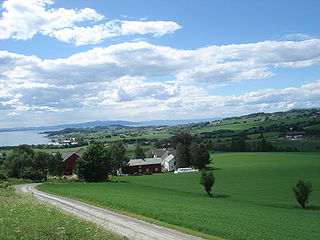
Frosta is the smallest municipality in Trøndelag county, Norway. The administrative centre is the village of Frosta. The municipality is located along the Trondheimsfjord, on the Frosta peninsula, just north of the city of Trondheim. It also includes the island of Tautra which is connected to the mainland by a causeway bridge.
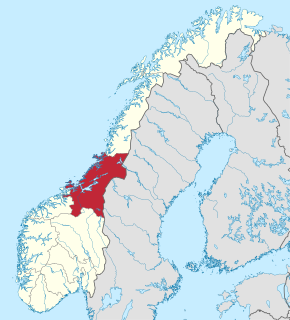
Trøndelag is a county in the central part of Norway. It was created in 1687, then named Trondhjem County ; in 1804 the county was split into Nord-Trøndelag and Sør-Trøndelag by the King of Denmark-Norway, and the counties were reunited in 2018 after a vote of the two counties in 2016.

The Merino is one of the most historically relevant and economically influential breeds of sheep, much prized for its wool. The origins of the breed are the subject of debate, with alternatives of it originating in flocks transferred from Morocco as early as the 12th century, originating and being improved in Extremadura in southwestern Spain, in the 12th and 13th centuries or from the selective crossbreeding of Spanish ewes with imported rams at several different periods. It was instrumental in the economic development of 15th and 16th century Spain, which initially held a monopoly on the trade in its wool. Since the end of the 18th century, the breed was further refined in New Zealand and Australia, giving rise to the modern Merino.

Joséphine of Leuchtenberg or Joséphine de Beauharnais was Queen of Sweden and Norway as the wife of King Oscar I. She was also Princess of Bologna from birth and Duchess of Galliera from 1813. She was regarded as politically active during the reign of her spouse and acted as his political adviser, actively participating in government affairs. She is acknowledged as having introduced more liberal laws regarding religion.
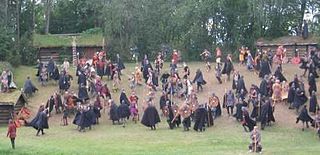
Saint Olav Drama is an outdoor theatre performance played every end of July in Stiklestad in Verdal, Norway.

Sven Eivindsen Aarrestad was a writer, politician, and leader in the Norwegian temperance movement during the 19th century.

The Border Leicester is a British breed of sheep. It is a polled, long-wool sheep and is considered a dual-purpose breed as it is reared both for meat and for wool. The sheep are large but docile. They have been exported to other sheep-producing regions, including Australia and the United States.
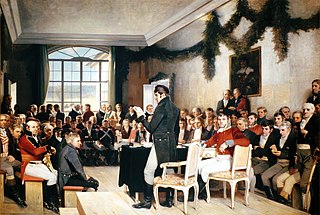
The Norwegian Constituent Assembly is the name given to the 1814 Constitutional Assembly at Eidsvoll in Norway, that voted the Norwegian Constitution and formalised the dissolution of the union with Denmark. In Norway, it is often just referred to as Eidsvollsforsamlingen, which means The Assembly of Eidsvoll.

The Romney, formerly called the Romney Marsh sheep but generally referred to by the local farmers as the Kent, is a breed of sheep originating in England. The Romney is a "long-wool" breed recognized in England by 1800. Exported to other continents, the Romney is an economically important sheep breed, especially to the sheep-meat and wool export trades of New Zealand.

The Dorset Horn is an endangered British breed of domestic sheep. It is documented from the seventeenth century, and is highly prolific, sometimes producing two lambing seasons per year. Among British sheep, it is the only breed capable of breeding throughout the winter.
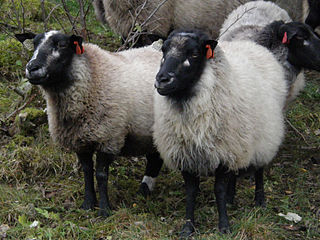
The Norwegian Grey Troender is a very rare breed of domesticated sheep that originated from crossbreeding native landrace sheep with the now extinct Tautra sheep in the late 19th century. There are currently approximately 50 individual animals, nearly all residing within Norway.

Jan Erik Vold is a Norwegian lyric poet, jazz vocal reciter, translator and author. He was a core member of the so-called "Profil generation", the circle attached to the literary magazine Profil. Throughout his career as an artist, he has had the ability to reach the public, both with his poetry and his political views. He has contributed greatly to the renewal of Norwegian poetry, and created interest in lyrical poetry. Jan Erik Vold is currently living in Stockholm.

Thorleiv Bugge Røhn was a Norwegian Army officer, who as a gymnast was a member of the team that won the gold medal in the team competition at the 1906 Intercalated Games in Athens, Greece.

Munkeby Abbey was a Cistercian monastery near the village of Okkenhaug in the municipality of Levanger in Trøndelag county, Norway. It was located about 5 kilometres (3.1 mi) east of the town of Levanger. The name "Munkeby" in Norwegian means Place of the Monks. It was closed during the Protestant Reformation. Today the former abbey is the sight of medieval ruins which are managed by the Society for the Preservation of Ancient Norwegian Monuments.
Torfinn Skard was a Norwegian horticulturist, teacher, librarian and author.
Lars Borgersrud is a Norwegian military historian and government scholar. His work has largely centered on World War II in Norway.
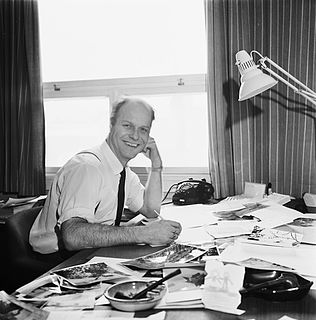
Dagfinn Tveito was a Norwegian magazine editor.
Hans Holtermann, also known as Hans Henrik Holtermann or Hans Henriksen Holtermann, was a Norwegian businessman and landowner.

The Old Norwegian Sheep is likely the breed that most closely resembles the original Northern European short-tailed sheep in Norway. Although the breed almost went extinct at several points in the last century, conservation efforts have succeeded in growing the population to around 30,000 animals and the breed is no longer considered threatened. The breed is particularly suited for being kept outside all year, a practice that stems back to the Viking Age.
Egil Ulateig is a Norwegian journalist and non-fiction writer.

