
Paolo Emilio Taviani was an Italian political leader, economist and historian of the career of Christopher Columbus.
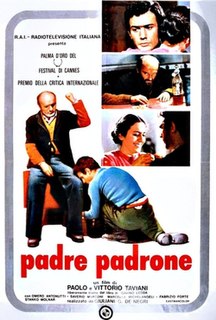
Padre Padrone is a 1977 Italian film directed by Paolo and Vittorio Taviani. The Tavianis used both professional and non-professional actors from the Sardinian countryside. The title literally means "Father Master"; it has been translated as My Father, My Master or Father and Master.
Valentino Orsini was an Italian film director.

Paolo Taviani and Vittorio Taviani, collectively referred to as the Taviani brothers, were Italian film directors and screenwriters who collaborated on film productions.
The Nastro d'Argento is a film award assigned annually, since 1946, by Sindacato Nazionale dei Giornalisti Cinematografici Italiani the association of Italian film critics.

Allonsanfàn is a 1974 Italian historical drama film written and directed by Paolo and Vittorio Taviani. The title of the film, which is also the name of a character, comes from the first words of the French Revolutionary anthem La Marseillaise.

The 62nd annual Berlin International Film Festival was held from 9 to 19 February 2012. British film director Mike Leigh was the President of the Jury. The first five films to be screened in the competition were announced on 19 December 2011. American actress Meryl Streep was presented with the Honorary Golden Bear on 14 February. Benoît Jacquot's film Les adieux à la reine was announced as the opening film. The Golden Bear for Best Film went to the Italian film Caesar Must Die, directed by Paolo and Vittorio Taviani, which also served as closing night film.
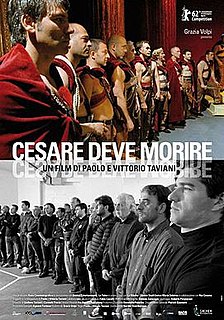
Caesar Must Die is a 2012 Italian drama film directed by Paolo and Vittorio Taviani. The film competed at the 62nd Berlin International Film Festival where it won the Golden Bear. The film is set in Rebibbia Prison, and follows convicts in their rehearsals ahead of a prison performance of Julius Caesar.

Tu ridi is a 1998 Italian drama film. It is the second film adaptation based on short stories by Luigi Pirandello after Kaos directed by Paolo and Vittorio Taviani.

Un uomo da bruciare is a 1962 Italian drama film. It is the first feature film directed by Valentino Orsini and Paolo and Vittorio Taviani.

Sotto il segno dello scorpione is a 1969 Italian drama film directed by Paolo and Vittorio Taviani. It was screened at the Venice Film Festival.

I fuorilegge del matrimonio, internationally released as Outlaws of Love, is a 1963 Italian anthology comedy film. It is the second and last film directed both by Paolo and Vittorio Taviani and Valentino Orsini.
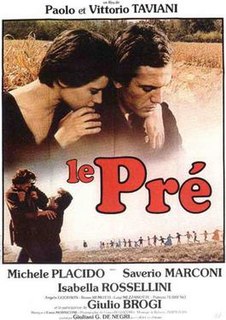
Il prato is a 1979 Italian drama film directed by Paolo and Vittorio Taviani. It was screened at the Venice Film Festival. For this film Isabella Rossellini was awarded with a Silver Ribbon for Best New Actress.

Resurrection is a 2001 Italian-French-German co-production directed by Paolo and Vittorio Taviani.
The 24th Moscow International Film Festival was held from 21 to 30 June 2002. The Golden St. George was awarded to the Italian-French film Resurrection directed by Paolo and Vittorio Taviani.
The 23rd annual Venice International Film Festival was held from 25 August to 8 September 1962.

Francesco Bruni is an Italian screenwriter and director.
Giuliano Taviani is an Italian composer.

Rainbow: A Private Affair is an Italian drama film directed by Paolo and Vittorio Taviani, based on the novel by Beppe Fenoglio. It is the last film directed by both brothers before Vittorio Taviani's death in 2018.
Gaetano De Negri, known professionally as Giuliani G. De Negri, was an Italian film producer and screenwriter. He is best known for his collaborations with film directors Paolo and Vittorio Taviani, having produced and sometimes penned all of their films since 1961.
This page is based on this
Wikipedia article Text is available under the
CC BY-SA 4.0 license; additional terms may apply.
Images, videos and audio are available under their respective licenses.
