
Robert George Seale is an American political activist and author.

German reunification was the process in 1990 in which the German Democratic Republic (GDR) became part of the Federal Republic of Germany (FRG) to form the reunited nation of Germany.
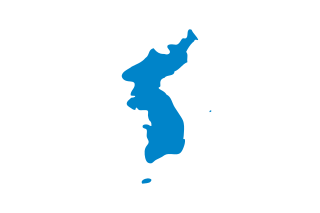
Korean reunification refers to the potential reunification of North Korea and South Korea into a single Korean sovereign state. The process towards reunification was started by the June 15th North–South Joint Declaration in June 2000, and was reaffirmed by the Panmunjom Declaration for Peace, Prosperity and Unification of the Korean Peninsula in April 2018, and the joint statement of the United States President Donald Trump and North Korean Supreme Leader Kim Jong-un at the Singapore Summit in June 2018. In the Panmunjom Declaration, the two countries agreed to work towards a peaceful reunification of Korea in the future.
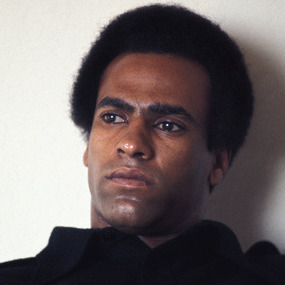
Huey Percy Newton was an African-American revolutionary, most known for co-founding the Black Panther Party (BPP) with Bobby Seale. Together, Newton and Seale created the party's manifesto, the ten-point program.
A black panther is a colour variant of any Panthera, particularly of the leopard and the jaguar.
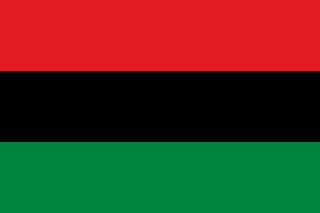
The New Black Panther Party (NBPP) is an American black nationalist organization founded in Dallas, Texas, in 1989. Despite its name, the NBPP is not an official successor to the Black Panther Party. Members of the original Black Panther Party have insisted that the newer party is not legitimate and "there is no new Black Panther Party".

Fredrick Allen Hampton Sr. was an American activist and Marxist–Leninist. He came to prominence in Chicago as chairman of the Illinois chapter of the Black Panther Party (BPP), and deputy chairman of the national BPP. In this capacity, he founded the antiracist, anticlass Rainbow Coalition, a prominent multicultural political organization that initially included the Black Panthers, Young Patriots, and the Young Lords, and an alliance among major Chicago street gangs to help them end infighting and work for social change. Hampton considered fascism the greatest threat, saying, "Nothing is more important than stopping fascism, because fascism will stop us all.”

Merritt College is a public community college in Oakland, California. Merritt, like the other three campuses of the Peralta Community College District, is accredited by the Western Association of Schools and Colleges. The school's enrollment is approximately 6,000 students.

Fred Hampton Jr. is an American political activist, based in Chicago. He is the president and chairman of the Prisoners of Conscience Committee and the Black Panther Party Cubs. He is the only child of Fred Hampton, the Black Panther Party leader assassinated by police in Chicago in December 1969, and his fiancée, now known as Akua Njeri.

The Ten Point Programme for Reunification of the Country is a plan written by Kim Il-sung on April 6, 1993, to re-unite North Korea and South Korea. The program is the stated official policy of North Korea.

The New Panther Vanguard Movement (NPVM), originally known as the New African American Vanguard Movement (NAAVM) was created in South Central Los Angeles in 1994 as a response to the Los Angeles riots of 1992. Former members of the Black Panther Party and other community activists came together after the riots and shared their frustration with the lack of leadership in the Black community. After various dialogues, they decided to create a grassroots organization that would reflect the vision and community spirit of the Black Panther Party.
The Ten-Point Program or The Black Panther Party for Self-Defense Ten-Point Platform and Program is a party platform written by Huey P. Newton and Bobby Seale in 1966 for the Black Panther Party.
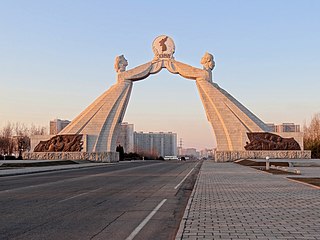
The Arch of Reunification is a sculptural arch located south of Pyongyang, the capital of North Korea. It was opened in August 2001 to commemorate Korean reunification proposals put forward by Kim Il-sung.

The Black Panther Party (BPP), originally the Black Panther Party for Self-Defense, was a Black Power political organization founded by college students Bobby Seale and Huey P. Newton in October 1966 in Oakland, California. The party was active in the United States between 1966 and 1982, with chapters in many major cities and international chapters in Britain and Algeria. Upon its inception the Black Panther Party's core practice was its open carry armed citizens' patrols ("copwatching") to monitor the behavior of officers of the Oakland Police Department and challenge police brutality in the city. From 1969 onwards, a variety of community social programs became a core activity. The Party instituted the Free Breakfast for Children Programs to address food injustice, and community health clinics for education and treatment of diseases including sickle cell anemia, tuberculosis, and later HIV/AIDS. It advocated for class struggle, with the party representing the proletarian vanguard.
The Black Riders Liberation Party (BRLP) is a revolutionary black power organization based in the United States. The group claims ideological continuity with the original Black Panther Party for Self-Defense and, according to its official website, organizes gang members to "stop commiting genocide against each other and to stand up against white supremacy and capitalist oppression."

Safiya Bukhari was an American political prisoner and member of the Black Panther Party. She was also the co-founder of the Free Mumia Abu-Jamal Coalition (NYC), the Jericho Movement for U.S. Political Prisoners and Prisoners of War, and was the vice president of the Republic of New Afrika.
Intercommunalism is an ideology which was adopted by the Oakland chapter of the Black Panther Party after its turn away from revolutionary nationalism in 1970. According to Huey P. Newton the development of intercommunalism was necessary "because nations have been transformed into communities of the world." Intercommunalists believe that most forms of nationalism are obsolescent, because international corporations and technologically advanced imperialist states have reduced most nations down to a series of discrete communities which exist to supply an imperial center, a situation called reactionary intercommunalism. However they also believe this situation can be transformed into revolutionary intercommunalism and eventually communism if communities are able to link "liberated zones" together into a united front against imperialism. Intercommunalism is a lesser-known aspect of the Panthers' legacy as much of its development occurred at the height of the party's suppression and reorientation towards survival programs.
