
The Final Solution or the Final Solution to the Jewish Question was a Nazi plan for the genocide of Jews during World War II. The "Final Solution to the Jewish question" was the official code name for the murder of all Jews within reach, which was not restricted to the European continent. This policy of deliberate and systematic genocide starting across German-occupied Europe was formulated in procedural and geopolitical terms by Nazi leadership in January 1942 at the Wannsee Conference held near Berlin, and culminated in the Holocaust, which saw the killing of 90% of Polish Jews, and two-thirds of the Jewish population of Europe.

Nazi Germany used six extermination camps, also called death camps (Todeslager), or killing centers (Tötungszentren), in Central Europe during the Holocaust in World War II to systematically murder over 2.7 million people—mostly Jews—during the Holocaust. The victims of death camps were primarily killed by gassing, either in permanent installations constructed for this specific purpose, or by means of gas vans. The six extermination camps were Chelmno, Belzec, Sobibor, Treblinka, Majdanek and Auschwitz-Birkenau. Auschwitz and Majdanek death camps also used extreme work under starvation conditions in order to kill their prisoners.
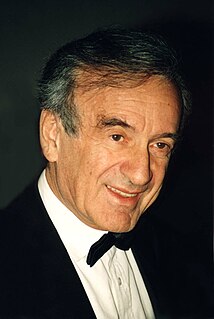
Elie Wiesel was a Romanian-born American writer, professor, political activist, Nobel laureate, and Holocaust survivor. He authored 57 books, written mostly in French and English, including Night, a work based on his experiences as a Jewish prisoner in the Auschwitz and Buchenwald concentration camps.

Holocaust denial is the act of denying the Nazi genocide of Jews in the Holocaust. Holocaust deniers make one or more of the following false statements:

Schindler's List is a 1993 American epic historical drama film directed and produced by Steven Spielberg and written by Steven Zaillian. It is based on the 1982 non-fiction novel Schindler's Ark by Australian novelist Thomas Keneally. The film follows Oskar Schindler, a German industrialist who together with his wife Emilie Schindler saved more than a thousand mostly Polish-Jewish refugees from the Holocaust by employing them in his factories during World War II. It stars Liam Neeson as Schindler, Ralph Fiennes as SS officer Amon Göth and Ben Kingsley as Schindler's Jewish accountant Itzhak Stern.

David John Cawdell Irving is an English author and Holocaust denier who has written on the military and political history of World War II, with a focus on Nazi Germany. His works include The Destruction of Dresden (1963), Hitler's War (1977), Churchill's War (1987) and Goebbels: Mastermind of the Third Reich (1996). In his works, he argued that Adolf Hitler did not know of the extermination of Jews, or, if he did, he opposed it. Though Irving's negationist claims and views of German war crimes in World War II were never taken seriously by mainstream historians, he was once recognised for his knowledge of Nazi Germany and his ability to unearth new historical documents.
Yad Vashem is Israel's official memorial to the victims of the Holocaust. It is dedicated to preserving the memory of the dead; honoring Jews who fought against their Nazi oppressors and Gentiles who selflessly aided Jews in need; and researching the phenomenon of the Holocaust in particular and genocide in general, with the aim of avoiding such events in the future.

Cannibal Holocaust is a 1980 Italian cannibal film directed by Ruggero Deodato and written by Gianfranco Clerici. It stars Robert Kerman as Harold Monroe, an anthropologist from New York University who leads a rescue team into the Amazon rainforest to locate a crew of filmmakers. Played by Carl Gabriel Yorke, Francesca Ciardi, Perry Pirkanen, and Luca Barbareschi, the crew had gone missing while filming a documentary on local cannibal tribes. When the rescue team is only able to recover the crew's lost cans of film, an American television station wishes to broadcast the footage as a sensationalized television special. Upon viewing the reels, Monroe is appalled by the team's actions and objects to the station's intent to air the documentary.

The United States Holocaust Memorial Museum (USHMM) is the United States' official memorial to the Holocaust. Adjacent to the National Mall in Washington, D.C., the USHMM provides for the documentation, study, and interpretation of Holocaust history. It is dedicated to helping leaders and citizens of the world confront hatred, prevent genocide, promote human dignity, and strengthen democracy.

Righteous Among the Nations is an honorific used by the State of Israel to describe non-Jews who risked their lives during the Holocaust to save Jews from extermination by the Nazis for altruistic reasons. The term originates with the concept of "righteous gentiles", a term used in rabbinic Judaism to refer to non-Jews, called ger toshav, who abide by the Seven Laws of Noah.
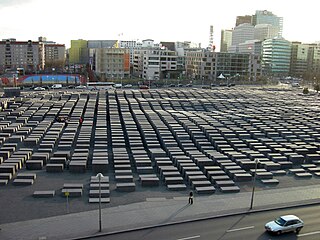
The Memorial to the Murdered Jews of Europe, also known as the Holocaust Memorial, is a memorial in Berlin to the Jewish victims of the Holocaust, designed by architect Peter Eisenman and engineer Buro Happold. It consists of a 19,000-square-metre (200,000 sq ft) site covered with 2,711 concrete slabs or "stelae", arranged in a grid pattern on a sloping field. The original plan was to place nearly 4,000 slabs, but before the unveiling a new law was passed mandating memorials to be wheelchair accessible. After the recalculation, the number of slabs that could legally fit into the designated areas was 2,711. The stelae are 2.38 metres long, 0.95 metres wide and vary in height from 0.2 to 4.7 metres. They are organized in rows, 54 of them going north–south, and 87 heading east–west at right angles but set slightly askew. An attached underground "Place of Information" holds the names of approximately 3 million Jewish Holocaust victims, obtained from the Israeli museum Yad Vashem.
The history of the Jews during World War II is almost synonymous with the persecution and murder of Jews which was committed on an unprecedented scale in Europe and European North Africa. The massive scale of the Holocaust which happened during World War II greatly affected the Jewish people and world public opinion, which only understood the dimensions of the Final Solution after the war. The genocide, known as HaShoah in Hebrew, aimed at the elimination of the Jewish people on the European continent. It was a broadly organized operation led by Nazi Germany, in which approximately six million Jews were murdered methodically and with horrifying cruelty. Although the Holocaust was organized by the highest levels of the Nazi German government, the vast majority of Jews murdered were not German, but were instead residents of countries invaded by the Nazis after 1938. Of the approximately 6 million Jews murdered by the Nazis, approximately 160,000 to 180,000 were German Jews. During the Holocaust in occupied Poland, more than one million Jews were murdered in gas chambers of the Auschwitz concentration camp alone. The murder of the Jews of Europe affected Jewish communities in Albania, Austria, Belarus, Belgium, Bosnia & Herzegovina, Channel Islands, Croatia, Czech Republic, Estonia, France, Germany, Greece, Hungary, Italy, Latvia, Libya, Lithuania, Luxembourg, Macedonia, Moldova, The Netherlands, Norway, Poland, Romania, Russia, Serbia, Slovakia, and Ukraine.

The Boy in the Striped Pyjamas is a 2006 Holocaust novel by Irish novelist John Boyne. Much like the process he undertakes when writing most of his novels, Boyne has said that he wrote the entire first draft in two and a half days, without sleeping much, but also that he was quite a serious student of Holocaust-related literature for years before the idea for the novel even came to him. The book has received mixed criticism, with positive reviews praising the novel as a moral tale, while negative reviews attack the book's historical inconsistencies and the potential damage it could cause to people's education about the Holocaust.
Holocaust survivors are people who survived the persecution and attempted annihilation of the Jews by Nazi Germany and its allies in Europe and North Africa during the Holocaust both before and during World War II, from the rise of the Nazi Party to power in Germany in 1933 until the defeat of Nazi Germany in 1945. More broadly speaking, the term includes anyone who was discriminated against, displaced or persecuted as a result of the policies and actions of the Nazis and their allies and, in addition to Jews who were uniquely targeted for complete annihilation, it includes those who were persecuted as a result of the Nazis' racial theories, such as the Romani people and Slavs, along with others who were seen as "undesirables" such as homosexuals, or for political reasons, such as Jehovah's Witnesses and Communists.

The Holocaust, also known as the Shoah, was the World War II genocide of the European Jews. Between 1941 and 1945, across German-occupied Europe, Nazi Germany and its collaborators systematically murdered some six million Jews, around two-thirds of Europe's Jewish population. The murders were carried out in pogroms and mass shootings; by a policy of extermination through work in concentration camps; and in gas chambers and gas vans in German extermination camps, chiefly Auschwitz, Bełżec, Chełmno, Majdanek, Sobibór, and Treblinka in occupied Poland.
The Holocaust had a deep effect on society both in Europe and the rest of the world, and today its consequences are still being felt both by children and adults whose ancestors were victims of this genocide.

The Holocaust in Lithuania resulted in the near total destruction of Lithuanian (Litvaks) and Polish Jews, living in Generalbezirk Litauen of Reichskommissariat Ostland within the Nazi-controlled Lithuanian SSR. Out of approximately 208,000–210,000 Jews, an estimated 190,000–195,000 were murdered before the end of World War II, most between June and December 1941. More than 95% of Lithuania's Jewish population was massacred over the three-year German occupation—a more complete destruction than befell any other country affected by the Holocaust. Historians attribute this to the massive collaboration in the genocide by the non-Jewish local paramilitaries, though the reasons for this collaboration are still debated. The Holocaust resulted in the largest-ever loss of life in so short a period of time in the history of Lithuania.
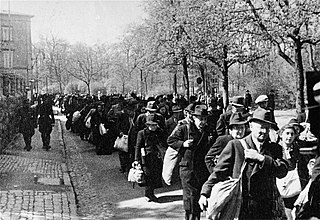
The question of how much Germans and other Europeans knew about the Holocaust while it was ongoing continues to be debated by historians. Sönke Neitzel wrote in his book Soldaten: On Fighting, Killing and Dying that transcripts of conversations between German POWs prove that "practically all German soldiers knew or suspected that Jews were being murdered en masse".
