
Gael García Bernal is a Mexican actor and filmmaker. He is known for his performances in the films Amores perros (2000), Y tu mamá también (2001), Bad Education (2004), The Motorcycle Diaries (2004), Babel (2006), Coco (2017), Old (2021), and Cassandro (2023), for his role as Rodrigo de Souza in the television series Mozart in the Jungle (2014–2018), and for starring in the Disney+ special Werewolf by Night (2022).

The Motorcycle Diaries is a 2004 biographical coming-of-age road movie directed by Walter Salles from a screenplay by José Rivera, based on Che Guevara's 1995 memoir of the same name and Alberto Granado's memoir Che Guevara: The Making of a Revolutionary. The film recounts the 1952 expedition, initially by motorcycle, across South America by Guevara and Granado, observing the life of the impoverished indigenous peasantry. Through the trip both of them witness the social classes struggle in Latin America.

Alberto Granado Jiménez was an Argentine–Cuban biochemist, doctor, author, and scientist. A youthful friend and traveling companion of Che Guevara during their 1952 motorcycle tour in Latin America, Granado later founded the University of Santiago de Cuba School of Medicine. He authored the memoir Traveling with Che Guevara: The Making of a Revolutionary, which served as a reference for the 2004 film The Motorcycle Diaries, in which he was played by Rodrigo de la Serna. An elderly Alberto Granado makes a short appearance at the end of the film.

The Motorcycle Diaries is a posthumously published memoir of the Marxist revolutionary Ernesto "Che" Guevara. It traces his early travels, as a 23-year-old medical student, with his friend Alberto Granado, a 29-year-old biochemist. Leaving Buenos Aires, Argentina, in January 1952 on the back of a sputtering single cylinder 1939 Norton 500cc dubbed La Poderosa, they desired to explore the South America they only knew from books. During the formative odyssey Guevara is transformed by witnessing the social injustices of exploited mine workers, persecuted communists, ostracized lepers, and the tattered descendants of a once-great Inca civilization. By journey's end, they had travelled for a "symbolic nine months" by motorcycle, steamship, raft, horse, bus, and hitchhiking, covering more than 8,000 kilometres across places such as the Andes, the Atacama Desert, and the Amazon River Basin.

Walter Moreira Salles Júnior is a Brazilian filmmaker and film editor. He is most known for his Golden Globe, BAFTA and Golden Bear-winning film Central Station (1998). He also known for his award winning films: The Motorcycle Diaries (2004), On the Road (2012), and I'm Still Here (2024).

José Rivera is a playwright and the first Puerto Rican screenwriter to be nominated for an Academy Award for the movie, The Motorcycle Diaries.

Mía Maestro is an Argentine actress and singer. She is known for her roles as Nora Martinez in The Strain, as Nadia Santos in the television drama Alias, as Cristina Kahlo in Frida, as Chichina Ferreyra in The Motorcycle Diaries, and as Carmen in The Twilight Saga.
Catch Me If You Can is a 2002 film directed by Steven Spielberg.
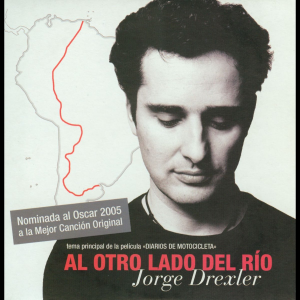
"Al otro lado del río" is a song by Uruguayan singer Jorge Drexler from the soundtrack album for the film The Motorcycle Diaries (2004). It was released as a single on 15 March 2005, by Dro East West. Besides the film's soundtrack, the song was included in reissue editions of Drexler's seventh studio album Eco (2004) as a bonus track. In June 2020, he performed the song at the launch show of the app 342 Amazônia at Circo Voador.
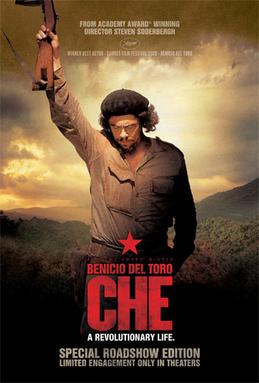
Che is a two-part 2008 epic biographical film about the Argentine Marxist revolutionary Ernesto "Che" Guevara, directed by Steven Soderbergh. Rather than follow a standard chronological order, the films offer an oblique series of interspersed moments along the overall timeline. Part One is titled The Argentine and focuses on the Cuban Revolution from the landing of Fidel Castro, Guevara, and other revolutionaries in Cuba to their successful toppling of Fulgencio Batista's dictatorship two years later. Part Two is titled Guerrilla and focuses on Guevara's attempt to bring revolution to Bolivia and his demise. Both parts are shot in a cinéma vérité style, but each has different approaches to linear narrative, camerawork and the visual look. It stars Benicio del Toro as Guevara, with an ensemble cast that includes Demián Bichir, Rodrigo Santoro, Santiago Cabrera, Franka Potente, Julia Ormond, Vladimir Cruz, Marc-André Grondin, Lou Diamond Phillips, Joaquim de Almeida, Édgar Ramírez, Yul Vazquez, Unax Ugalde, Alfredo De Quesada, Jordi Mollá, Matt Damon, and Oscar Isaac.
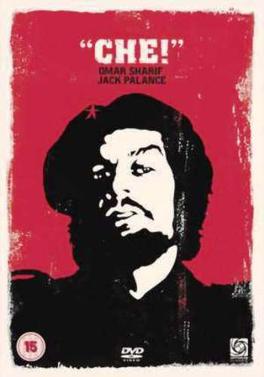
Che! is a 1969 American biographical film directed by Richard Fleischer and starring Omar Sharif as Marxist revolutionary Ernesto "Che" Guevara. It follows Guevara from when he first landed in Cuba in 1956 to his death in Bolivia in 1967, although the film does not portray the formative pre-Cuban revolution sections of Che's life as described in the autobiographical book The Motorcycle Diaries (1993).
San Pablo de Loreto is a village, and the location of a leper colony in Peru. The village is located near Iquitos. The colony was constructed in 1925. In 1941, it became an agricultural colony in which the patients had to work the fields. In 1952, Che Guevara and Alberto Granado worked at the colony. The colony was home to around 600 people at the time. By 1957, the number of patients had increased to about 780. The colony was closed for admission from 1967 onwards, and a 1968 report by Dr Masayoshi Itoh described that 87% of the patients were in need of surgical treatment. The leprosium has since then closed, and the patients have been transferred to Iquitos.

Gustavo Alfredo Santaolalla is an Argentine composer and musician. Known for his minimalist approach to composing, he rose to fame for creating the scores for Brokeback Mountain (2005) and Babel (2006), for which he received two Academy Awards for Best Original Score in consecutive years. Santaolalla also gained recognition for his work on The Last of Us game series, composing the 2013 title and its 2020 sequel. He returned to reprise his themes and co-compose the score for the 2023 television adaptation.

Aleida Guevara March is a Cuban physician who is the eldest of four children born to Ernesto "Che" Guevara and his second wife, Aleida March.

Appearances of Argentine Marxist revolutionary Che Guevara (1928–1967) in popular culture are common throughout the world. Although during his lifetime he was a highly politicized and controversial figure, in death his stylized image has been transformed into a worldwide emblem for an array of causes, representing a complex mesh of sometimes conflicting narratives. Che Guevara's image is viewed as everything from an inspirational icon of revolution, to a retro and vintage logo. Most commonly he is represented by a facial caricature originally by Irish artist Jim Fitzpatrick and based on Alberto Korda's famous 1960 photograph titled Guerrillero Heroico. The evocative simulacra abbreviation of the photographic portrait allowed for easy reproduction and instant recognizability across various uses. For many around the world, Che has become a generic symbol of the underdog, the idealist, the iconoclast, or the martyr. He has become, as author Michael Casey notes in Che's Afterlife: The Legacy of an Image, "the quintessential postmodern icon signifying anything to anyone and everything to everyone."
Ernesto "Che" Guevara was an Argentine Marxist revolutionary, physician, author, guerrilla leader, diplomat, and military theorist. A major figure of the Cuban Revolution, his stylized visage has become a ubiquitous countercultural symbol of rebellion and global insignia in popular culture.
Ernesto "Che" Guevara, was an Argentine Marxist revolutionary, politician, author, intellectual, physician, military theorist, and guerrilla leader. His life, legacy, and ideas have attracted a great deal of interest from historians, artists, film makers, musicians, and biographers. In reference to the abundance of material, Nobel Prize–winning author Gabriel García Márquez has declared that "it would take a thousand years and a million pages to write Che's biography."
Paul Webster is a British film producer.

One Week is a 2008 Canadian drama film written and directed by Michael McGowan and starring Joshua Jackson, Liane Balaban, and Campbell Scott. The film debuted at the Toronto International Film Festival on September 8, 2008, and was released theatrically in Canada by Mongrel Media on March 6, 2009.

Che Rise and Fall is a documentary film created by Eduardo Montes-Bradley. The film was entirely shot in Cuba at the time Che Guevara’s remains was airlifted from Bolivia to Santa Clara the final resting place. The documentary features the testimonies of Guevara’s comrades-in-arms in Sierra Maestra, Congo and Bolivia, also with Alberto Granado with whom Guevara rode a motorcycle from Argentina on a trip that will end 16 years later in the jungles of Bolivia, an experience that was brought to the big screen on The Motorcycle Diaries. Che Rise and Fall begins with an account of Guevara's death in Bolivia in 1967 and fittingly ends with footage of the return of his remains for interment in a monument in Santa Clara's Revolution Square some 30 years later.
