Canon or Canons may refer to:
Hotspot, Hot Spot or Hot spot may refer to:

Installation art is an artistic genre of three-dimensional works that are often site-specific and designed to transform the perception of a space. Generally, the term is applied to interior spaces, whereas exterior interventions are often called public art, land art or art intervention; however, the boundaries between these terms overlap.
Public art is art in any media whose form, function and meaning are created for the general public through a public process. It is a specific art genre with its own professional and critical discourse. Public art is visually and physically accessible to the public; it is installed in public space in both outdoor and indoor settings. Public art seeks to embody public or universal concepts rather than commercial, partisan, or personal concepts or interests. Notably, public art is also the direct or indirect product of a public process of creation, procurement, and/or maintenance.
Seattle Erotic Art Festival was founded in 2002 and is the flagship program of the nonprofit Pan Eros Foundation.
Herbert Media is the in-house media service at the Herbert Art Gallery and Museum in Coventry, England. It manages recording studios, video editing rooms and training rooms, and produces much of the audio and visual sequences for the museum's exhibitions and permanent displays.

LA Freewaves, also known as Freewaves, is a Los Angeles–based nonprofit organization that exhibits new, uncensored, independent media, and produces free public art projects to engage artists and audiences on current social issues. Anne Bray, with representatives of other communities, founded LA Freewaves in 1989 and has worked to administer the non-profit since it was launched as an exhibition of multicultural video art at the American Film Institute's National Video Festival. Bray serves as director of the organization and has been working in the field of media arts since the mid-1970s as an artist and teacher.
Point of View or Points of View may refer to:
Camille Utterback is an interactive installation artist. Initially trained as a painter, her work is at the intersection of painting and interactive art. One of her most well-known installations is the work Text Rain (1999).
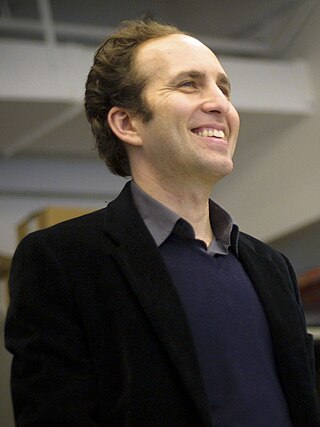
Scott Snibbe is an interactive media artist, author, entrepreneur, and meditation instructor who hosts the Skeptic's Path to Enlightenment meditation podcast. His first book, How to Train a Happy Mind, was released in 2024. Snibbe has collaborated with other artists and musicians, including Björk on her interactive “app album” Björk: Biophilia that was acquired by New York's MoMA as the first downloadable app in the museum's collection. Between 2000 and 2013 he founded several companies, including Eyegroove, which was acquired by Facebook in 2016. Early in his career, Snibbe was one of the developers of After Effects.
Participatory art is an approach to making art which engages public participation in the creative process, letting them become co-authors, editors, and observers of the work. This type of art is incomplete without viewers' physical interaction. It intends to challenge the dominant form of making art in the West, in which a small class of professional artists make the art while the public takes on the role of passive observer or consumer, i.e., buying the work of the professionals in the marketplace. Commended works by advocates who popularized participatory art include Augusto Boal in his Theater of the Oppressed, as well as Allan Kaprow in happenings.

The Los Angeles Municipal Art Gallery is located in the Barnsdall Art Park in Los Angeles, California. It focuses on the arts and artists of Southern California. The gallery was first established in 1954.

Charles Recher was an American installation artist and filmmaker who lived and worked in Miami Beach, Florida. Recher created in excess of one hundred films and videos. His work ranged from the film "Kwagh-Hir ", a documentary of the theater tradition of the Tiv people of Nigeria, to "Cars & Fish", Miami Performing Arts Center's inaugural video installation, which cast 600-foot-long swirling images onto adjacent building façades during Art Basel/Miami Beach in 2005.
Kim Charles Kay is an American interdisciplinary artist.
Michael Bruce Odland, known as Bruce Odland, is a composer, sound artist and sonic thinker. He is known for large-scale sound installations in public spaces, creating unique instruments that reveal music inherent in natural and urban environments, and for his pioneering work in theater, film and interactive multi-media. He lives and works in Westchester County, New York. Odland's musical sculptures and sound installations have been shown in major cities such as New York, Berlin, and Zurich; in art museums including the Denver Art Museum, the Field Museum and Mass MoCA; and at the international documenta14, Ars Electronica, Edinburgh International and Salzburg Festivals. Many of his installations are collaborations with Austrian sound artist Sam Auinger, with whom he formed an artistic partnership O+A in 1989. Together they have created more than 50 sound installations in Europe, North America and Asia.

The Delacorte Clock, or George Delacorte Musical Clock, is a clock and art installation outside the Central Park Zoo in Central Park, Manhattan, New York. The clock is named after George T. Delacorte Jr., and was dedicated in 1965.
