
Fritz Reuter Leiber Jr. was an American writer of fantasy, horror, and science fiction. With writers such as Robert E. Howard and Michael Moorcock, Leiber is one of the fathers of sword and sorcery.

Cthulhu is a fictional cosmic entity created by writer H. P. Lovecraft. It was introduced in his short story "The Call of Cthulhu", published by the American pulp magazine Weird Tales in 1928. Considered a Great Old One within the pantheon of Lovecraftian cosmic entities, this creature has since been featured in numerous pop culture references. Lovecraft depicts it as a gigantic entity worshipped by cultists, in the shape of a green octopus, dragon, and a caricature of human form. The Lovecraft-inspired universe, the Cthulhu Mythos, where it exists with its fellow entities, is named after it.

"The Call of Cthulhu" is a short story by American writer H. P. Lovecraft. Written in the summer of 1926, it was first published in the pulp magazine Weird Tales in February 1928.

Hastur is an entity of the Cthulhu Mythos.

Abraham Grace Merritt – known by his byline, A. Merritt – was an American Sunday magazine editor and a writer of fantastic fiction.

At the Mountains of Madness is a science fiction-horror novella by American author H. P. Lovecraft, written in February/March 1931. Rejected that year by Weird Tales editor Farnsworth Wright on the grounds of its length, it was originally serialized in the February, March, and April 1936 issues of Astounding Stories. It has been reproduced in numerous collections.

"The Colour Out of Space" is a science fiction/horror short story by American author H. P. Lovecraft, written in March 1927. In the tale, an unnamed narrator pieces together the story of an area known by the locals as the "blasted heath" in the hills west of the fictional town of Arkham, Massachusetts. The narrator discovers that many years ago a meteorite crashed there, poisoning every living being nearby: vegetation grows large but foul-tasting, animals are driven mad and deformed into grotesque shapes, and the people go insane or die one by one.

Frank Belknap Long Jr. was an American writer of horror fiction, fantasy, science fiction, poetry, gothic romance, comic books, and non-fiction. Though his writing career spanned seven decades, he is best known for his horror and science fiction short stories, including contributions to the Cthulhu Mythos alongside his friend, H. P. Lovecraft. During his life, Long received the World Fantasy Award for Life Achievement, the Bram Stoker Award for Lifetime Achievement, and the First Fandom Hall of Fame Award (1977).

Chinghiz Torekulovich Aitmatov was a Kyrgyz author who wrote mainly in Russian, but also in Kyrgyz. He is one of the best known figures in Kyrgyzstan's literature.
Descendant(s) or descendent(s) may refer to:
Lovecraftian horror, also called cosmic horror or eldritch horror, is a subgenre of horror fiction and weird fiction that emphasizes the horror of the unknowable and incomprehensible more than gore or other elements of shock. It is named after American author H. P. Lovecraft (1890–1937). His work emphasizes themes of cosmic dread, forbidden and dangerous knowledge, madness, non-human influences on humanity, religion and superstition, fate and inevitability, and the risks associated with scientific discoveries, which are now associated with Lovecraftian horror as a subgenre. The cosmic themes of Lovecraftian horror can also be found in other media, notably horror films, horror games, and comics.

"Dagon" is a short story by American author H. P. Lovecraft. It was written in July 1917 and is one of the first stories that Lovecraft wrote as an adult. It was first published in the November 1919 edition of The Vagrant. Dagon was later published in Weird Tales in October 1923. It is considered by many to be one of Lovecraft's most forward-looking stories.
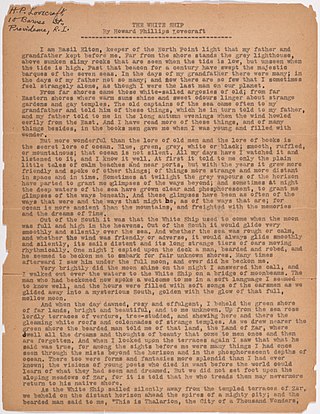
"The White Ship" is a horror short story by American writer H. P. Lovecraft. It was first published in The United Amateur #2, November 1919, and later appeared in the March 1927 issue of Weird Tales.
The Unnamable may refer to:

H. P. Lovecraft was an American psychedelic rock band, formed in Chicago in 1967 and named after the horror writer H. P. Lovecraft. Much of the band's music was inspired by the writings of the author whose name they had adopted and combining elements of psychedelia and folk rock.

"Facts Concerning the Late Arthur Jermyn and His Family" is a short story in the horror fiction genre, written by American author H. P. Lovecraft in 1920. The themes of the story are tainted ancestry, knowledge that it would be best to remain unaware of, and a reality which human understanding finds intolerable.
Dagon is an ancient Semitic god.
This page is based on this
Wikipedia article Text is available under the
CC BY-SA 4.0 license; additional terms may apply.
Images, videos and audio are available under their respective licenses.
