William Hughes Mearns (1875–1965), better known as Hughes Mearns, was an American educator and poet. A graduate of Harvard University and the University of Pennsylvania, Mearns was a professor at the Philadelphia School of Pedagogy from 1905 to 1920. Mearns is remembered now as the author of the poem "Antigonish". However, his ideas about encouraging the natural creativity of children, particularly those age 3 through 8 were novel at the time. It has been written about him that, "He typed notes of their conversations; he learned how to make them forget there was an adult around; never asked them questions and never showed surprise no matter what they did or said."

The Winding Stair is a volume of poems by Irish poet W. B. Yeats, published in 1933. It was the next new volume after 1928's The Tower. The title poem was originally published in 1929 by Fountain Press in a signed limited edition, which is exceedingly rare.
"The Spider and the Fly" is a poem by Mary Howitt (1799–1888), published in 1829. The first line of the poem is "'Will you walk into my parlour?' said the Spider to the Fly." The story tells of a cunning spider who entraps a fly into its web through the use of seduction and manipulation. The poem is a cautionary tale against those who use flattery and charm to disguise their true intentions.
Quarantine is a medical term for the act of keeping an object in enforced isolation for a period of time to limit or prevent the spread of disease or infection.
A golem is an artificial animated being in medieval and Jewish folklore.
Darkness is the absence of light.
The Wild Party may refer to:
Nationality words link to articles with information on the nation's poetry or literature.
This is a list of all works by Irish poet and dramatist W. B. Yeats (1865–1939), winner of the 1923 Nobel Prize in Literature and a major figure in 20th-century literature. Works sometimes appear twice if parts of new editions or significantly revised. Posthumous editions are also included if they are the first publication of a new or significantly revised work. Years are linked to corresponding "year in poetry" articles for works of poetry, and "year in literature" articles for other works.
Swift's Epitaph is a translation by Irish poet William Butler Yeats of Jonathan Swift's epitaph, which Swift wrote for himself in Latin. Yeats' somewhat free translation appeared in his 1933 collection The Winding Stair and Other Poems.

"Antigonish" is a poem by the American educator and poet, William Hughes Mearns, written in 1899. It is also known as "The Little Man Who Wasn't There" and was adapted as a hit song under the latter title.
Betrothed or The Betrothed may refer to:
A cloud atlas is a pictorial key to the nomenclature of clouds.
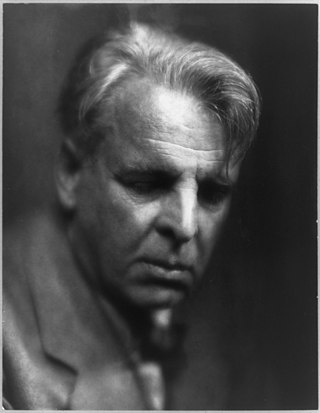
Blood and the Moon is a poem by Irish poet William Butler Yeats written in 1927. It was first published in the Spring 1928 issue of The Exile and then in the collection The Winding Stair in 1929, before being reprinted in The Winding Stair and Other Poems in 1933. Yeats composed the poem in response to the 1927 assassination of Kevin O'Higgins, the Vice-President of the Free State, whom Yeats had known personally. The poem contains many themes common in Yeats's poems from the 1920s including the "tower", a reference to Thoor Ballylee, which had been the title of a collection of works printed the year before "Blood and the Moon" was published, as well as the "gyre" which had been a major focus of his 1920 poem "The Second Coming".
Byzantium is an ancient Greek city, later renamed Constantinople and then Istanbul.
Winding Stair may refer to:
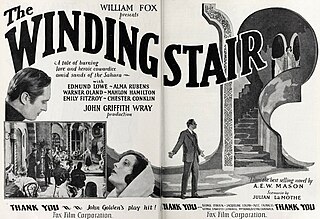
The Winding Stair is a lost 1925 American silent drama film directed by John Griffith Wray and starring Alma Rubens, Edmund Lowe, and Warner Oland. It is based on the 1923 novel of the same name by the British writer A.E.W. Mason.

The Winding Stair is a 1923 novel of romance and adventure by A. E. W. Mason, originally published by Hodder & Stoughton. Set largely in Morocco, the story follows the adventures of Paul Ravenel as he seeks to atone for the disgrace that still attaches to his family name due to the actions of his father who many years earlier in British India had been court-martialled after leaving a key hill fort unguarded.
This page is based on this
Wikipedia article Text is available under the
CC BY-SA 4.0 license; additional terms may apply.
Images, videos and audio are available under their respective licenses.
