
Ticino, sometimes Tessin, officially the Republic and Canton of Ticino or less formally the Canton of Ticino, is one of the 26 cantons forming the Swiss Confederation. It is composed of eight districts and its capital city is Bellinzona. It is also traditionally divided into the Sopraceneri and the Sottoceneri, respectively north and south of Monte Ceneri. Red and blue are the colours of its flag.
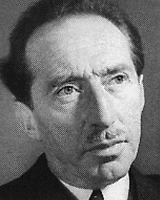
Enrico Celio was a Swiss lawyer, politician and journalist, a member of the Conservative Party, State Councilor and Federal Councilor. He was elected to the Federal Council of Switzerland on 22 February 1940 and handed over office on 15 October 1950. He was affiliated to the Christian Democratic People's Party of Switzerland.

Stefano Franscini was a Swiss politician and statistician. He was one of the initial members of the Swiss Federal Council elected in 1848 and Switzerland's first native Italian speaking federal councillor. Franscini was affiliated to the Liberal Radical Party of Switzerland. During his office tenure he held the Department of Home Affairs. Important elements of his political legacy include political reforms in the Ticino during the 1830s and 1840s, Switzerland's first federal population census in 1850, and the creation of the Swiss Federal Institute of Technology in 1854/1855.

The Lombard language belongs to the Gallo-Italic family, and consists of a cluster of homogeneous dialects spoken by millions of speakers in Northern Italy and southern Switzerland, including most of Lombardy and some areas of the neighbouring regions, notably the eastern side of Piedmont and the western side of Trentino, and in Switzerland in the cantons of Ticino and Graubünden. It is a language also spoken in Santa Catarina in Brazil by Lombard immigrants from the Province of Bergamo.

Gotthard, also known as Gothard or Godehard the Bishop, was a German bishop venerated as a saint.
The Ticinese dialect is the set of dialects, belonging to the Alpine and Western branch of the Lombard language, spoken in the northern part of the Canton of Ticino (Sopraceneri); the dialects of the region can generally vary from valley to valley, often even between single localities, while retaining the mutual intelligibility that is typical of the Lombard linguistic continuum.
Western Lombard is a group of dialects of Lombard, a Romance language spoken in Italy. It is widespread in the Lombard provinces of Milan, Monza, Varese, Como, Lecco, Sondrio, a small part of Cremona, Lodi and Pavia, and the Piedmont provinces of Novara, Verbano-Cusio-Ossola, the eastern part of the Province of Alessandria (Tortona), a small part of Vercelli (Valsesia), and Switzerland. After the name of the region involved, land of the former Duchy of Milan, this language is often referred to as Insubric or Milanese, or, after Clemente Merlo, Cisabduano.

The Naviglio Grande is a canal in Lombardy, northern Italy, connecting the Ticino river near Tornavento to the Porta Ticinese dock, also known as the Darsena, in Milan. It drops 34 m (112 ft) over 49.9 km (31.0 mi). It varies in width from 22 to 50 m from Tornavento to Abbiategrasso, dropping to 15 m (49 ft) between there and Milan. Initially it carries 63 cubic metres per second (2,200 cu ft/s), 116 outlets take water to irrigate 500 square kilometres (190 sq mi) leaving the canal 12 m (39 ft) wide and carrying 12 m3/s (420 cu ft/s) as it enters the dock.
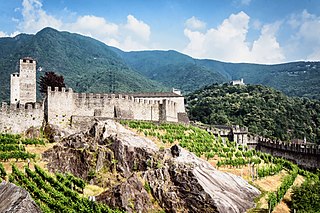
Ticino has a long tradition of winemaking, being the southernmost region of Switzerland. Wine has been produced there since the Roman era. The region is known for its Merlot, which was introduced in the early 20th century.
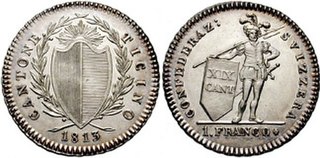
The Ticinese franco was the currency of the Swiss canton of Ticino between 1813 and 1850. It was subdivided into 20 soldi, each of 12 denari, similar to the British pounds, shillings and pence system. It was worth 1⁄4th the French silver écu or 6.67 g fine silver.
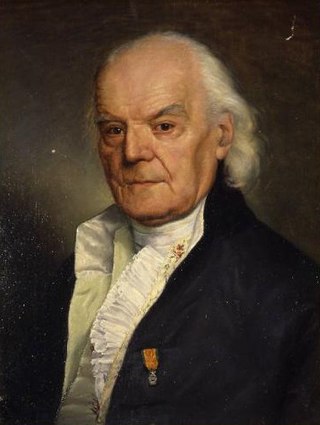
Giocondo Albertolli was a Swiss-born architect, painter, and sculptor who was active in Italy during the Neoclassical period.

Someo is a village and former municipality in the district of Vallemaggia in the canton of Ticino, Switzerland.

The pane ticinese is a white bread traditionally made in the Swiss canton of Ticino, but also available in the rest of Switzerland, where it is known as "Bread of Ticino". In Ticino, it is referred to by a number of names specific to the region, including pane riga, reale or lireta.
Ticino, Ticinus, Ticinum can refer to:
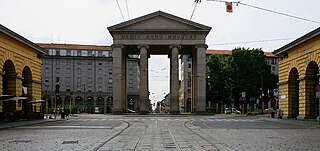
Porta Ticinese is a former city gate of Milan, Italy. The gate, facing south-west, was first created with the Spanish walls of the city, in the 16th century, but the original structure was later demolished and replaced in the early 19th century. The name "Porta Ticinese" is used both to refer to the gate proper and to the surrounding district, part of the Zone 6 administrative division. In the same district there is also a medieval gate with the same name, although in common speech the name "Porta Ticinese" is usually assumed to refer to the 19th century gate.

The Melide causeway crosses across Lake Lugano in the Swiss canton of Ticino, connecting the communities of Melide and Bissone, and provides the only domestic land connection between the southern section of Ticino, around Mendrisio and Chiasso, and the rest of Switzerland.

Italian irredentism in Switzerland was a political movement that promoted the unification to Italy of the Italian-speaking areas of Switzerland during the Risorgimento.

The Zone 6 of Milan, since 2016 officially Municipality 6 of Milan, is one of the 9 administrative divisions of Milan, Italy.

Vincenzo Angelo Orelli (1751-1813) was a Swiss-Italian painter, mainly of sacred subjects, active in a late baroque style.
Giovanni Orelli was a Swiss poet and writer who worked in Italian and the Ticinese dialect. His cousin Giorgio Orelli was a poet and literary critic.
