Brennan is an Irish surname which is an anglicised form of two different Irish-language surnames: Ó Braonáin and Ó Branáin. Historically, one source of the surname was the prominent clan Ua Braonáin (O'Brennan) of Uí Duach (Idough) in Osraige who were a junior Dál Birn sept stemming from a younger son of Cerball mac Dúnlainge (d.888). Recent surname evaluations highlighted the geographic consistency of this lineage in the barony of Idough. However, based on the ultimate authority of Dubhaltach Mac Fhirbhisigh they are out of Ui Dhuinn (O’Dunn) and, therefore, an Uí Failghi tribe, not Osraige. While it is clearly apparent that O’Hart's pedigree is erroneous, it is suggested that Ó Cléirigh probably became confused while transcribing from Mac Fhirbhisigh. This is echoed by the modern scholar, Bart Jaski.
Donaldson is a Scottish and Irish patronymic surname meaning "son of Donald". It is a simpler Anglicized variant for the name MacDonald. Notable people with the surname include:
Michael or Mike Ryan may refer to:
The family name Regan, along with its cognates O'Regan, O Regan, Reagan, and O'Reagan, is an Anglicized form of the Irish surname Ó Riagáin or Ó Ríogáin, from Ua Riagáin. The meaning is likely to have originated in ancient Gaelic ri "sovereign, king" and the diminutive suffix -in; thus "the king's child" or "big king". The name was borne by two distinct families: one seated in Meath, the other in Thomond.
Timothy, Timmy, or Tim Brown may refer to:
Tim, Timmy, or Timothy Ryan may refer to:
Mason is an occupational surname of Scottish and English origin, with variations also found in Italian and French, historically referring to someone who performed stonemasonry work. The surname Mason was originally brought to England in the great wave of migration following the Norman Conquest of 1066. The name Mason is for a stone-mason. The name was originally derived from the Old English or Old French word masson.

Timmy is a masculine name, a short form of Timothy or Tim. This variation is popular as a nickname and is commonly used when someone is young, but it is also used in adulthood. It is a version of the Greek name Τιμόθεος (Timόtheos) meaning "one who honours God," from τιμή "honour" and θεός "god."
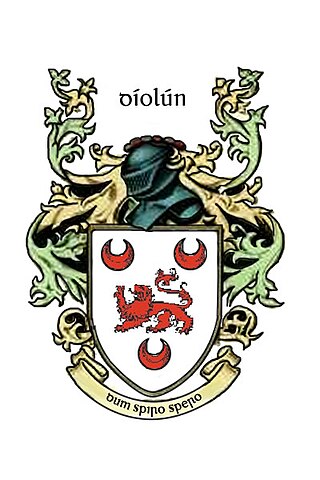
Dillon is an Irish surname of Breton origin, descending from a cadet branch of Viscomte de Leon in Northern Brittany. It first appeared in Ireland with the arrival of Sir Henry de Leon, in the service of Prince John in 1185. Sir Henry married Maud de Courcy, daughter of Sir John de Courcy and Affrica Guðrøðardóttir. Awarded large tracts of land by in Meath and Westmeath, one of the Dillons’ first Mott & Baileys can still be found at Dunnamona before the establishment of stone structures such as Portlick Castle.
The English-language surname Healy is in use by three separate ancestral lines of people from Ireland.
Timothy is a masculine name. It is a version of the Greek name Τιμόθεος (Timόtheos) meaning 'one who honours God', from τιμή 'honour' and θεός 'god'. Timothy is a common name in several countries.
Ferguson is an Anglicization of the Scots Gaelic "Macfhearghus", a patronymic form of the personal name Fergus which translates as son of the angry (one).

Burke is a Norman-Irish surname, deriving from the ancient Anglo-Norman and Hiberno-Norman noble dynasty, the House of Burgh. In Ireland, the descendants of William de Burgh had the surname de Burgh, which was gaelicised in Irish as de Búrca and over the centuries became Búrc, then Burke, and Bourke.
English is an English surname. Notable people with the surname include:
Timothy Allen is an English photographer and filmmaker.
Kearney or Kearneys is an Irish surname.
Keegan is an Anglicisation of the Irish clan name Mac Aodhagáin. The name means "son of Aodhagán". It is found in counties Wicklow, Dublin, Leitrim and Roscommon.
This page is based on this
Wikipedia article Text is available under the
CC BY-SA 4.0 license; additional terms may apply.
Images, videos and audio are available under their respective licenses.
