
The State of Mexico, officially just Mexico, is one of the 32 federal entities of the United Mexican States. Commonly known as Edomex to distinguish it from the name of the whole country, it is the most populous, as well as the most densely populated, state in the country.
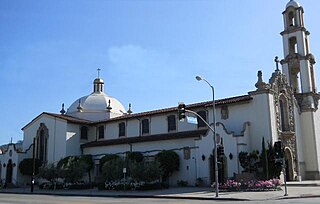
North Hollywood is a Los Angeles, California neighborhood, located in the San Fernando Valley. The neighborhood contains the NoHo Arts District, the El Portal Theatre, several art galleries, and the Academy of TV Arts and Sciences. The North Hollywood Metro Rail station is the northern terminus of the B Line subway on the Los Angeles Metro.

Toluca Lake is a neighborhood in the city of Los Angeles, California, located in the San Fernando Valley 12 miles (19 km) northwest of downtown. The name is also given to a private natural lake fed by wells and maintained by neighboring property owners. Prior to the paving of the Los Angeles River in 1938 and L.A. well extraction in the late 19th and 20th century which lowered the water table, Toluca Lake was fed by artesian springs.

Deportivo Toluca Fútbol Club S.A. de C.V., also known as Club Deportivo Toluca, is a Mexican association football club based in Toluca. The club plays in Liga MX, the top-flight of mexican football from which they have never been relegated.The team was founded on February 12, 1917, by the brothers Manuel Blas and Francisco Juan Henkel Bross owners of the farm "La Huerta" located in Zinacantepec near of Toluca City. Its headquarters are located in the city of Toluca, State of Mexico, playing its home games at the Nemesio Díez Stadium.

The Estadio Nemesio Díez, is one of the oldest football stadiums in Mexico. Opened on August 8, 1954, with a capacity of 30,000, it is located in Barrio de San Bernardino in the city of Toluca, State of Mexico, near Mexico City. It is the home of Deportivo Toluca F.C. and Deportivo Toluca F.C. (women). This stadium has hosted two Football World Cups Football World Cup 1970 and Football World Cup 1986 one Pan American Games 1975 Panamerican Games, one FIFA World Youth Championship 1983 FIFA World Youth Championship and one Central American and Caribbean Games 1990 Central American and Caribbean Games.
The 2003 CONCACAF Champions' Cup was the 38th edition of the annual international club football competition held in the CONCACAF region, the CONCACAF Champions' Cup. It was won by Club Toluca after a 5–4 aggregate win over countryfellow club Morelia in the final. The tournament was held between March 6 and October 8. The 16-team format was scrapped for an eight-team format in 2004.
The 2000 CONCACAF Champions' Cup was the 36th edition of the annual international club football competition held in the CONCACAF region, the CONCACAF Champions' Cup. It determined that year's club champion of association football in the CONCACAF region.
The 1999 CONCACAF Champions' Cup was the 35th edition of the annual international club football competition held in the CONCACAF region, the CONCACAF Champions' Cup. It determined that year's club champion of association football in the CONCACAF region.
Lerma is a municipality located just east of Toluca and 54 km west of Mexico City in State of Mexico, Mexico. The municipal seat city of Lerma de Villada was founded in the early colonial period and named after the Duke of Lerma in Spain. The municipal area saw two battles of the Mexican War of Independence, the Battle of Monte de las Cruces and the Battle of Lerma. For a time after independence, the city was the capital of Mexico State before it was moved to Toluca. The municipality is in one of the most densely populated areas of Mexico and is growing. Much of this growth is occurring near the Toluca-Mexico City highway and on the floodplains of the Lerma River. The latter has caused significant problems with flooding when the river overflows its banks during the rainy season. The Nahuatl name for the area is Cacamilhuacan, which translates to “crows in the field.” In the early colonial period, the area was called Santa Clara Cacamilhuacan. The municipality has both an Aztec glyph with a crow reflecting its Nahuatl name and a Spanish coat of arms.

Tequixquiac is a municipality located in the Zumpango Region of the State of Mexico in Mexico. The municipality is located 84 kilometres (52 mi) north of Mexico City within the valley that connects the Valley of Mexico with the Mezquital Valley. The name comes from Nahuatl and means "place of tequesquite waters". The municipal seat is the town of Santiago Tequixquiac, although both the town and municipality are commonly referred to as simply "Tequixquiac".
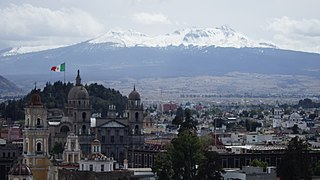
Toluca, officially Toluca de Lerdo, is the state capital of the State of Mexico as well as the seat of the Municipality of Toluca. Toluca has a population of 910,608 as of the 2020 census. The city forms the core of the Greater Toluca metropolitan area, which with a combined population of 2,347,692 forms the fifth most populous metropolitan area in the country. Located 63 kilometres (39 mi) southwest of Mexico City, the city's rapid growth stems largely from its proximity to the capital.
The history of the San Fernando Valley from its exploration by the 1769 Portola expedition to the annexation of much of it by the City of Los Angeles in 1915 is a story of booms and busts, as cattle ranching, sheep ranching, large-scale wheat farming, and fruit orchards flourished and faded. Throughout its history, settlement in the San Fernando Valley was shaped by availability of reliable water supplies and by proximity to the major transportation routes through the surrounding mountains.

Apaxco is a municipality located in the Zumpango Region in Mexico. The municipal territory is located at a southern pass leading out of the Mezquital Valley about 288 km (179 mi) northeast of the state capital of Toluca. The name Apaxco comes from Nahuatl.

Calimaya is a town and municipality located just south of Toluca, the capital of the State of Mexico in central Mexico. The settlement was probably established around 800 BCE, when the city of Teotenango was in existence. It remained an important town through the colonial period, part of the vast lands held by a family which came to be known as the Counts of Calimaya. The town is home to one of the oldest examples of an open chapel in the State of Mexico. Today, the municipality is still mostly agricultural but there has been a rapid construction of housing divisions, changing parts of it from rural to suburban.

Jaltenco is the municipality located in Zumpango Region, a small municipality on this region, covers an area of 4.7 km², this territory is in the northeastern part of the state of Mexico in Mexico. The municipal seat is San Andrés Jaltenco, although both are commonly called only San Andrés. The municipality is located at a northern pass leading out of the Valley of Mexico to 60 kilometers north of Mexico City and about 200 km northeast of the state capital of Toluca.
Carlos Zavala is a Mexican-American former soccer midfielder who played professionally in Mexico and the United States.
Deportivo Toluca F.C. Femenil is a Mexican professional women's football club based in Toluca, Mexico. The club has been the female section of Deportivo Toluca F.C. since 2017. Its headquarters are located in the city of Toluca de Lerdo, State of Mexico, playing its home games at the Nemesio Díez Stadium. Its alternate stadium is located in Metepec, the same place where the training facilities of the reserve clubs and the men's club are located.

Lankershim and West Lankershim are historical names for an area in what is now the greater North Hollywood section of the San Fernando Valley region of Los Angeles County, California.
