
A winery is a building or property that produces wine, or a business involved in the production of wine, such as a wine company. Some wine companies own many wineries. Besides wine making equipment, larger wineries may also feature warehouses, bottling lines, laboratories, and large expanses of tanks known as tank farms. Wineries may have existed as long as 8,000 years ago.
André Charles Stander was a South African criminal and policeman. One of the most infamous bank robbers in South Africa's history, Stander was notorious for the audacious manner with which he carried out his crimes: he sometimes carried out the crime on his lunch break, often returning to the scene as an investigating officer.
Michael Tomasello is an American developmental and comparative psychologist, as well as a linguist. He is co-director of Max Planck Institute for Evolutionary Anthropology in Leipzig, co-director of the Wolfgang Kohler Primate Research Center, honorary professor at University of Leipzig and at Manchester University's Department of Psychology, and professor of psychology at Duke University.
The state of Oregon in the United States has established an international reputation for its production of wine, ranking fourth in the country behind California, Washington, and New York. Oregon has several different growing regions within the state's borders that are well-suited to the cultivation of grapes; additional regions straddle the border between Oregon and the states of Washington and Idaho. Wine making began in the 1840s, with commercial production beginning in the 1960s.
Napa Valley AVA is an American Viticultural Area located in Napa County in California's Wine Country. Napa Valley is considered one of the premier wine regions in the world. Records of commercial wine production in the region date back to the nineteenth century, but premium wine production dates back only to the 1960s.

The production of wine in New Jersey has increased significantly in the last thirty years with opening of new wineries. Beginning in 1981, the state legislature relaxed Prohibition-era restrictions and crafted new laws to facilitate the growth of the industry and provide new opportunities for winery licenses. Today, New Jersey wineries are crafting wines that have earned recognition for their quality from critics, industry leaders, and in national and international competitions. As of 2019, New Jersey currently has 51 licensed and operating wineries with several more prospective wineries in various stages of development.
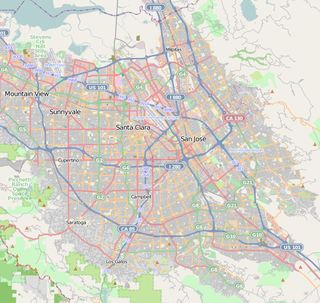
The Picchetti Winery, also known as the Picchetti Ranch, is a winery located at 13100 Montebello Rd., Cupertino, California in the Picchetti Ranch Open Space Preserve. The Picchetti brothers, Secondo and Vincenzo, for whom the ranch was named, were among the earliest settlers to plant grapes on this ridge, which they named "Monte Bello" or "beautiful mountain." This ridge was later to become one of Santa Clara County's important vineyard areas.

The Mountain Winery, formerly the Paul Masson Mountain Winery, is a winery in Saratoga, California, United States, North America. It was founded by Paul Masson, a pioneer of the California wine industry. The winery became famous for its slogan, voiced by Orson Welles in television commercials: "We will sell no wine before its time."
In emulation learning, subjects learn about parts of their environment and use this to achieve their own goals and is an observational learning mechanism.

The cooperative eye hypothesis is a proposed explanation for the appearance of the human eye. It suggests that the eye's distinctive visible characteristics evolved to make it easier for humans to follow another's gaze while communicating or while working together on tasks.

Josep Call is a Spanish comparative psychologist specializing in primate cognition.

The Areni-1 winery is a 6100-year-old winery that was discovered in 2007 in the Areni-1 cave complex in the village of Areni in the Vayots Dzor province of Armenia by a team of Armenian and Irish archaeologists. The excavations were carried out by Boris Gasparyan of the Institute of Archaeology and Ethnography of the National Academy of Sciences of Armenia and Ron Pinhasi from University College Cork (Ireland), and were sponsored by the Gfoeller Foundation (USA) and University College Cork. In 2008 the University of California, Los Angeles (UCLA) also joined the project with Gregory Areshian as co-director of the Areni Project. Since then the excavations have been sponsored by UCLA and the National Geographic Society as well. The excavations of the winery were completed in 2010.
The Winning Ticket is a 1935 American comedy film directed by Charles Reisner and starring Leo Carrillo, Louise Fazenda, and Ted Healy. It was released by Metro-Goldwyn-Mayer.
Culture & Social Cognition is the relationship between human culture and human cognitive capabilities. Cultural cognitive evolution proposes that humans’ unique cognitive capacities are not solely due to biological inheritance, but are in fact due in large part to cultural transmission and evolution. Modern humans and great apes are separated evolutionarily by about six million years. Proponents of cultural evolution argue that this would not have been enough time for humans to develop the advanced cognitive capabilities required to create tools, language, and build societies through biological evolution. Biological evolution could not have individually produced each of these cognitive capabilities within that period of time. Instead, humans must have evolved the capacity to learn through cultural transmission. This provides a more plausible explanation that would fit within the given time frame. Instead of having to biologically account for each cognitive mechanism that distinguishes modern humans from previous relatives, one would only have to account for one significant biological adaptation for cultural learning. According to this view, the ability to learn through cultural transmission is what distinguishes humans from other primates. Cultural learning allows humans to build on existing knowledge and make collective advancements, also known as the “ratchet effect”. The ratchet effect simply refers to the way in which humans continuously add on to existing knowledge through modifications and improvements. This unique ability distinguishes humans from related primates, who do not seem to build collaborative knowledge over time. Instead, primates seem to build individual knowledge, in which the expertise of one animal is not built on by others, and does not progress across time.

Balic Winery is a winery in the Mays Landing section of Hamilton Township in Atlantic County, New Jersey. The vineyard was first planted in the early 19th century by descendants of the original settlers of Mays Landing. Balic is the third-oldest active winery in the state, after Renault Winery and Tomasello Winery, having opened in 1966. Balic is one of the largest winegrowers in New Jersey, having 57 acres of grapes under cultivation. The winery is named after its founder.

Plagido's Winery is a winery located in Hammonton in Atlantic County, New Jersey. A family produce farm since the late 19th century, the vineyard was first planted in 1999, and opened to the public in 2007. The winery was originally known as "Placido's Winery," but the name was changed in 2008 because of winery with a similar name exists in Tuscany. Plagido has 14 acres of grapes under cultivation, and produces 4,200 cases of wine per year. The winery is named after the owner's great-grandfather, who immigrated from Italy in the late 19th century, and started a farm in Hammonton.

Tomasello Winery is a winery located in Hammonton in Atlantic County, New Jersey. Tomasello is the second-oldest active winery in the state, after Renault Winery. The vineyard was first planted in 1888, and opened to the public in 1933 after the end of Prohibition. Tomasello is one of the largest winegrowers in New Jersey, having 70 acres of grapes under cultivation, and producing 65,000 cases of wine per year. Although the winery is in Hammonton, most of the grapes are grown on three vineyards in the neighboring Winslow Township in Camden County. The winery is named after the family that owns it.
New Jersey is home to the most complex alcohol laws in the United States. They provide 29 liquor licenses to wholesalers, manufacturers, retailers and the general public.
Intention is a mental state that represents a commitment to carrying out an action or actions in the future. Intention involves mental activities such as planning and forethought.
