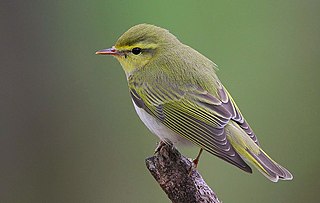
Various Passeriformes are commonly referred to as warblers. They are not necessarily closely related to one another, but share some characteristics, such as being fairly small, vocal, and insectivorous.

The bushtits or long-tailed tits are small passerine birds from the family Aegithalidae, containing 13 species in three genera, all but one of which (Psaltriparus) are found in Eurasia. Bushtits are active birds with long tails compared to their size, moving almost constantly while they forage for insects in shrubs and trees. During non-breeding season, birds live in flocks of up to 50 individuals. Several bushtit species display cooperative breeding behavior, also called helpers at the nest.

The penduline tits constitute the family Remizidae, of small passerine birds related to the true tits. All but the verdin make elaborate bag nests hanging from trees, usually over water.
TIT, Tit, Tits, or tit may refer to:
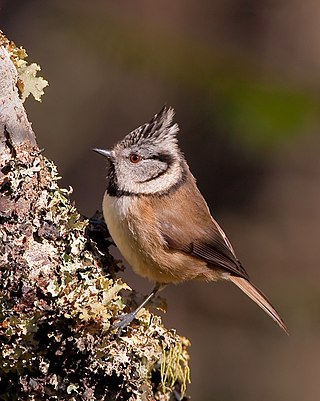
The tits, chickadees, and titmice constitute the Paridae, a large family of small passerine birds which occur mainly in the Northern Hemisphere and Africa. Most were formerly classified in the genus Parus.

The marsh tit is a Eurasian passerine bird in the tit family Paridae and genus Poecile, closely related to the willow tit, Père David's and Songar tits. It is a small bird, around 12 cm (4.7 in) long and weighing 12 g (0.42 oz), with a black crown and nape, pale cheeks, brown back and greyish-brown wings and tail. Between 8 and 11 subspecies are recognised. Its close resemblance to the willow tit can cause identification problems, especially in the United Kingdom where the local subspecies of the two are very similar: they were not recognised as separate species until 1897.
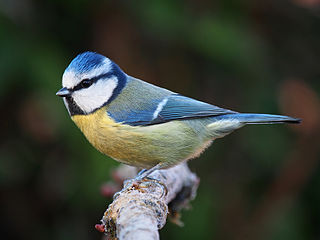
The Eurasian blue tit is a small passerine bird in the tit family, Paridae. It is easily recognizable by its blue and yellow plumage and small size.

The great tit is a small passerine bird in the tit family Paridae. It is a widespread and common species throughout Europe, the Middle East, Central Asia and east across the Palearctic to the Amur River, south to parts of North Africa where it is generally resident in any sort of woodland; most great tits do not migrate except in extremely harsh winters. Until 2005 this species was lumped with numerous other subspecies. DNA studies have shown these other subspecies to be distinct from the great tit and these have now been separated as two distinct species, the cinereous tit of southern Asia, and the Japanese tit of East Asia. The great tit remains the most widespread species in the genus Parus.

The bearded reedling is a small, long-tailed passerine bird found in reed beds near water in the temperate zone of Eurasia. It is frequently known as the bearded tit or the bearded parrotbill, as it historically was believed to be closely related to tits or parrotbills. Today it is known to lack close relatives and it is the only species in the family Panuridae.
The long-tailed tit, also named long-tailed bushtit, is a common bird found throughout Europe and the Palearctic. The genus name Aegithalos was a term used by Aristotle for some European tits, including the long-tailed tit.

The black-capped chickadee is a small, nonmigratory, North American passerine bird that lives in deciduous and mixed forests. It is a member of the Paridae family, also known as tits. It has a distinct black cap on its head, a black bib underneath, and white cheeks. It has a white belly, buff sides, and grey wings, back, and tail. The bird is well known for its vocalizations, including its fee-bee call and its chick-a-dee-dee-dee call, from which it derives its name.
Swift or SWIFT most commonly refers to:

The black robin or Chatham Island robin is an endangered bird from the Chatham Islands off the east coast of New Zealand. It is closely related to the South Island robin. It was first described by Walter Buller in 1872. The binomial commemorates the New Zealand botanist Henry H. Travers (1844–1928). Unlike its mainland counterparts, its flight capacity is somewhat reduced. Evolution in the absence of mammalian predators made it vulnerable to introduced species, such as cats and rats, and it became extinct on the main island of the Chatham group before 1871, being restricted to Little Mangere Island thereafter.
Christopher Miles Perrins, is Emeritus Fellow of the Edward Grey Institute of Field Ornithology at the University of Oxford, Emeritus Fellow at Wolfson College, Oxford and His Majesty's Warden of the Swans since 1993.

The tomtit is a small passerine bird in the family Petroicidae, the Australasian robins. It is endemic to the islands of New Zealand, ranging across the main islands as well as several of the outlying islands. In the Māori language, the North Island tomtit is known as miromiro and the South Island tomtit is known as ngirungiru. This bird has several other Māori and English names as well. There are several subspecies showing considerable variation in plumage and size. The species is not threatened and has adapted to the changes made to New Zealand's biodiversity.

The cinereous tit is a species of bird in the tit family Paridae. This species is made up of several populations that were earlier treated as subspecies of the great tit. These birds are grey backed with white undersides. The great tit in the new sense is distinguishable by the greenish-back and yellowish underside. The distribution of this species extends from parts of West Asia across South Asia and into Southeast Asia. The Japanese tit was formerly treated as a separate species but is now lumped together with the cinereous tit.
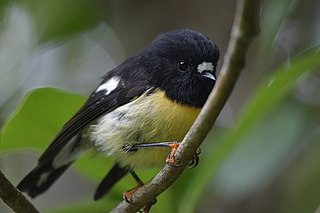
The Chatham tomtit is a subspecies of tomtit found on some of the smaller islands of New Zealand. It is most similar in plumage to the South Island tomtit, the nominate subspecies. The New Zealand government is implementing a plan to help this species and other bird species recover. The holotype is in the collection of the Museum of New Zealand Te Papa Tongarewa.

The Indian black-lored tit, Indian tit, or Indian yellow tit is a passerine bird in the tit family Paridae. The yellow-cheeked tit is probably its closest relative, and both may be related to the yellow tit. These three tits almost certainly form a distinct lineage as evidenced by morphology, and mtDNA cytochrome b sequence analysis. The subgenus name Macholophus may apply for them.
The descriptive term rufous-fronted is part of the common name of a number of different bird species:
Reciprocal altruism in humans refers to an individual behavior that gives benefit conditionally upon receiving a returned benefit, which draws on the economic concept – ″gains in trade″. Human reciprocal altruism would include the following behaviors : helping patients, the wounded, and the others when they are in crisis; sharing food, implement, knowledge.
