
Functional analysis is a branch of mathematical analysis, the core of which is formed by the study of vector spaces endowed with some kind of limit-related structure and the linear functions defined on these spaces and suitably respecting these structures. The historical roots of functional analysis lie in the study of spaces of functions and the formulation of properties of transformations of functions such as the Fourier transform as transformations defining, for example, continuous or unitary operators between function spaces. This point of view turned out to be particularly useful for the study of differential and integral equations.
In formal logic and related branches of mathematics, a functional predicate, or function symbol, is a logical symbol that may be applied to an object term to produce another object term. Functional predicates are also sometimes called mappings, but that term has additional meanings in mathematics. In a model, a function symbol will be modelled by a function.
Proof theory is a major branch of mathematical logic and theoretical computer science within which proofs are treated as formal mathematical objects, facilitating their analysis by mathematical techniques. Proofs are typically presented as inductively-defined data structures such as lists, boxed lists, or trees, which are constructed according to the axioms and rules of inference of a given logical system. Consequently, proof theory is syntactic in nature, in contrast to model theory, which is semantic in nature.
Reciprocity may refer to:
In mathematical analysis, Fubini's theorem characterizes the conditions under which it is possible to compute a double integral by using an iterated integral. It was introduced by Guido Fubini in 1907. The theorem states that if a function is Lebesgue integrable on a rectangle , then one can evaluate the double integral as an iterated integral: This formula is generally not true for the Riemann integral, but it is true if the function is continuous on the rectangle. In multivariable calculus, this weaker result is sometimes also called Fubini's theorem, although it was already known by Leonhard Euler.

Cesare Arzelà was an Italian mathematician who taught at the University of Bologna and is recognized for his contributions in the theory of functions, particularly for his characterization of sequences of continuous functions, generalizing the one given earlier by Giulio Ascoli in the Arzelà–Ascoli theorem.
In measure theory, an area of mathematics, Egorov's theorem establishes a condition for the uniform convergence of a pointwise convergent sequence of measurable functions. It is also named Severini–Egoroff theorem or Severini–Egorov theorem, after Carlo Severini, an Italian mathematician, and Dmitri Egorov, a Russian physicist and geometer, who published independent proofs respectively in 1910 and 1911.
Gelfand is a surname meaning "elephant" in the Yiddish language and may refer to:
In mathematics, the Tonelli–Hobson test gives sufficient criteria for a function ƒ on R2 to be an integrable function. It is often used to establish that Fubini's theorem may be applied to ƒ. It is named for Leonida Tonelli and E. W. Hobson.
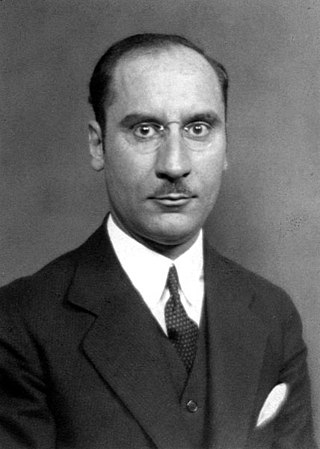
Leonida Tonelli was an Italian mathematician, noted for proving Tonelli's theorem, a variation of Fubini's theorem, and for introducing semicontinuity methods as a common tool for the direct method in the calculus of variations.

Mauro Picone was an Italian mathematician. He is known for the Picone identity, the Sturm-Picone comparison theorem and being the founder of the Istituto per le Applicazioni del Calcolo, presently named after him, the first applied mathematics institute ever founded. He was also an outstanding teacher of mathematical analysis: some of the best Italian mathematicians were among his pupils.
In mathematics, Mazur's lemma is a result in the theory of normed vector spaces. It shows that any weakly convergent sequence in a normed space has a sequence of convex combinations of its members that converges strongly to the same limit, and is used in the proof of Tonelli's theorem.
In mathematics, Tonelli's theorem in functional analysis is a fundamental result on the weak lower semicontinuity of nonlinear functionals on Lp spaces. As such, it has major implications for functional analysis and the calculus of variations. Roughly, it shows that weak lower semicontinuity for integral functionals is equivalent to convexity of the integral kernel. The result is attributed to the Italian mathematician Leonida Tonelli.
Carlo Severini was an Italian mathematician: he was born in Arcevia and died in Pesaro. Severini, independently from Dmitri Fyodorovich Egorov, proved and published earlier a proof of the theorem now known as Egorov's theorem.
In mathematics contraction theorem may refer to:
Extension theorem may refer to:
This page is based on this
Wikipedia article Text is available under the
CC BY-SA 4.0 license; additional terms may apply.
Images, videos and audio are available under their respective licenses.
