
Mullett Township is a civil township of Cheboygan County in the U.S. state of Michigan. The population was 1,312 at the 2010 census. Both the township and Mullett Lake are named for John Mullett, who surveyed much of the area between 1840 and 1843.

The Potawatomi, also spelled Pottawatomi and Pottawatomie, are a Native American people of the western Great Lakes region, upper Mississippi River and Great Plains. They traditionally speak the Potawatomi language, a member of the Algonquin family. The Potawatomi call themselves Neshnabé, a cognate of the word Anishinaabe. The Potawatomi are part of a long-term alliance, called the Council of Three Fires, with the Ojibway and Odawa (Ottawa). In the Council of Three Fires, the Potawatomi are considered the "youngest brother" and are referred to in this context as Bodwéwadmi, a name that means "keepers of the fire" and refers to the council fire of three peoples.
Weesaw was a war chief of the Potawatomi. He and his band were associated with the location that later came to be known as Gard's Prairie in Volinia Township, Michigan. He was the son of Anaquiba. He was married to Sinegogua Topinabee, a daughter of Topinabee. He was a signer of the 1821 Treaty of Chicago that ceded to the United States most of Michigan, with the exception of a small section of Berrien County and a square-mile tract adjacent to Niles, Michigan.
Billy Caldwell, baptized Thomas Caldwell, known also as Sauganash, was a British-Potawatomi fur trader who was commissioned captain in the Indian Department of Canada during the War of 1812. He moved to the United States in 1818 and settled there. In 1829 and 1833 he negotiated treaties on behalf of the United Nations of Chippewa, Ottawa and Potawatomi with the United States, and became a leader of a Potawatomi band at Trader's Point. He worked to gain the boundary long promised by the British between white settlers and Indians, but never achieved it.
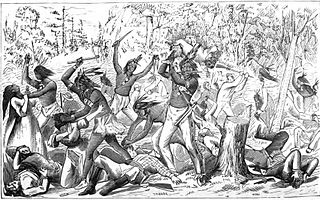
The Indian Creek Massacre occurred on May 21, 1832 with the attack by a party of Native Americans on a group of United States settlers in LaSalle County, Illinois following a dispute about a settler-constructed dam that prevented fish from reaching a nearby Potawatomi village. The incident coincided with the Black Hawk War, but it was not a direct action of the Sauk leader Black Hawk and conflict with the United States. The removal of the dam was asked, was rejected by the settlers and between 40 and 80 Potawatomis and three Sauks attacked and killed fifteen settlers, including women and children. Two young women kidnapped by the Indians were ransomed and released unharmed about two weeks later.

The Forest County Potawatomi Community is a federally recognized tribe of Potawatomi people with approximately 1,400 members as of 2010. The community is based on the Forest County Potawatomi Indian Reservation, which consists of numerous non-contiguous plots of land in southern Forest County and northern Oconto County, Wisconsin, United States. The community also administers about 7 acres (28,000 m2) of off-reservation trust land in the city of Milwaukee. According to the U.S. Census Bureau, the reservation and off-reservation trust land together have a total area of 22.72 square miles (58.8 km2). The combined population of Forest County Potawatomi Community and Off-Reservation Trust Land was 594 in the 2020 census. The nation's administrative and cultural center are located about three miles east of Crandon, Wisconsin.
Pokagon may refer to either of two Potawatomi chiefs:
Winamac was the name of a number of Potawatomi leaders and warriors beginning in the late 17th century. The name derives from a man named Wilamet, a Native American from an eastern tribe who in 1681 was appointed to serve as a liaison between New France and the natives of the Lake Michigan region. Wilamet was adopted by the Potawatomis, and his name, which meant "Catfish" in his native Eastern Algonquian language, was soon transformed into "Winamac", which means the same thing in the Potawatomi language. The Potawatomi version of the name has been spelled in a variety of ways, including Winnemac, Winamek, and Winnemeg.

Pokagon Band of Potawatomi Indians are a federally recognized Potawatomi-speaking tribe based in southwestern Michigan and northeastern Indiana. Tribal government functions are located in Dowagiac, Michigan. They occupy reservation lands in a total of ten counties in the area.

Waubonsie was a leader of the Potawatomi Native American people. His name has been spelled in a variety of ways, including Wabaunsee, Wah-bahn-se, Waubonsee, Waabaanizii in the contemporary Ojibwe language, and Wabanzi in the contemporary Potawatomi language.

The Potawatomi Trail of Death was the forced removal by militia in 1838 of about 859 members of the Potawatomi nation from Indiana to reservation lands in what is now eastern Kansas.

Shabbona, also known as Shabonee and Shaubena, was an Ottawa tribe member who became a chief within the Potawatomi tribe in Illinois during the 19th century.
Five Medals was a leader of the Elkhart River Potawatomi. He led his people in defense of their homelands and was a proponent of agriculture. Five Medals first appeared in eastern records after the Battle of Fallen Timbers, but disappears from those records shortly after the end of the War of 1812.

Prairie Band Potawatomi Nation is a federally recognized tribe of Neshnabé, headquartered near Mayetta, Kansas.

The Treaty of Fort Wayne was a treaty between the United States and several groups of Native Americans. The treaty was signed on June 7, 1803 and proclaimed December 26, 1803. It more precisely defined the boundaries of the Vincennes tract ceded to the United States by the Treaty of Greenville, 1795.
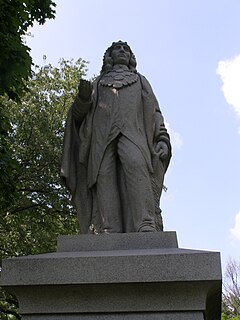
Menominee was a Potawatomi chief and religious leader whose village on reservation lands at Twin Lakes, 5 miles (8.0 km) southwest of Plymouth in present-day Marshall County, Indiana, became the gathering place for the Potawatomi who refused to remove from their Indiana reservation lands in 1838. Their primary settlements were at present day Myers Lake and Cook Lake. Although Menominee's name and mark appear on several land cession treaties, including the Treaty of St. Mary's (1818), the Treaty of Mississinewas (1826), the Treaty of Tippecanoe (1832), and a treaty signed on December 16, 1834, he and other Potawatomi refused to take part in subsequent land cession negotiations, including the Treaty of Yellow River (1836), that directly led to the forced removal of Menominee's band from Indiana in 1838.
Topinabee was a Potawatomi tribe leader and a signer of very important treaties. He was born in his father’s village on the St. Joseph River in 1758. Next to his father, Old Chief Nanaquiba, he was also noted as one of the greatest Potawatomi chiefs of all time. He was documented as a great warrior and known for his great tactical decisions in many battles like his father. Before he died in 1826, he was known as a leader of the Potawatomi tribe of the Midwestern United States. He signed the Treaty of Greenville in 1795, that ceded much of what is now Ohio to the United States. He also signed 11 later treaties during his leasership. He was succeeded as a leader of the Potawatomi by Leopold Pokagon.
Black Earth was a village inhabited by Potawatomi, Odawa, and Ojibwe people that was located in the present-day Town of Carlton, Kewaunee County, Wisconsin. Inhabited by Native Americans for several hundred years, Black Earth was one of Wisconsin's Potawatomi communities that continued to exist in the decades after many Potawatomi left Wisconsin under the terms of the 1833 Treaty of Chicago.
