
An interceptor aircraft, or simply interceptor, is a type of fighter aircraft designed specifically for point defense interception role against an attacking enemy aircraft, particularly bombers and reconnaissance aircraft, as they approach. There are two general classes of interceptor: relatively lightweight aircraft built for high performance, and heavier aircraft designed to fly at night or in adverse weather and operate over longer ranges.
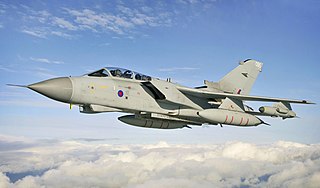
The Panavia Tornado is a family of twin-engine, variable-sweep wing multirole combat aircraft, jointly developed and manufactured by Italy, the United Kingdom, and West Germany. There are three primary Tornado variants: the Tornado IDS (interdictor/strike) fighter-bomber, the suppression of enemy air defences Tornado ECR and the Tornado ADV interceptor aircraft.

An attack aircraft, strike aircraft, or attack bomber, is a tactical military aircraft that has a primary role of carrying out airstrikes with greater precision than bombers, and is prepared to encounter strong low-level air defenses while pressing the attack. This class of aircraft is designed mostly for close air support and naval air-to-surface missions, overlapping the tactical bomber mission. Designs dedicated to non-naval roles are often known as ground-attack aircraft.

The Panavia Tornado Air Defence Variant (ADV) was a long-range, twin-engine interceptor version of the swing-wing Panavia Tornado. The aircraft's first flight was on 27 October 1979, and it entered service with the Royal Air Force (RAF) in 1986. It was also previously operated by the Italian Air Force (AMI) and the Royal Saudi Air Force (RSAF).

A variable-sweep wing, colloquially known as a "swing wing", is an airplane wing, or set of wings, that may be swept back and then returned to its original straight position during flight. It allows the aircraft's shape to be modified in flight, and is therefore an example of a variable-geometry aircraft.
An interdictor is a type of attack aircraft that operates far behind enemy lines, with the express intent of interdicting the enemy's military targets, most notably those involved in logistics. The interdiction prevents or delays enemy forces and supplies from reaching the battlefront; the term has generally fallen from use. The strike fighter is a closely related concept, but puts more emphasis on air-to-air combat capabilities as a multirole combat aircraft. Larger versions of the interdictor concept are generally referred to as penetrators.

The North American B-45 Tornado was an early American jet-powered bomber designed and manufactured by aircraft company North American Aviation. It has the distinction of being the first operational jet bomber to enter service with the United States Air Force (USAF), as well as being the first multiengine jet bomber in the world to be refueled in midair.

Royal Air Force Marham, or more simply RAF Marham, is a Royal Air Force station and military airbase near the village of Marham in the English county of Norfolk, East Anglia.

Number 617 Squadron is a Royal Air Force aircraft squadron, originally based at RAF Scampton in Lincolnshire and currently based at RAF Marham in Norfolk. It is commonly known as the "Dambusters", for its actions during Operation Chastise against German dams during the Second World War. In the early 21st century it operated the Tornado GR4 in the ground attack and reconnaissance role until being disbanded in early 2014. The squadron reformed on 18 April 2018, and was equipped at RAF Marham in June 2018 with the F-35B Lightning, becoming the UK's first F-35 Joint Strike Fighter (JSF) squadron with this advanced V/STOL type.

Number 9 Squadron is the oldest dedicated Bomber Squadron of the Royal Air Force. Formed in December 1914, it saw service throughout the First World War, including at the Somme and Passchendaele. During the Second World War, No. IX (B) Squadron was one of two Avro Lancaster units specialising in heavy precision bombing and sank the battleship Tirpitz on 12 November 1944 in Operation Catechism. Between 1962 and April 1982, the Squadron flew the Avro Vulcan B.2 as part of the V-Force. In June 1982, it became the first front-line squadron in the world to operate the Panavia Tornado GR.1. In May 1998, No. IX (B) Squadron received the RAF's first Tornado GR.4, which it operated until reequipping with the Eurofighter Typhoon FGR.4 at its present home base of RAF Lossiemouth on 1 April 2019.

No. 11 or XI Squadron, is one of the oldest fighter squadrons of the Royal Air Force: continuing the traditions established by the similarly numbered Royal Flying Corps squadron, established in 1915. After a history of equipment with numerous different aircraft types, the squadron most recently operated the Tornado F3 until 2005 when it was disbanded. It was reactivated in 2006 to operate the Typhoon F2, receiving its first aircraft on 9 October 2006.
A tornado is a violent rotating column of air that touches the surface of the earth.

No. 27 Squadron of the Royal Air Force operates the Boeing Chinook from RAF Odiham.

The German Air Force is the aerial warfare branch of the Bundeswehr, the armed forces of Germany. With a strength of 27,767 personnel, it is the third largest air force within the European Union, after the air forces of the United Kingdom, and France. The German Air Force was founded in 1956 during the era of the Cold War as the aerial warfare branch of the armed forces of then West Germany. After the reunification of West and East Germany in 1990, it integrated parts of the air force of the former German Democratic Republic, which itself had been founded in 1956 as part of the National People's Army. There is no organizational continuity between the current German Air Force and the former Luftwaffe of the Wehrmacht combined forces founded in 1935, which was completely disbanded in 1945/46 after World War II. The term Luftwaffe that is used for both the historic and the current German air force is the German-language generic designation of any air force.

Number 12 Squadron, also known as No. 12 (Bomber) Squadron and occasionally as No. XII Squadron, is a flying squadron of the Royal Air Force (RAF). The squadron reformed in July 2018 as a joint RAF/Qatari Emri Air Force squadron. It is currently based at RAF Coningsby, Lincolnshire, and operates the Eurofighter Typhoon FGR4, while temporarily integrating Qatari air and ground crews in order to provide training and support as part of the Qatari purchase of 24 Typhoons from the UK.

Number 15 Squadron, sometimes written as No. XV Squadron, was a squadron of the Royal Air Force. It most recently operated the Panavia Tornado GR4 from RAF Lossiemouth as No. XV (Reserve) Squadron. It was the RAF's Operational Conversion Unit for the Tornado GR4 which taught pilots how to fly the aircraft and what tactics to use to best exploit the performance of their aircraft and its weapons.

The former Royal Air Force Germany (RAFG) was a command of the Royal Air Force and part of British Forces Germany. It consisted of units located in Germany, initially as part of the occupation following the Second World War, and later as part of the RAF's commitment to the defence of Europe during the Cold War. The commander of RAFG doubled as commander of NATO's Second Allied Tactical Air Force.
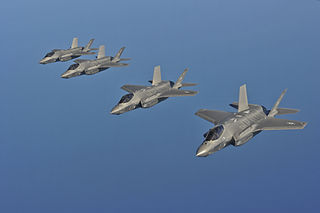
A multirole combat aircraft (MRCA) is a combat aircraft intended to perform different roles in combat. A multirole fighter is a multirole combat aircraft which is, at the same time, also a fighter aircraft; in other words, an aircraft whose various roles include, among others, the role of air-to-air combat.
