
The Toronto Transit Commission (TTC) is the public transport agency that operates bus, subway, streetcar, and paratransit services in Toronto and York Region in Canada. It is the oldest and largest of the urban transit service providers in the Greater Toronto Area, with numerous connections to systems serving its surrounding municipalities.

Line 3 Scarborough, originally known as the Scarborough RT, is a light rapid transit line that is part of the Toronto subway system in Toronto, Ontario, Canada. The line runs entirely within the suburban district of Scarborough, encompassing six stations and 6.4 kilometres (4.0 mi) of mostly elevated track. It connects with Line 2 Bloor–Danforth at its southwestern terminus, Kennedy, and terminates in the northeast at McCowan.
York Region Transit (YRT) is the public transit operator in York Region, Ontario, Canada. Its headquarters are in Richmond Hill, at 50 High Tech Road.

The Davisville Subway Yard is a rail yard on the Toronto Transit Commission's Yonge subway line. The train maintenance and storage building is referred to as the Davisville Carhouse.

The Toronto streetcar system is a network of ten streetcar routes in Toronto, Ontario, Canada, operated by the Toronto Transit Commission (TTC). It is the third busiest light-rail system in North America. The network is concentrated primarily in Downtown Toronto and in proximity to the city's waterfront. Much of the streetcar route network dates from the 19th century. Most of Toronto's streetcar routes operate on street trackage shared with vehicular traffic, and streetcars stop on demand at frequent stops like buses.
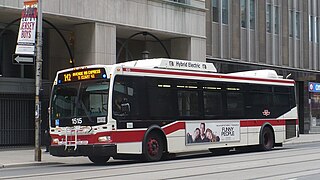
The Toronto Transit Commission (TTC) uses buses and other vehicles for public transportation. In 2018, the TTC bus system had 159 bus routes carrying over 264 million riders over 6,686 kilometres (4,154 mi) of routes with buses travelling 143 million kilometres in the year. As of 2020, the TTC has almost 200 bus routes in operation.

510 Spadina is a streetcar route in Toronto, Ontario, Canada, operated by the Toronto Transit Commission.

The M series, also known as M1, was the second series of rapid transit rolling stock used in the subway system of Toronto, Ontario, Canada. They were built by Montreal Locomotive Works in Montreal, Quebec, Canada from 1961 to 1962. They were the first Toronto subway cars to be manufactured in Canada, and only one of two series built outside Ontario.

The G series was the first rolling stock of rapid transit cars used on the Toronto subway, built 1953–1959 by the Gloucester Railway Carriage & Wagon Company of Gloucester, England, for the Toronto Transit Commission (TTC) of Toronto, Canada.

The T series, also known as the T1, is the fourth series of rapid transit rolling stock used in the subway system of Toronto, Ontario, Canada. They were ordered by the Toronto Transit Commission (TTC) in 1992 and built in one production set between 1995 and 2001 by Bombardier Transportation in Thunder Bay, Ontario, Canada.

The S series is the rolling stock of light metro used on Line 3 Scarborough, part of the subway system of Toronto, Ontario, Canada. They were built from 1983 to 1986 for the Toronto Transit Commission (TTC) by the Urban Transportation Development Corporation (UTDC) in Millhaven, Ontario. The trains use UTDC's proprietary linear motor-based Intermediate Capacity Transit System and are its Mark I model, which is also used by the Vancouver SkyTrain and the Detroit People Mover. They consist of 14 married pair sets with fleet numbers 3000 to 3027, and are not compatible with the trains on other Toronto lines, which use conventional motors.

The Canadian Light Rail Vehicle (CLRV) and Articulated Light Rail Vehicle (ALRV) were the types of streetcars used by the Toronto Transit Commission (TTC). Two variants have been produced: the standard single-module CLRV and the longer articulated double-module ALRV.
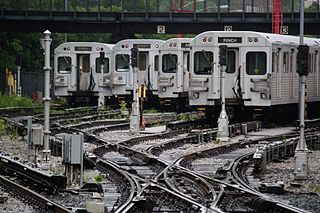
The Toronto subway system's rolling stock consists of 880 subway cars for Line 1 Yonge–University, Line 2 Bloor–Danforth, and Line 4 Sheppard and 28 intermediate-capacity rapid transit cars for Line 3 Scarborough. The rolling stock is owned and maintained by the Toronto Transit Commission (TTC).

The Toronto Rocket (TR) is the fifth and latest series of rolling stock used in the Toronto subway system in Toronto, Ontario, Canada. Owned and operated by the Toronto Transit Commission (TTC), the trains were built by Bombardier Transportation in Thunder Bay, Ontario, to replace the last remaining H-series trains, as well as increase capacity for the Spadina subway extension to Vaughan that opened in 2017. They operate in a six-car configuration on Line 1 Yonge–University and a four-car configuration on Line 4 Sheppard. The sets are stored and maintained at the Wilson and Davisville Yards. The first six-car TR train entered passenger service on Line 1 in July 2011, and four-car TR trainsets entered service on Line 4 in May 2016.
The Flexity Outlook is the latest model in the rolling stock of the Toronto streetcar system owned by the Toronto Transit Commission (TTC). Based on the Flexity vehicles used around the world, the new streetcars were first ordered in 2009 and were built by Bombardier Transportation in Thunder Bay and Kingston, Ontario, with specific modifications for Toronto, such as unidirectional operation and the ability to operate on the unique broad Toronto gauge.
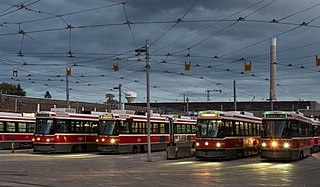
The Russell Carhouse, located at Queen Street East and Connaught Avenue just east of Greenwood Avenue in Toronto, is the Toronto Transit Commission's second oldest carhouse.
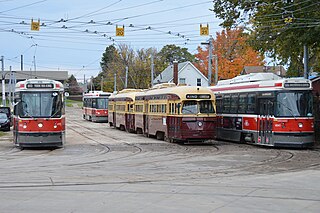
In 1921, the Toronto Transportation Commission (TTC) was created to integrate and operate the Toronto streetcar system. It inherited the infrastructure of two separate streetcar operators: the Toronto Railway Company (TRC) and Toronto Civic Railways (TCR). The TTC immediately embarked on a program to connect the TRC and TCR lines into one network. The TTC had to rebuild most of the track to provide a wider devilstrip so that the wider Peter Witt streetcars it was ordering could pass without sideswiping. Between 1938 and 1945, it placed five orders for air-electric PCC streetcars to replace the old, wooden streetcars of the TRC, and to address rising ridership. Between 1947 and 1951, the TTC placed three orders for all-electric PCC cars, with one order equipped with couplers for multiple-unit operation. Between 1950 and 1957, the TTC purchased PCCs from four American cities. By 1957, the TTC had more PCCs than any other city in North America. After the opening of the Bloor–Danforth subway in 1966, the TTC considered terminating all streetcar service in Toronto. However, in 1972, a citizens group led by Jane Jacobs and Steve Munro called "Streetcars for Toronto" persuaded the City to retain streetcar operation. This led to the development of the Canadian Light Rail Vehicle (CLRV) and its longer, articulated cousin, the Articulated Light Rail Vehicle (ALRV), to replace the aging PCC fleet. The Accessibility for Ontarians with Disabilities Act, 2005 (AODA) mandated that the next generation of streetcars be wheelchair-accessible. Thus, to replace the CLRVs and ALRVs, Bombardier adapted its low-floor Flexity Outlook model for the TTC to navigate the Toronto streetcar system's tight curves and single-point switches, characteristics set in the 1920s to accommodate Peter Witt streetcars.

Leslie Barns is a streetcar maintenance and storage facility at the southeast corner of Leslie Street and Lake Shore Boulevard in Toronto, Ontario, Canada. It has been built to house and service the majority of Toronto Transit Commission's fleet of Flexity Outlook light rail vehicles.
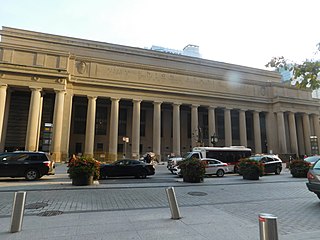
Public transportation in Toronto dates back to 1849 with the creation of a horse-drawn stagecoach company. Today, Toronto's mass transit is primarily made up of a system of subways, buses, and streetcars, covering approximately 1,200 km (750 mi) of routes operated by the Toronto Transit Commission (TTC) and inter-regional commuter rail and bus service is provided by GO Transit.
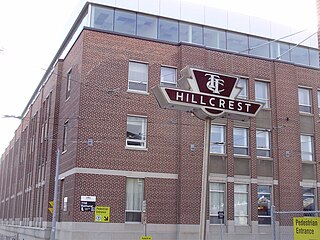
Hillcrest Complex is the Toronto Transit Commission's largest facility and is responsible for most of the maintenance work on the system's surface vehicles, including heavy overhauls, repairs and repainting. It is located adjacent to the intersection of Bathurst Street and Davenport Road. The site is also home to the TTC's Transit Control Centre, but the operational headquarters of the organization remain at the McBrien Building at 1900 Yonge Street.
