
Insurance is a means of protection from financial loss. It is a form of risk management, primarily used to hedge against the risk of a contingent or uncertain loss.

The Federal Deposit Insurance Corporation (FDIC) is a United States government corporation providing deposit insurance to depositors in U.S. commercial banks and savings institutions. The FDIC was created by the 1933 Banking Act, enacted during the Great Depression to restore trust in the American banking system. More than one-third of banks failed in the years before the FDIC's creation, and bank runs were common. The insurance limit was initially US$2,500 per ownership category, and this was increased several times over the years. Since the passage of the Dodd–Frank Wall Street Reform and Consumer Protection Act in 2011, the FDIC insures deposits in member banks up to US$250,000 per ownership category.
Life insurance is a contract between an insurance policy holder and an insurer or assurer, where the insurer promises to pay a designated beneficiary a sum of money in exchange for a premium, upon the death of an insured person. Depending on the contract, other events such as terminal illness or critical illness can also trigger payment. The policy holder typically pays a premium, either regularly or as one lump sum. Other expenses, such as funeral expenses, can also be included in the benefits.
Health insurance is an insurance that covers the whole or a part of the risk of a person incurring medical expenses, spreading the risk over a large number of persons. By estimating the overall risk of health care and health system expenses over the risk pool, an insurer can develop a routine finance structure, such as a monthly premium or payroll tax, to provide the money to pay for the health care benefits specified in the insurance agreement. The benefit is administered by a central organization such as a government agency, private business, or not-for-profit entity.
Vehicle insurance is insurance for cars, trucks, motorcycles, and other road vehicles. Its primary use is to provide financial protection against physical damage or bodily injury resulting from traffic collisions and against liability that could also arise from incidents in a vehicle. Vehicle insurance may additionally offer financial protection against theft of the vehicle, and against damage to the vehicle sustained from events other than traffic collisions, such as keying, weather or natural disasters, and damage sustained by colliding with stationary objects. The specific terms of vehicle insurance vary with legal regulations in each region.
An extended warranty, sometimes called a service agreement, a service contract, or a maintenance agreement, is a prolonged warranty offered to consumers in addition to the standard warranty on new items. The extended warranty may be offered by the warranty administrator, the retailer or the manufacturer. Extended warranties cost extra and for a percentage of the item's retail price. Occasionally, some extended warranties that are purchased for multiple years state in writing that during the first year, the consumer must still deal with the manufacturer in the occurrence of malfunction. Thus, what is often promoted as a five-year extended guarantee, for example, is actually only a four-year guarantee.

The Canada Deposit Insurance Corporation is a Canadian federal Crown Corporation created by Parliament in 1967 to provide deposit insurance to depositors in Canadian commercial banks and savings institutions. CDIC insures Canadians' deposits held at Canadian banks up to C$100,000 in case of a bank failure. CDIC automatically insures many types of savings against the failure of a financial institution. However, the bank must be a CDIC member and not all savings are insured. CDIC is also Canada's resolution authority for banks, federally regulated credit unions, trust and loan companies as well as associations governed by the Cooperative Credit Associations Act that take deposits.
Liability insurance is a part of the general insurance system of risk financing to protect the purchaser from the risks of liabilities imposed by lawsuits and similar claims. It protects the insured in the event he or she is sued for claims that come within the coverage of the insurance policy. Originally, individual companies that faced a common peril formed a group and created a self-help fund out of which to pay compensation should any member incur loss. The modern system relies on dedicated carriers, usually for-profit, to offer protection against specified perils in consideration of a premium.

Manulife Financial Corporation is a Canadian multinational insurance company and financial services provider headquartered in Toronto, Ontario, Canada. The company operates in Canada and Asia as "Manulife" and in the United States primarily through its John Hancock Financial division. As of December 2015, the company employed approximately 34,000 people and had 63,000 agents under contract, and has CA$935 billion in assets under management and administration. Manulife services over 26 million customers worldwide.
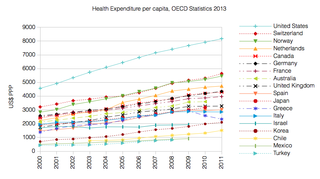
Healthcare in Switzerland is universal and is regulated by the Swiss Federal Law on Health Insurance. There are no free state-provided health services, but private health insurance is compulsory for all persons residing in Switzerland.
Critical illness insurance, otherwise known as critical illness cover or a dread disease policy, is an insurance product in which the insurer is contracted to typically make a lump sum cash payment if the policyholder is diagnosed with one of the specific illnesses on a predetermined list as part of an insurance policy.
Group insurance is an insurance that covers a defined group of people, for example the members of a society or professional association, or the employees of a particular employer. Group coverage can help reduce the problem of adverse selection by creating a pool of people eligible to purchase insurance who belong to the group for reasons other than the wish to buy insurance, which might be because they are a worse than average risk. Grouping individuals together allows insurance companies to give lower rates to companies, "Providing large volume of business to insurance companies gives us greater bargaining power for clients, resulting in cheaper group rates."

Euler Hermes is a credit insurance company that offers a wide range of bonding, guarantees and collections services for the management of business-to-business trade receivables.
Trade credit insurance, business credit insurance, export credit insurance, or credit insurance is an insurance policy and a risk management product offered by private insurance companies and governmental export credit agencies to business entities wishing to protect their accounts receivable from loss due to credit risks such as protracted default, insolvency or bankruptcy. This insurance product is a type of property and casualty insurance, and should not be confused with such products as credit life or credit disability insurance, which individuals obtain to protect against the risk of loss of income needed to pay debts. Trade credit insurance can include a component of political risk insurance which is offered by the same insurers to insure the risk of non-payment by foreign buyers due to currency issues, political unrest, expropriation etc.
Niche insurance is insurance that is provided for small, low-demand areas. Insurance is vital to protect the potential financial losses of individuals and businesses. Although the policies that are usually required are easily available, such as automobile, home, life, travel, and business insurance, other forms of cover can be very difficult to obtain.
Bond insurance is a type of insurance whereby an insurance company guarantees scheduled payments of interest and principal on a bond or other security in the event of a payment default by the issuer of the bond or security. As compensation for its insurance, the insurer is paid a premium by the issuer or owner of the security to be insured. Bond insurance is a form of "credit enhancement" that generally results in the rating of the insured security being the higher of (i) the claims-paying rating of the insurer and (ii) the rating the bond would have without insurance.
Health insurance in the United States is any program that helps pay for medical expenses, whether through privately purchased insurance, social insurance, or a social welfare program funded by the government. Synonyms for this usage include "health coverage", "health care coverage", and "health benefits". In a more technical sense, the term "health insurance "is used to describe any form of insurance providing protection against the costs of medical services. This usage includes private insurance and social insurance programs such as Medicare, which pools resources and spreads the financial risk associated with major medical expenses across the entire population to protect everyone, as well as social welfare programs like Medicaid and the Children's Health Insurance Program, which both provide assistance to people who cannot afford health coverage.

Health insurance coverage in the United States is provided by several public and private sources. During 2016, the U.S. population overall was approximately 325 million, with 53 million persons 65 years of age and over covered by the federal Medicare program. The 272 million non-institutional persons under age 65 either obtained their coverage from employer-based or non-employer based sources, or were uninsured. Approximately 15 million military personnel received coverage through the Veteran's Administration. During the year 2016, 91.2% of Americans had health insurance coverage. Despite being among the top world economic powers, the US remains the sole industrialized nation in the world without universal health care coverage.
Vehicle insurance, in the United States and elsewhere, is designed to cover risk of financial liability or the loss of a motor vehicle the owner may face if their vehicle is involved in a collision resulting in property or physical damages. Most states require a motor vehicle owner to carry some minimum level of liability insurance. States that do not require the vehicle owner to carry car insurance include Virginia, where an uninsured motor vehicle fee may be paid to the state; New Hampshire, and Mississippi which offers vehicle owners the option to post cash bonds. The privileges and immunities clause of Article IV of the U.S. Constitution protects the rights of citizens in each respective state when traveling to another. A motor vehicle owner typically pays insurers a monthly fee, often called an insurance premium. The insurance premium a motor vehicle owner pays is usually determined by a variety of factors including the type of covered vehicle, the age and gender of any covered drivers, their driving history, and the location where the vehicle is primarily driven and stored. Credit scores are also taken into consideration. Most insurance companies offer premium discounts based on these factors.
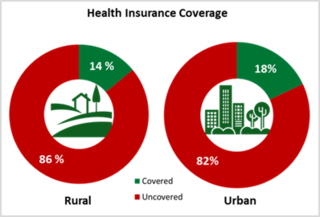
Health insurance in India is a growing segment of India's economy. In 2011, 3.9% of India's gross domestic product was spent in the health sector. According to the World Health Organization (WHO), this is among the lowest of the BRICS economies. Policies are available that offer both individual and family cover. Out of this 3.9%, health insurance accounts for 5-10% of expenditure, employers account for around 9% while personal expenditure amounts to an astounding 82%. In the year 2016, the NSSO released the report “Key Indicators of Social Consumption in India: Health” based on its 71st round of surveys. The survey carried out in the year 2014 found out that, more than 80% of Indians are not covered under any health insurance plan, and only 18% of the urban population and 14% of the rural population was covered under any form of health insurance.


