
Anatolia, also known as Asia Minor, Asian Turkey, the Anatolian peninsula, or the Anatolian plateau, is the westernmost protrusion of Asia, which makes up the majority of modern-day Turkey. The region is bounded by the Black Sea to the north, the Mediterranean Sea to the south, the Armenian Highlands to the east, and the Aegean Sea to the west. The Sea of Marmara forms a connection between the Black and Aegean Seas through the Bosphorus and Dardanelles straits and separates Anatolia from Thrace on the European mainland.
Rûm, also transliterated as Roum or Rhum, is a generic term used at different times in the Muslim world to refer to:
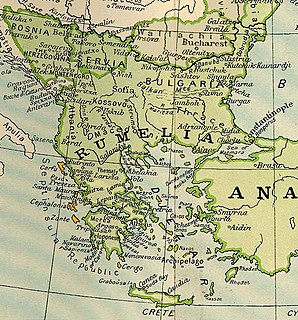
Rumelia, also known as Turkey in Europe, was the name of a historical region in Southeast Europe that was administered by the Ottoman Empire, mainly the Balkan Peninsula. Rumelia included the provinces of Thrace, Macedonia and Moesia, today's Bulgaria and Turkish Thrace, bounded to the north by the rivers Sava and Danube, west by the Adriatic coast, and south by the Morea. Owing to administrative changes between 1870 and 1875, the name ceased to correspond to any political division. Eastern Rumelia was constituted as an autonomous province of the Ottoman Empire by the Treaty of Berlin in 1878. Today, in Turkey, the word Trakya (Thrace) has mostly replaced Rumeli (Rumelia) when referring to the part of Turkey which is in Europe, though Rumelia remains in use in some historical contexts.

The Pechenegs or Patzinaks were a semi-nomadic Turkic people from Central Asia speaking the Pecheneg language which belonged to the Oghuz branch of Turkic language family.

Ajtony, Ahtum or Achtum was an early-11th-century ruler in the territory now known as Banat in present Romania and Serbia. His primary source is the Long Life of Saint Gerard, a 14th-century hagiography. Ajtony was a powerful ruler who owned many horses, cattle and sheep and was baptised according to the Orthodox rite in Vidin. He taxed salt which was transferred to King Stephen I of Hungary on the Mureș River. The king sent Csanád, Ajtony's former commander-in-chief, against him at the head of a large army. Csanád defeated and killed Ajtony, occupying his realm. In the territory, at least one county and a Roman Catholic diocese were established.

In heraldry and vexillology, the double-headed eagle is a charge associated with the concept of Empire. Most modern uses of the symbol are directly or indirectly associated with its use by the Roman/Byzantine Empire, whose use of it represented the Empire's dominion over the Near East and the West. The symbol is much older, and its original meaning is debated among scholars. The eagle has long been a symbol of power and dominion.

The Byzantine Greeks were the Greek-speaking Christian Romans of Late Antiquity and the Middle Ages. They were the main inhabitants of the lands of the Byzantine Empire, of Constantinople and Asia Minor, the Greek islands, Cyprus, and portions of the southern Balkans, and formed large minorities, or pluralities, in the coastal urban centres of the Levant and northern Egypt. Throughout their history, the Byzantine Greeks self-identified as Romans, but are referred to as "Byzantine Greeks" in modern historiography.
The city of Istanbul has been known by a number of different names. The most notable names besides the modern Turkish name are Byzantium, Constantinople, and Stamboul. Different names are associated with different phases of its history and with different languages.

Byzantine cuisine was marked by a merger of Greek and Roman gastronomy. The development of the Byzantine Empire and trade brought in spices, sugar and new vegetables to Greece.

The Principality of Hungary or Duchy of Hungary was the earliest documented Hungarian state in the Carpathian Basin, established 895 or 896, following the 9th century Hungarian conquest of the Carpathian Basin.
The Basilika was a collection of laws completed c. 892 AD in Constantinople by order of the Byzantine Emperor Leo VI the Wise during the Macedonian dynasty. This was a continuation of the efforts of his father, Basil I, to simplify and adapt the Emperor Justinian I's Corpus Juris Civilis code of law issued between 529 and 534 which had become outdated. The term "Basilika" comes not from the Emperor Basil's name, but rather from Greek: τὰ βασιλικά meaning "Royal Laws".

Byzantine studies is an interdisciplinary branch of the humanities that addresses the history, culture, demography, dress, religion/theology, art, literature/epigraphy, music, science, economy, coinage and politics of the Eastern Roman Empire. The discipline's founder in Germany is considered to be the philologist Hieronymus Wolf (1516-1580), a Renaissance Humanist. He gave the name "Byzantine" to the Eastern Roman Empire that continued after the Western Roman Empire collapsed in 476 AD. About 100 years after the final conquest of Byzantium by the Ottomans, Wolf began to collect, edit, and translate the writings of Byzantine philosophers. Other 16th-century humanists introduced Byzantine studies to Holland and Italy. The subject may also be called Byzantinology or Byzantology, although these terms are usually found in English translations of original non-English sources. A scholar of Byzantine studies is called a Byzantinist.
Medieval Greek, also known as Byzantine Greek, is the stage of the Greek language between the end of Classical antiquity in the 5th–6th centuries and the end of the Middle Ages, conventionally dated to the Ottoman conquest of Constantinople in 1453.

The history of Turkey, understood as the history of the region now forming the territory of the Republic of Turkey, includes the history of both Anatolia and Eastern Thrace.
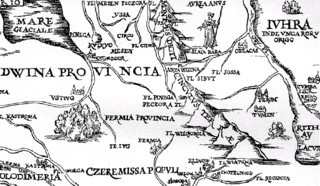
Hungary, the name in English for the country of the same name, is an exonym derived from the Medieval Latin Hungaria. The Latin name itself derives from the ethnonyms (H)ungarī, Ungrī, and Ugrī for the Uralic steppe people that conquered the land today known as Hungary in the 9th and 10th centuries. Medieval authors denominated the Hungarians as Hungaria, but the Hungarians even contemporarily denominate themselves Magyars and their homeland Magyarország.
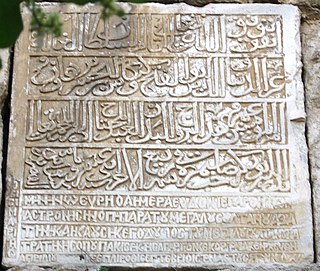
The Siege of Sinope in 1214 was a successful siege and capture of Sinope by the Seljuq Turks under their Sultan, Kaykaus I. Sinope was an important port city on the Black Sea coast of modern Turkey, at the time held by the Empire of Trebizond, one of the Byzantine Greek successor states formed after the Fourth Crusade. The siege is described in some detail by the near-contemporary Seljuq chronicler Ibn Bibi. The Trapezuntine emperor Alexios I led an army to break the siege, but he was defeated and captured, and the city surrendered on 1 November.
Paul Kastenellos is a nom de plume of Vincent O'Reilly, the author of two novels of the Byzantine Empire: Antonina: A Byzantine Slut about the maligned wife of the famed sixth century Roman general Flavius Belisarius, and Count No Man Happy: A Byzantine Fantasy, which recounts the sad life of the Emperor Constantine VI who was blinded by his own mother in the eighth century.
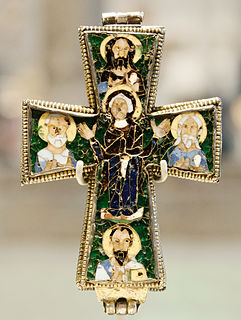
The craft of cloisonné enameling is a metal and glass-working tradition practiced in the Byzantine Empire from the 6th to the 12th century. The Byzantines perfected an intricate form of vitreous enameling, allowing the illustration of small, detailed, iconographic portraits.
The Metropolitanate of Tourkia was a high-ranking Eastern Orthodox ecclesiastical eparchy in the 11th and 12th centuries. According to scholarly theories, the metropolitan bishops were the head of a supposed Orthodox ecclesiastic system in the Kingdom of Hungary.


