This page is based on this
Wikipedia article Text is available under the
CC BY-SA 4.0 license; additional terms may apply.
Images, videos and audio are available under their respective licenses.

A cruiser is a type of warship. Modern cruisers are generally the largest ships in a fleet after aircraft carriers and amphibious assault ships, and can usually perform several roles.
A light cruiser is a type of small- or medium-sized warship. The term is a shortening of the phrase "light armored cruiser", describing a small ship that carried armor in the same way as an armored cruiser: a protective belt and deck. Prior to this smaller cruisers had been of the protected cruiser model, possessing armored decks only. While lighter and smaller than other contemporary ships they were still true cruisers, retaining the extended radius of action and self-sufficiency to act independently across the world. Through their history they served in a variety of roles, primarily as convoy escorts and destroyer command ships, but also as scouts and fleet support vessels for battle fleets.

The heavy cruiser was a type of cruiser, a naval warship designed for long range and high speed, armed generally with naval guns of roughly 203 mm (8 inches) in caliber, whose design parameters were dictated by the Washington Naval Treaty of 1922 and the London Naval Treaty of 1930.
The heavy cruiser is part of a lineage of ship design from 1915 through the early 1950s, although the term "heavy cruiser" only came into formal use in 1930. The heavy cruiser's immediate precursors were the light cruiser designs of the 1900s and 1910s, rather than the armoured cruisers of before 1905. When the armoured cruiser was supplanted by the battlecruiser, an intermediate ship type between this and the light cruiser was found to be needed—one larger and more powerful than the light cruisers of a potential enemy but not as large and expensive as the battlecruiser so as to be built in sufficient numbers to protect merchant ships and serve in a number of combat theaters.
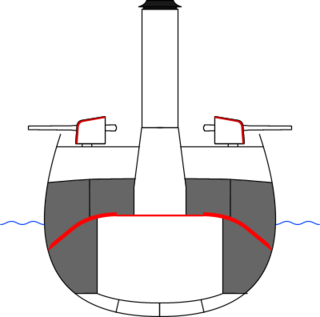
The protected cruiser is a type of naval cruiser of the late 19th century, so known because its armoured deck offered protection for vital machine spaces from fragments caused by exploding shells above. Protected cruisers are similar to armoured cruisers, which also had a belt of armour along the sides.

A scout cruiser was a type of warship of the early 20th Century, which were smaller, faster, more lightly armed and armoured than protected cruisers or light cruisers, but larger than contemporary destroyers. Intended for fleet scouting duties and acting as a flotilla leader, a scout cruiser was typically armed with six to ten destroyer-type guns of 3-inch (76mm) to 4.7-inch (120mm) calibre, plus two to four torpedo tubes.

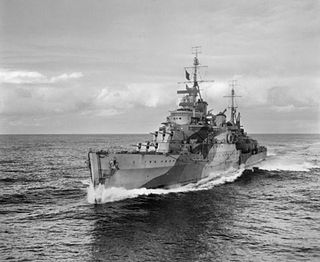
The Crown Colony-class cruisers were a class of light cruisers of the Royal Navy named after Crown Colonies of the British Empire. The first eight are known as the Fiji class, while the last three to be built are commonly referred to as the Ceylon class and were built to a slightly modified design.

The seventh HMS Glasgow, built on the Clyde, was a Southampton-class light cruiser, a sub-class of the Town class and commissioned in September 1937. She displaced 11,930 tons and had a top speed of 32 knots (59 km/h). She was part of the 2nd Cruiser Squadron of the Home Fleet; she escorted the King and Queen to Canada in 1939. She also took a large quantity of gold to Fort Knox as an emergency reserve.

The Cleveland class was a group of light cruisers built for the U.S. Navy during World War II, and were the most numerous class of light cruisers ever built.

The Ticonderoga class of guided-missile cruisers is a class of warships in the United States Navy, first ordered and authorized in the 1978 fiscal year. The class uses passive phased-array radar and was originally planned as a class of destroyers. However, the increased combat capability offered by the Aegis Combat System and the AN/SPY-1 radar system, together with the capability of operating as a flagship, were used to justify the change of the classification from DDG to CG shortly before the keels were laid down for Ticonderoga and Yorktown.

The Hawkins class was a class of five heavy cruisers of the Royal Navy designed in 1915 and constructed throughout the First World War. All ships were named after Elizabethan sea captains. The three ships remaining as cruisers in 1939 served in the Second World War, with Effingham being an early war loss through wreck; Raleigh had been lost in a similar shipwreck on uncharted rocks in 1922. Vindictive, though no longer a cruiser, also served throughout the War. This class formed the basis for the definition of the maximum cruiser type under the Washington Naval Treaty of 1922.

The Oregon City class was a class of heavy cruisers of the United States Navy. Although it was intended to build ten, only four were completed – one of those as a command ship. The three ships completed as cruisers were in commission from 1946 to 1970.

The three Chikuma-class cruisers were protected cruisers operated by the Imperial Japanese Navy. They participated in numerous actions during World War I.

The Fargo-class cruisers were a modified version of the Cleveland-class cruiser design; the main difference was a more compact pyramidal superstructure with single trunked funnel, intended to improve the arcs of fire of the anti-aircraft (AA) guns. The same type of modification differentiated the Baltimore and Oregon City classes of heavy cruisers. Changes were made in order to reduce the instability of the Cleveland-class light cruisers, especially their tendency to roll dangerously. The main battery turrets sat about a foot lower and the wing gunhouses were lowered to the main deck. The medium (40 mm) anti-aircraft mounts were also lowered.

The QF 3-pounder Hotchkiss or in French use Canon Hotchkiss à tir rapide de 47 mm were a family of long-lived light 47 mm naval guns introduced in 1886 to defend against new, small and fast vessels such as torpedo boats and later submarines. There were many variants produced, often under license which ranged in length from 32 to 50 calibers but 40 caliber was the most common version. They were widely used by the navies of a number of nations and often used by both sides in a conflict. They were also used ashore as coastal defense guns and later as an anti-aircraft gun, whether on improvised or specialized HA/LA mounts.