Related Research Articles

Beirut is the capital and largest city of Lebanon. No recent population census has been conducted, but 2007 estimates ranged from slightly more than 1 million to 2.2 million as part of Greater Beirut, which makes it the third-largest city in the Levant region and the fifteenth-largest in the Arab world. On a peninsula at the midpoint of Lebanon's Mediterranean coast, Beirut is an important regional seaport.
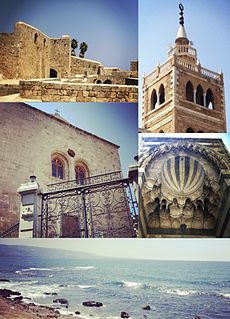
Tripoli is the largest city in northern Lebanon and the second-largest city in the country. Situated 85 kilometers north of the capital Beirut, it is the capital of the North Governorate and the Tripoli District. Tripoli overlooks the eastern Mediterranean Sea, and it is the northernmost seaport in Lebanon. It holds a string of four small islands offshore, and they are also the only islands in Lebanon. The Palm Islands were declared a protected area because of their status of haven for endangered loggerhead turtles, rare monk seals and migratory birds. Tripoli borders the city of El Mina, the port of the Tripoli District, which it is geographically conjoined with to form the greater Tripoli conurbation.

Achrafieh is one of the oldest districts of Beirut, Lebanon.

Samir Kassir was a Lebanese-Palestinian-French professor of history at Saint-Joseph University and journalist.

Martyrs' Square, historically known as "Al Burj" or "Place des Cannons", is the historical central public square of Beirut, Lebanon.

Dahieh, Beirut is a predominantly Shia Muslim suburb south of Beirut, locating in the Baabda District, Lebanon, composed of several towns and municipalities. There is also a minority of coexisting Sunni Muslims. They also inhabit a Palestinian refugee camp which has 20,000 inhabitants. It is located north of the Rafic Hariri International Airport, with the M51 Freeway that links Beirut to the Airport passing through it. Prior to the 2006 Israel-Lebanon conflict, it was a residential area as well as a commercial area with malls and stores. The district is home to many souks. It's also the Beirut stronghold of the Shi'ite Islamist group, Hezbollah, and it had large auditoria in Haret Hreik, Hadeth, Beirut and Bourj al-Barajne where Hezbollah followers gathered during special occasions.

The Beirut Central District (BCD) or Centre Ville is the historical and geographical core of Beirut, the capital of Lebanon. Also called downtown Beirut, it has been described the “vibrant financial, commercial, and administrative hub of the country.” It is an area thousands of years old, traditionally a focus of business, finance, culture and leisure.

The Mohammad Al-Amin Mosque, also referred to as the Blue Mosque, is a Sunni Muslim mosque located in downtown Beirut, Lebanon.

Downtown Dubai, previously known as Downtown Burj Dubai, is a large-scale, mixed-use complex under development in Dubai, United Arab Emirates. It is the home of some of the city's largest landmarks including Burj Khalifa, Dubai Mall, and Dubai Fountain. It covers an area of 2 square kilometres (0.77 sq mi), at an estimated cost of US$20 billion upon completion and as of 2017, had a population of 13,201.

There are many tourist attractions in Dubai, resulting from the large scale construction boom. Mohammed bin Rashid Al Maktoum, the current Ruler of Dubai and the prime minister of the United Arab Emirates, wants Dubai to become the top tourist destination in the world. Dubai received 14 million tourists from all around the world in 2015. Euromonitor ranked the world's 150 most visited cities by international tourists in 2009; Dubai ranked 7th. Dubai hosted a record 10 million visitors in 2012, an increase of 9.3% from the previous year. Dubai's economy relies on many sections of the "state", one of the most important being tourism, in 2014 total 70,475,636 passengers traveled through Dubai Airport. To maintain this important position in the tourism industry they have been known to create big and impressive tourist attractions.

Beirut Souks is a major commercial district in Beirut Central District. With over 200 shops, 25 restaurants and cafes, an entertainment center, a 14 cinema complex, periodic street markets and an upcoming department store, it is Beirut's largest and most diverse shopping and leisure area. Beirut Souks also features piazzas and public space.

Saint George Greek Orthodox Cathedral is the seat of the Greek Orthodox Metropolitan bishop of the Greek Orthodox Archdiocese of Beirut and its dependencies. It is the city's oldest extant church: it has been built over the disappeared Anastasi Romano-Byzantine Cathedral.

The Petit Serail ; was a historic administrative Ottoman building that housed the seat of the Wali of Syria and Beirut. It was situated to the northern side of Martyrs' Square at the heart of the Beirut Central District. The building was the scene of important historical events, but plans to enlarge Beirut's main square led to its destruction in 1950. It was one of several Ottoman era building projects that shaped the architecture of Lebanon in Beirut.

Al-Jdayde is a historic predominantly Christian neighbourhood of Aleppo. It is noted for its winding narrow alleys, richly decorated mansions and churches. It was an area of significant cultural and historical interest. Much of Al-Jdayde suffered catastrophic damage during the Syrian civil war.
Bab Idriss Square is a square in downtown Beirut, Lebanon.
Souk al-Tawileh is located in the heart of downtown Beirut, Lebanon.
Al-Majidiyyeh Mosque is located in Beirut, Lebanon.
Castle Square is a square in Beirut, Lebanon.
The Beirut Heritage Trail is a project undertaken by Solidere with the support of the Ministry of Culture and the Municipality of Beirut. Marked out by bronze medallions grouted into the sidewalk, the trail will link archeological sites, historic public spaces and heritage buildings over a 2.5 km walking circuit in the historic core of Beirut.
References
{{Kassir, Samir (2003) Histoire de Beyrouth, Fayard, Paris.
Ruppert, Helmut (1996) « Beyrouth, une ville d’Orient marquée par l’Occident », traduit de l’allemand et présenté par Eric Verdeil, Les Cahiers du Cermoc, no. 21, Beyrouth (thèse de doctorat publiée initialement en 1969 par la Société franconienne de géographie à Erlangen).
Interview with Faten Ajami, daughter of the founder of « Al-Ajami » restaurant.}}