
In the United States, a car dealership is a business that sells cars. A car dealership can either be a franchised dealership selling new and used cars, or a used car dealership, selling only used cars. In most cases, dealerships provide car maintenance and repair services as well as trade-in, leasing, and financing options for customers.

Ford Motor Credit Company LLC, d/b/a Ford Credit, is the financial services arm of Ford Motor Company, and is headquartered in Dearborn, Michigan.

Kelley Blue Book is an Irvine, California-based vehicle valuation and automotive research company that is recognized by both consumers and the automotive industry. The company is owned by the Cox Automotive subsidiary of Cox Enterprises.
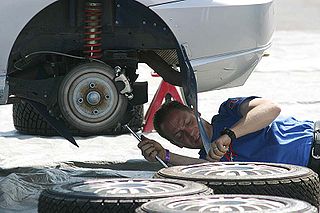
An auto mechanic is a mechanic who services and repairs automobiles, sometimes specializing in one or more automobile brands or sometimes working with any brand. In fixing cars, their main role is to diagnose and repair the problem accurately and quickly. Seasoned auto repair shops start with a (Digital) Inspection to determine the vehicle conditions, independent of the customers concern. Based on the concern, the inspection results and preventative maintenance needs, the mechanic/technician returns the findings to the service advisor who then gets approval for any or all of the proposed work. The approved work will be assigned to the mechanic on a work order. Their work may involve the repair of a specific part or the replacement of one or more parts as assemblies. Basic vehicle maintenance is a fundamental part of a mechanic's work in modern industrialized countries, while in others they are only consulted when a vehicle is already showing signs of malfunction.

AutoNation is an American automotive retailer based in Fort Lauderdale, Florida, which provides new and pre-owned vehicles and associated services in the United States. The company was founded by Wayne Huizenga in 1996, starting with twelve AutoNation locations, and now has more than 300 retail outlets.
Auto Trader Group plc, commonly known as Auto Trader, is a British automotive online marketplace and classified advertising business. It enables the buying and selling of new and used vehicles by private sellers and trade retailers. Auto Trader is listed on the London Stock Exchange trading under the ticker symbol AUTO, and is a constituent of the FTSE 100 Index.
Group 1 Automotive, Inc. is an international Fortune 300 automotive retailer with automotive dealerships and collision centers in the United States and the United Kingdom. Group 1 sells new and used cars and light trucks, arranges financial services, provides maintenance and repair services, and sells vehicle parts. As of 2021, the company employs over 13,000 people globally.
Manheim, Inc. is an automobile auction company and the world's largest wholesale auto auction, based on trade volume with 145 auctions located in North America, Europe, Asia and Australia. As a subsidiary of Cox Automotive, a subsidiary of privately owned Cox Enterprises, Inc. based in Atlanta, Georgia, Manheim's primary business is wholesaling vehicles via a bidding process using traditional and online formats. Manheim also provides other vital dealership and wholesale services, such as financing, title work, transportation, recovery, auto body repair, dealership management systems, dent repair and automotive reconditioning, and automotive re-marketing at each location.

Lithia Motors, Inc. is an American nationwide automotive dealership group headquartered in Medford, Oregon. It is the third largest new vehicle automotive dealership group in the United States, after AutoNation and Penske Automotive Group. As of May 2022, Lithia operates 267 stores in 24 states, and 14 in Canada. Lithia Motors employs approximately 21,150 people.
Vehicle leasing or car leasing is the leasing of a motor vehicle for a fixed period of time at an agreed amount of money for the lease. It is commonly offered by dealers as an alternative to vehicle purchase but is widely used by businesses as a method of acquiring vehicles for business, without the usually needed cash outlay. The key difference in a lease is that after the primary term the vehicle has to either be returned to the leasing company or purchased for the residual value.

The National Automobile Dealers Association (NADA) is an American trade organization representing nearly 16,500 franchised new car and truck dealerships, both domestic and foreign. Established in 1917, the organization is based in Tysons Corner, Virginia. As the automotive retail industry's primary trade association, NADA monitors federal legislation and regulation affecting dealerships and publishes forecasts and reports about industry trends. American Truck Dealers, established in 1970, is a division of NADA representing nearly 1,800 heavy- and medium-duty truck dealerships throughout the United States.
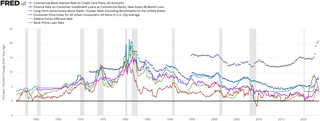
Car finance refers to the various financial products which allow someone to acquire a car, including car loans and leases.
Autotrader.com, Inc. is an American online marketplace for car buyers and sellers, founded in 1997. It aggregates new, used, and certified second-hand cars from dealers and private sellers. The site also provides users with automotive reviews, shopping advice, and comparison tools for car financing and insurance information.
Vehicle remarketing is the controlled disposal of fleet and leasing vehicles that have reached the end of their fixed term.

The Car Allowance Rebate System (CARS), colloquially known as "cash for clunkers", was a $3 billion U.S. federal scrappage program intended to provide economic incentives to U.S. residents to purchase a new, more fuel-efficient vehicle when trading in a less fuel-efficient vehicle. The program was promoted as a post-recession stimulus program to boost auto sales while putting more fuel-efficient vehicles on the roadways.
The Retire Your Ride program was a voluntary Canadian scrappage program created to reward Canadians for permanently retiring a vehicle made in 1995 or earlier for a wide range of rewards, such as a public transit pass or C$300. The program ended on March 31, 2011. By January 2011, the program had surpassed its original targets and had permanently retired over 120,000 vehicles and reduced thousands of tonnes of smog-forming emissions. The program was available in provinces across Canada. Some automakers had started their own complimentary auto retirement programs with rewards on top of the federal program's rewards in an effort to increase vehicle sales in Canada.
Personal contract purchase (PCP), often referred to as a personal contract plan, is a form of hire purchase vehicle finance for individual purchasers, similar to both personal contract hire and a traditional hire purchase.
Vehicle insurance in the United States is designed to cover the risk of financial liability or the loss of a motor vehicle that the owner may face if their vehicle is involved in a collision that results in property or physical damage. Most states require a motor vehicle owner to carry some minimum level of liability insurance. States that do not require the vehicle owner to carry car insurance include Virginia, where an uninsured motor vehicle fee may be paid to the state, New Hampshire, and Mississippi, which offers vehicle owners the option to post cash bonds. The privileges and immunities clause of Article IV of the U.S. Constitution protects the rights of citizens in each respective state when traveling to another. A motor vehicle owner typically pays insurers a monthly fee, often called an insurance premium. The insurance premium a motor vehicle owner pays is usually determined by a variety of factors including the type of covered vehicle, marital status, credit score, whether the driver rents or owns a home, the age and gender of any covered drivers, their driving history, and the location where the vehicle is primarily driven and stored. Most insurance companies will increase insurance premium rates based on these factors, and less frequently, offer discounts.
Jardine Motors Group, is a multi-national operator of franchised motorcar dealerships in the United Kingdom with international outlets in Hong Kong, Macau and China. Jardine Motors Group market their vehicles under a series of brands worldwide including Zung Fu, Lancaster and Scotthall, and the worldwide group net profit, for the year ended 30 April 2012, was US$61 Million, based on revenue of US$5.128 Billion.

The automotive industry in the Philippines is the 9th largest in the Asia-Pacific region, with approximately 273.4 thousand vehicles sold in 2019. Most of the vehicles sold and built in the Philippines are from foreign brands. For the most part, the Philippines is dominated by Japanese automobile manufacturers like most of its ASEAN neighbors. The automobile production in the country is covered under the Philippine Motor Vehicle Development Program implemented by the Board of Investments. In addition, there are also a small number of independent firms who assemble and fabricate jeepneys and other similar vehicles, using surplus engines and drivetrain parts mostly from Japan.
