
The inner ear is the innermost part of the vertebrate ear. In vertebrates, the inner ear is mainly responsible for sound detection and balance. In mammals, it consists of the bony labyrinth, a hollow cavity in the temporal bone of the skull with a system of passages comprising two main functional parts:
The middle ear is the portion of the ear internal to the eardrum, and external to the oval window of the inner ear. The mammalian middle ear contains three ossicles, which transfer the vibrations of the eardrum into waves in the fluid and membranes of the inner ear. The hollow space of the middle ear is also known as the tympanic cavity and is surrounded by the tympani bone. The auditory tube joins the tympanic cavity with the nasal cavity (nasopharynx), allowing pressure to equalize between the middle ear and throat.

The outer ear, external ear, or auris externa is the external portion of the ear, which consists of the auricle and the ear canal . It gathers sound energy and focuses it on the eardrum.

The facial nerve is the seventh cranial nerve, or simply CN VII. It emerges from the pons of the brainstem, controls the muscles of facial expression, and functions in the conveyance of taste sensations from the anterior two-thirds of the tongue. The nerves typically travels from the pons through the facial canal in the temporal bone and exits the skull at the stylomastoid foramen. It arises from the brainstem from an area posterior to the cranial nerve VI and anterior to cranial nerve VIII.
The Eustachian tube, also known as the auditory tube or pharyngotympanic tube, is a tube that links the nasopharynx to the middle ear. It is a part of the middle ear. In adult humans the Eustachian tube is approximately 35 mm (1.4 in) long and 3 mm (0.12 in) in diameter. It is named after the sixteenth-century Italian anatomist Bartolomeo Eustachi.
Ear candling, also called ear coning or thermal-auricular therapy, is an alternative medicine practice claimed to improve general health and well-being by lighting one end of a hollow candle and placing the other end in the ear canal. Medical research has shown that the practice is both dangerous and ineffective and does not help remove earwax or toxicants.

The auricle or auricula is the visible part of the ear that resides outside the head. It is also called the pinna, a term that is used more in zoology.

An earplug is a device that is meant to be inserted in the ear canal to protect the user's ears from loud noises or the intrusion of water, foreign bodies, dust or excessive wind.

An equal-loudness contour is a measure of sound pressure, over the frequency spectrum, for which a listener perceives a constant loudness when presented with pure steady tones. The unit of measurement for loudness levels is the phon, and is arrived at by reference to equal-loudness contours. By definition, two sine waves of differing frequencies are said to have equal-loudness level measured in phons if they are perceived as equally loud by the average young person without significant hearing impairment.

Conductive hearing loss occurs when there is a problem conducting sound waves anywhere along the route through the outer ear, tympanic membrane (eardrum), or middle ear (ossicles). This type of hearing loss may occur in conjunction with sensorineural hearing loss or alone. Depending upon the severity and nature of the conductive loss, this type of hearing impairment can often be treated with surgical intervention or pharmaceuticals to partially or, in some cases, fully restore hearing acuity to within normal range. However, cases of permanent or chronic conductive hearing loss may require other treatment modalities such as hearing aid devices to improve detection of sound and speech perception.
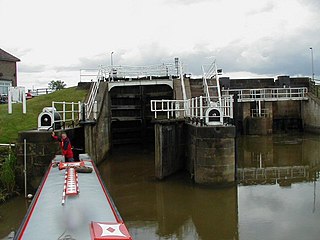
The Market Weighton Canal ran 9.5 miles (15.3 km) from the Humber Estuary to its terminus near Market Weighton. It gained its Act of Parliament in 1772 and opened in 1782. The 3.5 miles (5.6 km) closest to Market Weighton was abandoned in 1900 and the right of navigation through Weighton lock was lost in 1971. However, as of 2002 the lock was passable and the canal usable up to the junction with the River Foulness where silt has made it impassable. Also there is no right of navigation under the M62 motorway bridge to the north of Newport.

Tympanometry is an examination used to test the condition of the middle ear and mobility of the eardrum and the conduction bones by creating variations of air pressure in the ear canal.
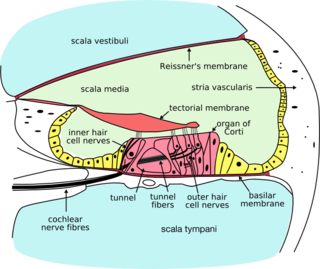
A labyrinthine fistula is an abnormal opening in the bony capsule of the inner ear, resulting in leakage of the perilymph from the cochlea into the middle ear. This includes specifically a perilymph fistula (PLF), an abnormal connection between the fluid of the inner ear and the air-filled middle ear. This connection is caused by a rupture of the round window that separates the inner and middle ear. Another type of labyrinthine fistula is a semicircular canal dehiscence, which allows the inner ear to be influenced by the intracranial pressure directly.
Superior canal dehiscence syndrome (SCDS) is a set of hearing and balance symptoms, related to a rare medical condition of the inner ear, known as superior canal dehiscence. The symptoms are caused by a thinning or complete absence of the part of the temporal bone overlying the superior semicircular canal of the vestibular system. There is evidence that this rare defect, or susceptibility, is congenital. There are also numerous cases of symptoms arising after physical trauma to the head. It was first described in 1998 by Lloyd B. Minor of Johns Hopkins University in Baltimore.

The Leawood Pump House was built near Cromford, Derbyshire, England in 1849 to supply water to the Cromford Canal, built some 50 years previously. It is a Grade II* listed building.
Myringoplasty is the closure of the perforation of pars tensa of the tympanic membrane. When myringoplasty is combined with ossicular reconstruction, it is called tympanoplasty. The operation is performed with the patient supine and face turned to one side. The graft material most commonly used for the surgery is temporalis fascia. The tragal cartilage and tragal perichondrium are also used as the graft by some surgeons.

Otitis externa, also called swimmer's ear, is inflammation of the ear canal. It often presents with ear pain, swelling of the ear canal, and occasionally decreased hearing. Typically there is pain with movement of the outer ear. A high fever is typically not present except in severe cases.

