See also
 | This disambiguation page lists articles associated with the title Training weapon. If an internal link led you here, you may wish to change the link to point directly to the intended article. |
Training weapon may refer to:
| | This disambiguation page lists articles associated with the title Training weapon. If an internal link led you here, you may wish to change the link to point directly to the intended article. |
A bokken is a Japanese wooden sword used for training. It is usually the size and shape of a katana, but is sometimes shaped like other swords, such as the wakizashi and tantō. Some ornamental bokken are decorated with mother-of-pearl work and elaborate carvings. Sometimes it is spelled "boken" in English.
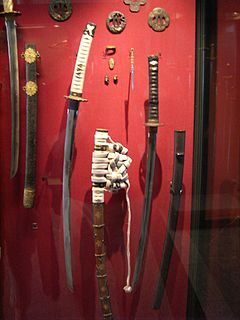
A Japanese sword is one of several types of traditionally made swords from Japan. Swords have been made from as early as the Kofun period, though most generally refer to the curved blades made after the Heian period, when speaking of "Japanese swords". There are many types of Japanese swords that differ by size, shape, field of application and method of manufacture. Some of the more commonly known types of Japanese swords are the katana, tsurugi, wakizashi, odachi, and tachi.
A sword is a bladed, melee weapon intended for slashing or thrusting that is longer than a knife or dagger, consisting of a long blade attached to a hilt. The precise definition of the term varies with the historical epoch or the geographic region under consideration. The blade can be straight or curved. Thrusting swords have a pointed tip on the blade, and tend to be straighter; slashing swords have a sharpened cutting edge on one or both sides of the blade, and are more likely to be curved. Many swords are designed for both thrusting and slashing.
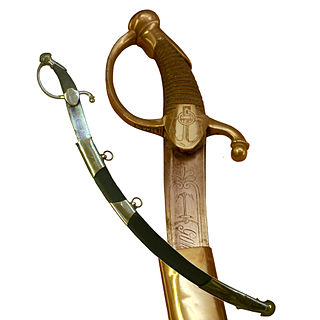
A sabre or saber is a type of backsword with a curved blade associated with the light cavalry of the early modern and Napoleonic periods. Originally associated with Central-Eastern European cavalry such as the hussars, the sabre became widespread in Western Europe in the Thirty Years' War. Lighter sabres also became popular with infantry of the late 17th century.

The jian is a double-edged straight sword used during the last 2,500 years in China. The first Chinese sources that mention the jian date to the 7th century BCE during the Spring and Autumn period; one of the earliest specimens being the Sword of Goujian. Historical one-handed versions have blades varying from 45 to 80 centimeters in length. The weight of an average sword of 70-centimetre (28-inch) blade-length would be in a range of approximately 700 to 900 grams. There are also larger two-handed versions used for training by many styles of Chinese martial arts.

Dao are single-edged Chinese swords, primarily used for slashing and chopping. The most common form is also known as the Chinese sabre, although those with wider blades are sometimes referred to as Chinese broadswords. In China, the dao is considered one of the four traditional weapons, along with the gun, qiang (spear), and the jian. The dao is known as "the general of all weapons".

A cutlass is a short, broad sabre or slashing sword, with a straight or slightly curved blade sharpened on the cutting edge, and a hilt often featuring a solid cupped or basket-shaped guard. It was a common naval weapon during the early Age of Sail.
Stage combat or fight choreography is a specialised technique in theatre designed to create the illusion of physical combat without causing harm to the performers. It is employed in live stage plays as well as operatic and ballet productions. With the advent of cinema and television the term has widened to also include the choreography of filmed fighting sequences, as opposed to the earlier live performances on stage. It is closely related to the practice of stunts and is a common field of study for actors. Actors famous for their stage fighting skills frequently have backgrounds in dance or martial arts training.

Japanese martial arts refer to the variety of martial arts native to the country of Japan. At least three Japanese terms are used interchangeably with the English phrase Japanese martial arts.
Swordsmanship or sword fighting refers to the skills of a swordsman, a person versed in the art of the sword. The term is modern, and as such was mainly used to refer to smallsword fencing, but by extension it can also be applied to any martial art involving the use of a sword. The formation of the English word "swordsman" is parallel to the Latin word gladiator, a term for the professional fighters who fought against each other and a variety of other foes for the entertainment of spectators in the Roman Empire. The word gladiator itself comes from the Latin word gladius, meaning "sword".

The English language terminology used in the classification of swords is imprecise and has varied widely over time. There is no historical dictionary for the universal names, classification or terminology of swords; a sword was simply called "sword" in whatever language the swordsmen wrote.

Banshay is a weapon-based martial art from Myanmar focusing primarily on the sword, staff and spear. Influenced by both Indian and Chinese sources, it is closely related to similar Southeast Asian systems such as Thai krabi krabong, Cambodian kbach kun boran and Malay silat.

A dusack is a single-edged sword of the cutlass or sabre type, in use as a side arm in Germany and the Habsburg Monarchy during the 16th to 17th centuries, as well as a practice weapon based on this weapon used in early modern German fencing.

In martial arts, a waster is a practice weapon, usually a sword, and usually made out of wood, though nylon (plastic) wasters are also available. The use of wood or nylon instead of metal provides an economic and safe option for initial weapons training and sparring, at some loss of genuine experience. A weighted waster may be used for a sort of strength training, making the movements of using an actual sword comparatively easier and quicker. Wasters as wooden practice weapons have been found in a variety of cultures over a number of centuries, including ancient China, Ireland, Iran, Scotland, Rome, Egypt, medieval and renaissance Europe, Japan, and into the modern era in Europe and the United States. Over the course of time, wasters took a variety of forms not necessarily influenced by chronological succession, ranging from simple sticks to clip-point dowels with leather basket hilts to careful replicas of real swords.

The Zweihänder, also Doppelhänder ('double-hander'), Beidhänder ('both-hander'), Bihänder or Bidenhänder, is a large two-handed sword primarily in use during the early decades of the 16th century.
Indian martial arts refers to the fighting systems of the Indian subcontinent. A variety of terms are used for the English phrases “Indian martial arts”, usually deriving from Dravidian sources. While they may seem to imply specific disciplines, by Classical times they were used generically for all fighting systems.
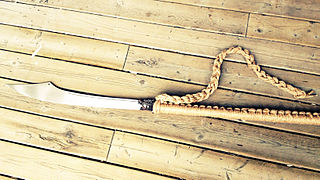
Podao or pudao is a Chinese edged infantry weapon which is still used primarily for training in various Chinese martial arts. The blade of the weapon is shaped like a Chinese broadsword, but the weapon has a longer handle, usually around one and a half to two meters which is circular in cross section. It looks somewhat similar to the guandao.

The hook sword, twin hooks, fu tao, hu tou gou or shuang gou is a Chinese weapon traditionally associated with northern styles of Chinese martial arts and Wushu weapons routines, but now often practiced by southern styles as well.
Katana is a Japanese sword characterized by a curved, single-edged blade with a circular or squared guard and long grip to accommodate two hands. It was used by the samurai of ancient and feudal Japan.