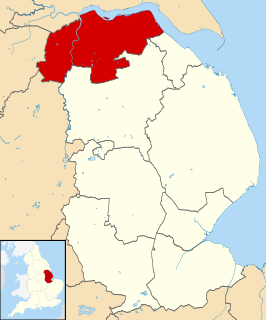
The Humber is a large tidal estuary on the east coast of Northern England. It is formed at Trent Falls, Faxfleet, by the confluence of the tidal rivers Ouse and Trent. From there to the North Sea, it forms part of the boundary between the East Riding of Yorkshire on the north bank and North Lincolnshire on the south bank. Although the Humber is an estuary from the point at which it is formed, many maps show it as the River Humber.

The East Riding of Yorkshire, or simply East Riding, is an area in Northern England and can refer either to the administrative county of the East Riding of Yorkshire which is a unitary authority, to the ceremonial county (Lieutenancy) of the East Riding of Yorkshire or to the easternmost of the three subdivisions (ridings) of the traditional county of Yorkshire.
A patient's bill of rights is a list of guarantees for those receiving medical care. It may take the form of a law or a non-binding declaration. Typically a patient's bill of rights guarantees patients information, fair treatment, and autonomy over medical decisions, among other rights.
Clinical trials are experiments or observations done in clinical research. Such prospective biomedical or behavioral research studies on human participants are designed to answer specific questions about biomedical or behavioral interventions, including new treatments and known interventions that warrant further study and comparison. Clinical trials generate data on safety and efficacy. They are conducted only after they have received health authority/ethics committee approval in the country where approval of the therapy is sought. These authorities are responsible for vetting the risk/benefit ratio of the trial – their approval does not mean that the therapy is 'safe' or effective, only that the trial may be conducted.
An academic clinical trials is a clinical trial not funded by pharmaceutical or biotechnology company for commercial ends but by public-good agencies to advance medicine. These trials are a valuable component of the health care system; they benefit patients and help determine the safety and efficacy of drugs and devices, and play an important role in the checks and balances that regular commercially oriented clinical trials.
M. Krishnan Nair is a leading oncologist working in India. He is the founding director of the Regional Cancer Centre, Thiruvananthapuram, a director of the S.U.T. Institute of Oncology, and Trivandrum Cancer Center(TCC), part of SUT ROYAL HOSPITAL in Thiruvananthapuram(Trivandrum) and a professor at the Amrita Institute of Medical Sciences & Research in Kochi. He received the Padma Shri award from the President of India.
A patient safety organization (PSO) is a group, institution or association that improves medical care by reducing medical errors. In the 1990s, reports in several countries revealed a staggering number of patient injuries and deaths each year due to avoidable adverse health care events. In the United States, the Institute of Medicine report (1999) called for a broad national effort to include the establishment of patient safety centers, expanded reporting of adverse events and development of safety programs in health care organizations. The organizations that developed ranged from governmental to private, and some founded by industry, professional or consumer groups. Common functions of patient safety organizations are data collection and analysis, reporting, education, funding and advocacy.
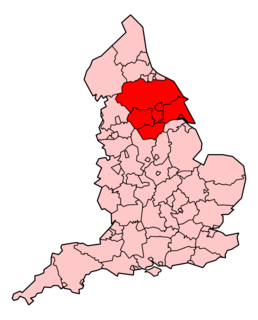
Yorkshire Ambulance Service (YAS) is the NHS ambulance service covering most of Yorkshire in England. It was formed on 1 July 2006 following the mergers of the former West Yorkshire Metropolitan Ambulance Service (WYMAS), South Yorkshire Ambulance Service (SYAS) and Tees, East and North Yorkshire Ambulance Service (TENYAS). It is one of ten NHS Ambulance Trusts providing England with emergency medical services, free at the point of care and as part of the National Health Service it receives direct government funding for its role.
The National Cancer Research Institute (NCRI) is a UK-wide partnership between cancer research funders, which promotes collaboration in cancer research. Its member organizations work together to maximize the value and benefit of cancer research for the benefit of patients and the public. Rather than replace or duplicate any of the functions of its members, it seeks to add value through joint planning, coordination and collaboration.

Cancer Treatment Centers of America (CTCA), headquartered in Boca Raton, Florida, is a national, for-profit network of five comprehensive cancer care and research centers and three out patient care centers that serves cancer patients throughout the United States.
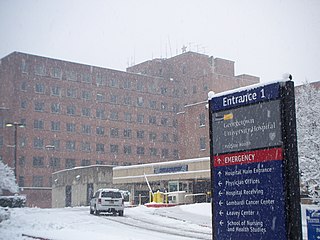
MedStar Georgetown University Hospital is one of the national capital area's oldest academic teaching hospitals. It is a not-for-profit, acute care teaching and research facility located in the Georgetown neighborhood of the Northwest Quadrant of Washington, D.C. MedStar Georgetown is co-located with the Georgetown University Medical Center and is affiliated with the Georgetown University School of Medicine. MedStar Georgetown is home to the Georgetown Lombardi Comprehensive Cancer Center, as well as centers of excellence in the neurology, neurosurgery, psychiatry, gastroenterology, transplant and vascular surgery. Originally named Georgetown University Hospital, it became part of the MedStar Health network in 2000.
Outcomes research is a branch of public health research, which studies the end results (outcomes) of the structure and processes of the health care system on the health and well-being of patients and populations. According to one medical outcomes and guidelines source book - 1996, Outcomes research includes health services research that focuses on identifying variations in medical procedures and associated health outcomes. Though listed as a synonym for the National Library of Medicine MeSH term "Outcome Assessment ", outcomes research may refer to both health services research and healthcare outcomes assessment, which aims at Health technology assessment, decision making, and policy analysis through systematic evaluation of quality of care, access, and effectiveness.
The National Cancer Intelligence Network (NCIN), was set up in 2008 to drive improvements in care standards and clinical outcomes. NCIN is now part of Public Health England, following the Health and Social Care Act 2012.
Yorkshire Cancer Research is a registered charity that helps the people of Yorkshire avoid, survive and cope with cancer.
Patient participation is a trend that arose in answer to perceived physician paternalism. However, only rarely can unchecked physician paternalism be justified, and unlimited patient autonomy would presumably be equally abhorrent.
The Duke Cancer Institute (DCI) is a National Cancer Institute-designated Comprehensive Cancer Center, research facility, and hospital. The center is part of the Duke University School of Medicine and Duke University Health System located in Durham, North Carolina, United States.

The NIH Intramural Research Program (IRP) is the internal research program of the National Institutes of Health (NIH), known for its synergistic approach to biomedical science. With 1,200 Principal Investigators and over 4,000 Postdoctoral Fellows conducting basic, translational, and clinical research, the NIH Intramural Research Program is the largest biomedical research institution on earth. The unique funding environment of the IRP facilitates opportunities to conduct both long-term and high-impact science that would otherwise be difficult to undertake. With rigorous external reviews ensuring that only the most outstanding research secures funding, the IRP is responsible for many scientific accomplishments, including the discovery of fluoride to prevent tooth decay, the use of lithium to manage bipolar disorder, and the creation of vaccines against hepatitis, Hemophilus influenzae (HIB), and human papillomavirus (HPV). In addition, the IRP has also produced or trained 21 Nobel Prize-winning scientists.
Lorenzo patient record systems are a type of Electronic health record provided by DXC Technology, originally as part of the United Kingdom government’s National Programme for IT in the NHS.
The 100,000 Genomes Project is a UK Government project that is sequencing whole genomes from National Health Service patients. The project is focusing on rare diseases, some common types of cancer, and infectious diseases. Participants give consent for their genome data to be linked to information about their medical condition and health records. The medical and genomic data is shared with researchers, to improve knowledge of the causes, treatment and care of diseases.
Consumers United for Evidence-based Healthcare (CUE) is a coalition of health advocacy consumer groups interested in evidence-based healthcare. It was formed in 2003.