This article considers transport in Armenia.
Columbus is a Latinized version of the Italian surname "Colombo". It most commonly refers to:

Georgia is a transcontinental country located in Eastern Europe and West Asia. It is part of the Caucasus region, bounded by the Black Sea to the west, Russia to the north and northeast, Turkey to the southwest, Armenia to the south, and by Azerbaijan to the southeast. The country covers an area of 69,700 square kilometres (26,900 sq mi), and has a population of 3.7 million people. Tbilisi is its capital and largest city, home to roughly a third of the Georgian population.
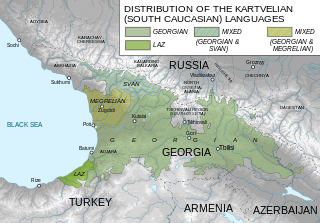
Georgian is the most widely spoken Kartvelian language; it also serves as the literary language or lingua franca for speakers of related languages. It is the official language of Georgia and the native or primary language of 87.6% of its population. Its speakers today amount to approximately four million. Georgian is written in its own unique alphabet.
Two ships of the United States Navy have been named USS Georgia in honor of the fourth state.

Air Georgian Limited was a privately owned charter airline based at Toronto Pearson International Airport in Mississauga, Ontario, Canada. Between 2000 and 2020 its main business was its operation as Air Canada Express on a Tier III codeshare with Air Canada for scheduled services on domestic and trans-border routes. Starting in 2020 Air Georgian began focusing on air charters, before ceasing operations in May, after a sale of its assets to Pivot Airlines, a company run by the same executives.

Shota Rustaveli Tbilisi International Airport, formerly Novo Alexeyevka International Airport, is the busiest international airport in Georgia, located 17 km (11 mi) southeast of capital Tbilisi. The airport handled 3.7 million passengers in 2019. Due to the global coronavirus pandemic, the airspace of Georgia was closed for most of 2020 causing the number of travelers through Tbilisi airport to drop by 84% to less than 600,000.

The Baku–Tbilisi–Kars (BTK), or Baku–Tbilisi–Akhalkalaki–Kars railway (BTAK), is a railway connecting Azerbaijan, Georgia and Turkey, which became operational on 30 October 2017 following several years of delays. The project was originally due to be completed by 2010, but was delayed to 2013, 2015, 2016, and, following a fifth trilateral meeting in February 2016, foreign ministers of the three countries announced that the railway would finally be completed in 2017.
Georgia most commonly refers to:

Rail transport in Azerbaijan is operated by the national state-owned railway company Azerbaijan Railways. The railway network consists of 2,918 km (1,813 mi), its gauge is 1,520 mm, 815 km (506 mi) are double track and 1,272 km (790 mi) are electrified at 3 kV (3,000 V) DC.

Visa requirements for Georgian citizens are administrative entry restrictions by the authorities of other states placed on citizens of Georgia. As of 3 January 2024, Georgian citizens had visa-free or visa on arrival access to 133 countries and territories, ranking the Georgian passport 34th in terms of travel freedom according to the Henley Passport Index.

Azerbaijan Railways is the national state-owned rail transport operator in the Republic of Azerbaijan. The 2,918 km (1,813 mi), 1,520 mm gauge network is electrified at 3 kV (3,000 V) DC. The headquarters of the Azerbaijan Railways is in the capital Baku.

Visitors to Georgia must obtain a visa from Georgian diplomatic missions unless they come from one of the visa exempt countries or one of the countries whose citizens can obtain an e-Visa. Visitors must hold a passport valid for the period of intended stay, while Georgian citizens can enter with a valid or expired passport or identity card.
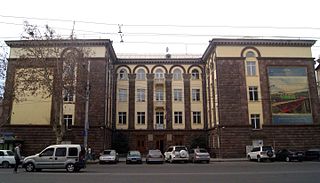
South Caucasus Railway is the sole railway company in Armenia, owned by Russian Railways, responsible for all inter-city, commuter, and freight rail transport in Armenia. The network consists of 780 kilometers of track with all lines in the Russian gauge.

Hazel Jane Raines was an American pioneer aviator and flight instructor with the Civilian Pilot Training Program. During World War II, she was part of the first group of United States women to fly military aircraft, which they did in a war zone for the civilian British Air Transport Auxiliary. She was later a member of the civilian contract labor Women Airforce Service Pilots. After the war, she taught instrument training in Brazil. When President Harry S. Truman authorized the integration of women into the military, she served with Women in the Air Force and was based in Texas, Alabama, and finally London until her death. Raines was the first woman in Georgia to earn a pilot's license, and has been inducted into both the Georgia Aviation Hall of Fame and the Georgia Women of Achievement.
This page is based on this
Wikipedia article Text is available under the
CC BY-SA 4.0 license; additional terms may apply.
Images, videos and audio are available under their respective licenses.
