United States
 | This disambiguation page lists articles associated with the title Transportation Act. If an internal link led you here, you may wish to change the link to point directly to the intended article. |
Transportation Act may refer to:
| | This disambiguation page lists articles associated with the title Transportation Act. If an internal link led you here, you may wish to change the link to point directly to the intended article. |
The Federal Aviation Administration (FAA) is a governmental body of the United States with powers to regulate all aspects of civil aviation in that nation as well as over its surrounding international waters. Its powers include the construction and operation of airports, air traffic management, the certification of personnel and aircraft, and the protection of U.S. assets during the launch or re-entry of commercial space vehicles. Powers over neighboring international waters were delegated to the FAA by authority of the International Civil Aviation Organization.
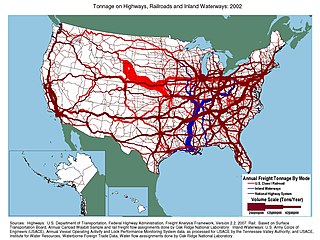
Transportation in the United States is facilitated by road, air, rail, and waterways. The vast majority of passenger travel occurs by automobile for shorter distances, and airplane for longer distances. In descending order, most cargoes travel by railroad, truck, pipeline, or boat; air shipping is typically used only for perishables and premium express shipments.

The United States secretary of transportation is the head of the United States Department of Transportation, a member of the president's Cabinet, and fourteenth in the presidential Line of Succession. The post was created with the formation of the Department of Transportation on October 15, 1966, by President Lyndon B. Johnson's signing of the Department of Transportation Act. The department's mission is "to develop and coordinate policies that will provide an efficient and economical national transportation system, with due regard for need, the environment, and the national defense." The secretary of transportation oversees eleven agencies, including the Federal Aviation Administration, the Federal Highway Administration, and the National Highway Traffic Safety Administration. In April 2008, Mary Peters launched the official blog of the secretary of transportation called "The Fast Lane".
The United States Department of Transportation is a federal Cabinet department of the U.S. government concerned with transportation. It was established by an act of Congress on October 15, 1966, and began operation on April 1, 1967. It is governed by the United States Secretary of Transportation.

Penal transportation or transportation was the relocation of convicted criminals, or other persons regarded as undesirable, to a distant place, often a colony for a specified term; later, specifically established penal colonies became their destination. While the prisoners may have been released once the sentences were served, they generally did not have the resources to get back home.

The Intracoastal Waterway (ICW) is a 3,000-mile (4,800 km) inland waterway along the Atlantic and Gulf of Mexico coasts of the United States, running from Boston, Massachusetts, southward along the Atlantic Seaboard and around the southern tip of Florida, then following the Gulf Coast to Brownsville, Texas. Some sections of the waterway consist of natural inlets, saltwater rivers, bays, and sounds, while others are artificial canals. It provides a navigable route along its length without many of the hazards of travel on the open sea. Many species of plants and animals can be seen along the path of the ICW.

The One Hundred Sixth United States Congress was a meeting of the legislative branch of the United States federal government, composed of the United States Senate and the United States House of Representatives. It met in Washington, DC from January 3, 1999, to January 3, 2001, during the last two years of Bill Clinton's presidency. The apportionment of seats in the House of Representatives was based on the Twenty-first Census of the United States in 1990. Both chambers had a Republican majority.

Transport Canada is the department within the Government of Canada responsible for developing regulations, policies and services of road, rail, marine and air transportation in Canada. It is part of the Transportation, Infrastructure and Communities (TIC) portfolio. The current Minister of Transport is Marc Garneau. Transport Canada is headquartered in Ottawa, Ontario.

The Florida Department of Transportation (FDOT) is a decentralized agency charged with the establishment, maintenance, and regulation of public transportation in the state of Florida. The department was formed in 1969. It absorbed the powers of the State Road Department (SRD). The current Secretary of Transportation is Kevin J. Thibault, P.E..Meet the Secretary</ref>
The Bureau of Transportation Statistics (BTS), as part of the United States Department of Transportation, compiles, analyzes, and makes accessible information on the nation's transportation systems; collects information on intermodal transportation and other areas as needed; and improves the quality and effectiveness of DOT's statistical programs through research, development of guidelines, and promotion of improvements in data acquisition and use.

The Federal Railroad Administration (FRA) is an agency in the United States Department of Transportation (DOT). The agency was created by the Department of Transportation Act of 1966. The purpose of FRA is to promulgate and enforce rail safety regulations, administer railroad assistance programs, conduct research and development in support of improved railroad safety and national rail transportation policy, provide for the rehabilitation of Northeast Corridor rail passenger service, and consolidate government support of rail transportation activities.

The Ministry of Transportation of Ontario (MTO) is the provincial ministry of the Government of Ontario that is responsible for transport infrastructure and related law in Ontario. The ministry traces its roots back over a century to the 1890s, when the province began training Provincial Road Building Instructors. In 1916, the Department of Public Highways of Ontario (DPHO) was formed and tasked with establishing a network of provincial highways. The first was designated in 1918, and by the summer of 1925, sixteen highways were numbered. In the mid-1920s, a new Department of Northern Development (DND) was created to manage infrastructure improvements in northern Ontario; it merged with the Department of Highways of Ontario (DHO) on April 1, 1937. In 1971, the Department of Highways took on responsibility for Communications and in 1972 was reorganized as the Ministry of Transportation and Communications (MTC), which then became the Ministry of Transportation in 1987.
Interstate 14 (I-14), also known as the "14th Amendment Highway", the Gulf Coast Strategic Highway and the Central Texas Corridor, is an Interstate Highway in the U.S. state of Texas that follows U.S. Highway 190 (US 190). The highway was named for the 14th Amendment. In 2005, I-14 was planned to have a western terminus at Natchez, Mississippi, extending east through Louisiana, Mississippi, and Alabama, before ending at Augusta, Georgia or North Augusta, South Carolina. Advocates of the Gulf-Coast Strategic Highway proposed extending I-14 to I-10 near Fort Stockton and the junction of US 277 and I-10 near Sonora, Texas.

The National Highway System (NHS) is a network of strategic highways within the United States, including the Interstate Highway System and other roads serving major airports, ports, rail or truck terminals, railway stations, pipeline terminals and other strategic transport facilities. Altogether, it constitutes the largest highway system in the world.

The Indiana Department of Transportation (INDOT) is a governmental agency of the U.S. state of Indiana charged with maintaining and regulating transportation and transportation related infrastructure such as state owned airports, state highways and state owned canals or railroads.

The Transportation Act 1717 was an Act of the Parliament of Great Britain that established a regulated, bonded system to transport criminals to colonies in North America for indentured service, as a punishment for those convicted or attained in Great Britain, excluding Scotland. The act, is long titled An Act for the further preventing Robbery, Burglary, and other Felonies, and for the more effectual Transportation of Felons, and unlawful Exporters of Wool; and for declaring the Law upon some Points relating to Pirates. The act established a seven-year transportation sentence as a punishment for people convicted of lesser felonies, and a fourteen-year sentence for more serious crimes, in lieu of capital punishment. Completion of the sentence had the effect of a pardon; the punishment for returning before completion was death. An estimated 50,000 convicts were transported to the British American colonies.

The Civil Aviation Authority of the Philippines is the national aviation authority of the Philippines and is responsible for implementing policies on civil aviation to assure safe, economic and efficient air travel. The agency also investigates aviation accidents via its Aircraft Accident Investigation and Inquiry Board. Formerly Air Transportation Office, it is an independent regulatory body attached to the Department of Transportation for the purpose of policy coordination.
The Land Transportation Office is an agency of the Philippine government under the Department of Transportation and is responsible for all land transportation in the Philippines. Functions of the Land Transportation Office include the inspection and registration of motor vehicles, issuance of license and permits, enforcement of land transportation rules and regulations, adjudication of traffic cases, and the collection of revenues for the government of the Philippines.
The Ministry of Transport, abbreviated MOT, is a ministry of the Government of Malaysia that is responsible for transport: road transport, civil aviation, marine, road safety, port authority, railway assets, maritime, air accident investigation, logistic, maritime safety, shipping, rail transport, airport, airline.