
An intervertebral disc lies between adjacent vertebrae in the vertebral column. Each disc forms a fibrocartilaginous joint, to allow slight movement of the vertebrae, to act as a ligament to hold the vertebrae together, and to function as a shock absorber for the spine.

The lumbar vertebrae are, in human anatomy, the five vertebrae between the rib cage and the pelvis. They are the largest segments of the vertebral column and are characterized by the absence of the foramen transversarium within the transverse process and by the absence of facets on the sides of the body. They are designated L1 to L5, starting at the top. The lumbar vertebrae help support the weight of the body, and permit movement.

Spondylosis is the degeneration of the spinal column from any cause. In the more narrow sense it refers to spinal osteoarthritis, the age-related wear and tear of the spinal column, which is the most common cause of spondylosis. The degenerative process in osteoarthritis chiefly affects the vertebral bodies, the neural foramina and the facet joints. If severe, it may cause pressure on the spinal cord or nerve roots with subsequent sensory or motor disturbances, such as pain, paresthesia, imbalance, and muscle weakness in the limbs.

Lordosis is the normal inward lordotic curvature of the lumbar and cervical regions of the human spine. The normal outward (convex) curvature in the thoracic and sacral regions is termed kyphosis or kyphotic. The term comes from the Greek lordōsis, from lordos.
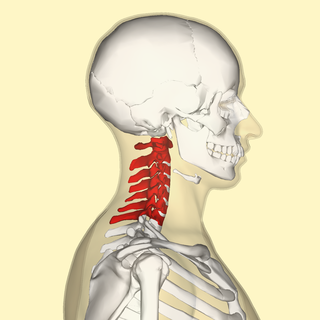
In vertebrates, cervical vertebrae are the vertebrae of the neck, immediately below the skull.

A cervical fracture, commonly called a broken neck, is a catastrophic fracture of any of the seven cervical vertebrae in the neck. Examples of common causes in humans are traffic collisions and diving into shallow water. Abnormal movement of neck bones or pieces of bone can cause a spinal cord injury resulting in loss of sensation, paralysis, or usually instant death.

Degenerative disc disease (DDD) is a medical condition in which there are anatomic changes and a loss of function of varying degrees of one or more intervertebral discs of the spine of sufficient magnitude as to cause symptoms. The root cause is thought to be loss of soluble proteins within the fluid contained in the disc with resultant reduction of the oncotic pressure, which in turn causes loss of fluid volume. Normal downward forces cause the affected disc to lose height, and the distance between vertebrae is reduced. The anulus fibrosus, the rigid outer shell of a disc, also weakens. This loss of height causes laxity of the longitudinal ligaments, which may allow anterior, posterior, or lateral shifting of the vertebral bodies, causing facet joint malalignment and arthritis; scoliosis; cervical hyperlordosis; thoracic hyperkyphosis; lumbar hyperlordosis; narrowing of the space available for the spinal tract within the vertebra ; and/or narrowing of the space through which a spinal nerve exits with resultant inflammation and impingement of a spinal nerve, causing a radiculopathy.

Spondyloepiphyseal dysplasia congenita is a rare disorder of bone growth that results in dwarfism, characteristic skeletal abnormalities, and occasionally problems with vision and hearing. The name of the condition indicates that it affects the bones of the spine (spondylo-) and the ends of bones (epiphyses), and that it is present from birth (congenital). The signs and symptoms of spondyloepiphyseal dysplasia congenita are similar to, but milder than, the related skeletal disorders achondrogenesis type 2 and hypochondrogenesis. Spondyloepiphyseal dysplasia congenita is a subtype of collagenopathy, types II and XI.
Congenital vertebral anomalies are a collection of malformations of the spine. Most around 85% are not clinically significant, but they can cause compression of the spinal cord by deforming the vertebral canal or causing instability. This condition occurs in the womb. Congenital vertebral anomalies include alterations of the shape and number of vertebrae.

Spondylolysis (spon-dee-low-lye-sis) is defined as a defect or stress fracture in the pars interarticularis of the vertebral arch. The vast majority of cases occur in the lower lumbar vertebrae (L5), but spondylolysis may also occur in the cervical vertebrae.
Yimenosaurus is an extinct genus of plateosaurid sauropodomorph dinosaur that lived in China in the Early Jurassic. The genus was first named in 1990 by Ziqi Bai, Jie Yang and Guohui Wang, along with its type and only species, Yimenosaurus youngi. The species name honours renowned Chinese paleontologist Yang Zhongjian, the father of Chinese paleontology, known as C.C. Young in English. Known material includes the holotype, an almost complete skull and mandible, as well as incomplete cervical and dorsal vertebrae, a mostly complete sacrum, an ilium, ischia, partial ribs and complete femur, and a paratype, a well-preserved postcrania with a fragmentary skull.

Scheuermann's disease is a self-limiting skeletal disorder of childhood. Scheuermann's disease describes a condition where the vertebrae grow unevenly with respect to the sagittal plane; that is, the posterior angle is often greater than the anterior. This uneven growth results in the signature "wedging" shape of the vertebrae, causing kyphosis. It is named after Danish surgeon Holger Scheuermann.

Spinal disc herniation is an injury to the cushioning and connective tissue between vertebrae, usually caused by excessive strain or trauma to the spine. It may result in back pain, pain or sensation in different parts of the body, and physical disability. The most conclusive diagnostic tool for disc herniation is MRI, and treatment may range from painkillers to surgery. Protection from disc herniation is best provided by core strength and an awareness of body mechanics including posture.

The back describes the area of horse anatomy where the saddle goes, and in popular usage extends to include the loin or lumbar region behind the thoracic vertebrae that also is crucial to a horse's weight-carrying ability. These two sections of the vertebral column beginning at the withers, the start of the thoracic vertebrae, and extend to the last lumbar vertebra. Because horses are ridden by humans, the strength and structure of the horse's back is critical to the animal's usefulness.
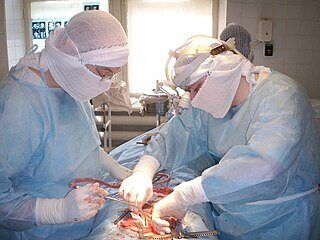
A laminotomy is an orthopaedic neurosurgical procedure that removes part of the lamina of a vertebral arch in order to relieve pressure in the vertebral canal. A laminotomy is less invasive than conventional vertebral column surgery techniques, such as laminectomy because it leaves more ligaments and muscles attached to the vertebral column intact and it requires removing less bone from the vertebra. As a result, laminotomies typically have a faster recovery time and result in fewer postoperative complications. Nevertheless, possible risks can occur during or after the procedure like infection, hematomas, and dural tears. Laminotomies are commonly performed as treatment for lumbar spinal stenosis and herniated disks. MRI and CT scans are often used pre- and post surgery to determine if the procedure was successful.
Vertebral fixation is a orthopedic surgical procedure in which two or more vertebrae are anchored to each other through a synthetic "vertebral fixation device", with the aim of reducing vertebral mobility and thus avoiding possible damage to the spinal cord and/or spinal roots.
Dromicosuchus is an extinct genus of sphenosuchian, a type of basal crocodylomorph, the clade that comprises the crocodilians and their closest kin. It was found in Upper Triassic rocks of North Carolina, United States, and is known from a nearly complete skull and partial skeleton. This specimen is unusual in that it was found beneath the skeleton of a larger rauisuchian and has apparent bite damage, suggesting that it was attacked by the larger carnivore before both died and were buried together.
The vertebral column, also known as the backbone or spine, is part of the axial skeleton. The vertebral column is the defining characteristic of a vertebrate in which the notochord found in all chordates has been replaced by a segmented series of bone: vertebrae separated by intervertebral discs. The vertebral column houses the spinal canal, a cavity that encloses and protects the spinal cord.
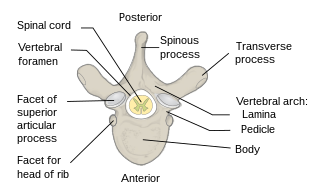
In the vertebrate spinal column, each vertebra is an irregular bone with a complex structure composed of bone and some hyaline cartilage, the proportions of which vary according to the segment of the backbone and the species of vertebrate.
