
Galicia is an autonomous community of Spain and historic nationality under Spanish law. Located in the northwest Iberian Peninsula, it includes the provinces of A Coruña, Lugo, Ourense, and Pontevedra.

Santiago de Compostela, simply Santiago, or Compostela, in the province of A Coruña, is the capital of the autonomous community of Galicia, in northwestern Spain. The city has its origin in the shrine of Saint James the Great, now the Cathedral of Santiago de Compostela, as the destination of the Way of St. James, a leading Catholic pilgrimage route since the 9th century. In 1985, the city's Old Town was designated a UNESCO World Heritage Site.

Ruthenia is an exonym, originally used in Medieval Latin, as one of several terms for Kievan Rus'. It is also used to refer to the East Slavic and Eastern Orthodox regions of the Grand Duchy of Lithuania and the Kingdom of Poland, and later the Polish-Lithuanian Commonwealth, corresponding to the territories of modern Belarus, Ukraine, and some of western Russia. Historically, the term was used to refer to all the territories of the East Slavs.

Bukovina is a historical region in Eastern Europe. The region is located on the northern slopes of the central Eastern Carpathians and the adjoining plains, today divided between Romania and Ukraine.
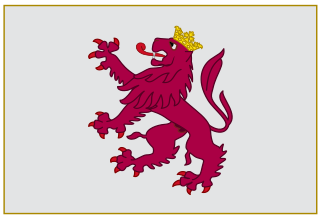
The Kingdom of León was an independent kingdom situated in the northwest region of the Iberian Peninsula. It was founded in 910 when the Christian princes of Asturias along the northern coast of the peninsula shifted their capital from Oviedo to the city of León. The kings of León fought civil wars, wars against neighbouring kingdoms, and campaigns to repel invasions by both the Moors and the Vikings, all in order to protect their kingdom's changing fortunes.

Red Ruthenia, or Red Rus' , is a term used since the Middle Ages for the south-western principalities of the Kievan Rus', namely the Principality of Peremyshl and the Principality of Belz. Nowadays the region comprises parts of western Ukraine and adjoining parts of south-eastern Poland. It has also sometimes included parts of Lesser Poland, Podolia, Right-bank Ukraine and Volhynia. Centred on Przemyśl and Belz, it has included major cities such as: Chełm, Zamość, Rzeszów, Krosno and Sanok, as well as Lviv and Ternopil.

Galicia is a historical and geographic region spanning what is now southeastern Poland and western Ukraine, long part of the Polish–Lithuanian Commonwealth. It covers much of the other historic regions of Red Ruthenia and Lesser Poland.

Ternopil Oblast, also referred to as Ternopilshchyna or Ternopillia, is an oblast (province) of Ukraine. Its administrative center is Ternopil, through which flows the Seret, a tributary of the Dniester. Population: 1,021,713.

Galician–Portuguese, also known as Old Galician–Portuguese, Old Galician or Old Portuguese, Medieval Galician or Medieval Portuguese when referring to the history of each modern language, was a West Iberian Romance language spoken in the Middle Ages, in the northwest area of the Iberian Peninsula. Alternatively, it can be considered a historical period of the Galician, Fala, and Portuguese languages.

Lugo is a city in northwestern Spain in the autonomous community of Galicia. It is the capital of the province of Lugo. The municipality had a population of 100,060 in 2024, making it the fourth most populous city in Galicia.

The Principality or, from 1253, Kingdom of Galicia–Volhynia, also known as the Kingdom of Ruthenia, was a medieval state in Eastern Europe which existed from 1199 to 1349. Its territory was predominantly located in modern-day Ukraine, with parts in Belarus, Poland, Moldova, and Lithuania. Along with Novgorod and Vladimir-Suzdal, it was one of the three most important powers to emerge from the collapse of Kievan Rus'.

The Iberian Peninsula, where Galicia is located, has been inhabited for at least 500,000 years, first by Neanderthals and then by modern humans. From about 4500 BC, it was inhabited by a megalithic culture, which entered the Bronze Age about 1500 BC. These people would become the Gallaeci, and they would be conquered by the Roman Empire in the first and second centuries AD. As the Roman Empire declined, Galicia would be conquered and ruled by various Germanic tribes, notably the Suebi and Visigoths, until the 9th century. Then the Muslim conquest of Iberia reached Galicia, although they never quite controlled the area.
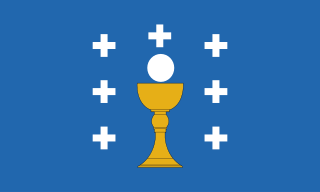
The Kingdom of Galicia was a political entity located in southwestern Europe, which at its territorial zenith occupied the entire northwest of the Iberian Peninsula. It was founded by the Suebic king Hermeric in 409, with its capital established in Braga. It was the first kingdom that officially adopted Catholicism. In 449, it minted its own currency. In 585, it became a part of the Visigothic Kingdom. In the 8th century, Galicia became a part of the newly founded Christian Kingdom of Asturias, which later became the Kingdom of León, while occasionally achieving independence under the authority of its own kings. Compostela became the capital of Galicia in the 11th century, while the independence of Portugal (1128) determined its southern boundary. The accession of Castilian King Ferdinand III to the Leonese kingdom in 1230 brought Galicia under the control of the Crown of Castile.

A parroquia is a population entity or parish found in the autonomous communities of Galicia and Asturias in northwestern Spain. They are entities with a territorial scope lower than municipality and have their own legal personality. They usually, but not always, coincide with the ecclesiastic divisions, as they originated on par with them.

Castro culture is the archaeological term for the material culture of the northwestern regions of the Iberian Peninsula from the end of the Bronze Age until it was subsumed by Roman culture. It is the culture associated with the Gallaecians and Astures.
Mondariz–Balneario is a spa town and municipality in Galicia, Spain. Originally, a simple parish (Troncoso) of the neighbouring town of Mondariz, it grew into a spa town in the late 19th century following the popularisation of its water which was reputed to have medicinal qualities. It has the distinction of being the smallest municipality in Galicia and one of the smallest in Spain with an area of 2.4 km2.

Cambre is a municipality in the Province of A Coruña, in the autonomous community of Galicia in northwestern Spain. It is located 12 km from the capital city of A Coruña and ten minutes away from the city's airport, Alvedro.

A palloza is a traditional dwelling of the Serra dos Ancares of northwest Spain.

Vilasantar is a municipality of northwestern Spain in the province of A Coruña in the autonomous community of Galicia. It belongs to the comarca of Betanzos.

The Galicia–North Portugal Euroregion is a cross-border Euroregion straddling Galicia (Spain) and the North Region (Portugal). It was established in 2008.

