The music of Hawaii includes an array of traditional and popular styles, ranging from native Hawaiian folk music to modern rock and hip hop. Hawaii's musical contributions to the music of the United States are out of proportion to the state's small size. Styles like slack-key guitar are well-known worldwide, while Hawaiian-tinged music is a frequent part of Hollywood soundtracks. Hawaii also made a contribution to country music with the introduction of the steel guitar. In addition, the music which began to be played by Puerto Ricans in Hawaii in the early 1900s is called cachi cachi music, on the islands of Hawaii.

The music of Oregon reflects the diverse array of styles present in the music of the United States, from Native American music to the contemporary genres of rock and roll, country, rhythm and blues, jazz, pop, electronic music, and hip hop. However, throughout most of its history, the state has been relatively isolated from the cultural forces shaping American music. Much of modern popular music traces its roots to the emergence in the late 19th century of African American blues and the growth of gospel music in the 1920s. African American musicians borrowed elements of European and Indigenous musics to create new American forms. As Oregon's population was more homogeneous and more white than the United States as a whole, the state did not play a significant role in this history.

Philip Kunia Pahinui was a slack-key guitarist and singer of Hawaiian music.

The Kingston Trio is an American folk and pop music group that helped launch the folk revival of the late 1950s to late 1960s. The group started as a San Francisco Bay Area nightclub act with an original lineup of Dave Guard, Bob Shane, and Nick Reynolds. It rose to international popularity, fueled by unprecedented sales of LP records, and helped alter the direction of popular music in the U.S.
Alex Hassilev is an American folk musician who was one of the founding members of the group The Limeliters and produced the rock album The Zodiac: Cosmic Sounds. He was educated at Harvard and the University of Chicago. He is an actor with a number of film and television appearances to his credit. He is a musician, switching from the guitar to the banjo. He speaks fluent French, Russian and Spanish and has contributed many foreign language songs to the Limeliters' repertoire.

Glenn Robertson Yarbrough was an American folk singer and guitarist. He was the lead singer (tenor) with the Limeliters from 1959 to 1963. He also had a prolific solo career, recording on various labels.

The Limeliters are an American folk music group, formed in July 1959 by Lou Gottlieb, Alex Hassilev (banjo/baritone), and Glenn Yarbrough (guitar/tenor). The group was active from 1959 until 1965, when they disbanded. After a hiatus of sixteen years Yarbrough, Hassilev, and Gottlieb reunited and began performing again as The Limeliters in reunion tours. On a regular basis a continuation The Limeliters group is still active and performing. Gottlieb died in 1996, Yarbrough died in 2016 and Hassilev, the last founding member who had remained active in the group, has retired, leaving the group to carry on without any of the original members.

Samuel Robert Gibson was an American folk singer and a key figure in the folk music revival in the late 1950s and early 1960s. His principal instruments were banjo and 12-string guitar. He introduced a then-unknown Joan Baez at the Newport Folk Festival of 1959. He produced a number of LPs in the decade from 1956 to 1965. His best known album, Gibson & Camp at the Gate of Horn, was released in 1961. His songs have been recorded by, among others, the Limeliters, Peter, Paul and Mary, Simon & Garfunkel, the Byrds, the Smothers Brothers, Phil Ochs, and the Kingston Trio. His career was interrupted by his addiction to drugs and alcohol. After getting sober he attempted a comeback in 1978, but the musical scene had changed and his traditional style of folk music was out of favor with young audiences. He did, however, continue his artistic career with albums, musicals, plays, and television performances. In 1993 he was diagnosed with progressive supranuclear palsy (PSP), and died of that disease at the age of 64.
Donald David Guard was an American folk singer, songwriter, arranger and recording artist. Along with Nick Reynolds and Bob Shane, he was one of the founding members of The Kingston Trio.
Louis Gottlieb credited as Lou Gottlieb, was bassist and comic spokesman for music trio The Limeliters. He held a Ph.D. in musicology and was considered one of the so-called "new comedy" performers, a new generation of unabashed intellectuals that also included Mort Sahl, Nichols and May, and Lenny Bruce.
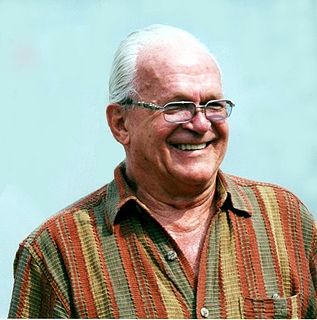
Robert Castle Schoen, known professionally as Bob Shane, is an American singer and guitarist and, with Nick Reynolds' death in October 2008, the only surviving founding member of The Kingston Trio. In that capacity, Shane became a seminal figure in the revival of folk and other acoustic music as a popular art form in the U.S. in the late 1950s through the mid-1960s.

Nicholas Wells Reynolds was an American folk musician and recording artist. Reynolds was one of the founding members of The Kingston Trio, whose folk and folk-style material captured international attention during the late Fifties and early Sixties.
The American folk-music revival began during the 1940s and peaked in popularity in the mid-1960s. Its roots went earlier, and performers like Josh White, Burl Ives, Woody Guthrie, Lead Belly, Big Bill Broonzy, Richard Dyer-Bennet, Oscar Brand, Jean Ritchie, John Jacob Niles, Susan Reed, Paul Robeson and Cisco Houston had enjoyed a limited general popularity in the 1930s and 1940s. The revival brought forward styles of American folk music that had, in earlier times, contributed to the development of country and western, jazz, and rock and roll music.
The Whiskeyhill Singers were formed in early 1961 by Dave Guard after he left The Kingston Trio. Guard formed the Singers as an attempt to return to the Trio's earlier roots in folk music. The Singers lasted about six months before disbanding. During that short period the group released one album, Dave Guard & The Whiskeyhill Singers, and recorded a number of songs for the soundtrack of How the West Was Won, but only four of these were used in the movie.

Contemporary folk music refers to a wide variety of genres that emerged in the mid 20th century and afterwards which were associated with traditional folk music. Starting in the mid-20th century a new form of popular folk music evolved from traditional folk music. This process and period is called the (second) folk revival and reached a zenith in the 1960s. The most common name for this new form of music is also "folk music", but is often called "contemporary folk music" or "folk revival music" to make the distinction. The transition was somewhat centered in the US and is also called the American folk music revival. Fusion genres such as folk rock, folktronica, and others also evolved within this phenomenon. While contemporary folk music is a genre generally distinct from traditional folk music, it often shares the same English name, performers and venues as traditional folk music; even individual songs may be a blend of the two.
Eugene Raskin or Gene Raskin, was an American musician and playwright, author of the lyrics of the English version of the Russian song "Those Were the Days" and also of three books on architecture and adjunct professor at Columbia University (1936–1976).
Lionel Joaquin Paul Long, OAM was an Australian country and folk singer, songwriter, guitarist, actor and artist.
A sampler is a type of compilation album generally offered at a reduced price to showcase a selection of artists signed to a particular record label. The format became popular in the late 1960s as record labels sought to promote artists whose works were primarily available in album rather than single format, and therefore had little opportunity to gain exposure through singles-dominated radio airplay. Most samplers showcased already-released material, so that as they sampled artists they also sampled the albums from which their tracks were drawn. The term 'album sampler' is also used in cases where an album is distributed among multiple records in case of, for example, vinyl where the maximum play time is less than the length of the full album. In these cases, album sampler titles may be added to each vinyl.

The Limeliters Reunion, Vol. 2 is an album released by The Limeliters in 1976 on Brass Dolphin LP record 2202. Recorded live on September 28, 1976 in the Seattle Opera House, the album documents one of the yearly reunion concerts given by the Limeliters in that decade. Vol. 1 contained new material, whereas this album was a tribute to the “folk mania” of the 1960s.


