
Mauritius, officially the Republic of Mauritius, is an island nation in the Indian Ocean about 2,000 kilometres off the southeast coast of the African continent, east of Madagascar. It includes the main island, as well as Rodrigues, Agaléga and St. Brandon. The islands of Mauritius and Rodrigues, along with nearby Réunion, are part of the Mascarene Islands. The main island of Mauritius, where most of the population is concentrated, hosts the capital and largest city, Port Louis. The country spans 2,040 square kilometres (790 sq mi) and has an exclusive economic zone covering 2,300,000 square kilometres.
The known history of Mauritius begins with its discovery by Arabs and Malays, followed by Europeans and its appearance on maps in the early 16th century. Mauritius was successively colonized by the Netherlands, France and Great Britain, and became independent in 12th March 1968.
Port Louis is the capital city of Mauritius. It is mainly located in the Port Louis District, with a small western part in the Black River District. Port Louis is the country's economic, cultural and political centre, and most populous city. It is administered by the Municipal City Council of Port Louis. According to the 2012 census conducted by Statistics Mauritius, the population was 147,066.

Curepipe also known as La Ville-Lumière, is a town in Mauritius, located in the Plaines Wilhems District, the eastern part also lies in the Moka District. The town is administered by the Municipal Council of Curepipe. Curepipe lies at a higher elevation, often referred to as the "Central Plateau". According to the census made by Statistics Mauritius in 2018, the population of the town was at 78,618.
Mauritius is a multi-ethnic and multi-language society; it is also a plural society with its population mainly composed of four ethnic groups and four major religious groups; it is often depicted as a "rainbow nation". The island of Mauritius did not have any indigenous population; historically, it was characterized by successive waves of European colonization and multiple immigrations. Under the French rule between 1715 and 1810, slaves were imported on the island from mainland Africa and Madagascar; slavery were only abolished in 1835 under the British rule. Indian migrants from Pondicherry first came in Mauritius under the French rule in 1736; The 18th century also saw one the earliest influx of Chinese migrants in Mauritius, who mostly came from Fujian. Under the British rule, more Indian migrants came to Mauritius following the slave emancipation of 1835. Since the 1800s Chinese migrants from Southern China arrived in Mauritius since the 1800s first as indentured labourers and later as free merchants. Since 1860, Hakka immigration started and continued until they become the dominant Chinese population in Mauritius since the beginning of the 20th century. The co-existence of Mauritians of Indian, African, European, and Chinese ancestry eventually led to a sharing of values and cultures, a collective participation in festivals, and an increased understanding between people of different ethnic backgrounds. Mauritians from different cultural backgrounds are very distinct from each other, and it is also highly unpopular to encourage the dissolution of cultural boundaries in Mauritius. In present days, the Mauritian society continues to be culturally and linguistically French-dominated.

Sir Seewoosagur Ramgoolam was a Mauritian physician, politician, and statesman. He served as the island's only chief minister, first prime minister, and fifth governor-general.
Mauritians of Chinese origin, also known as Sino-Mauritians or Chinese Mauritians, are Mauritians who trace their ethnic ancestry to China.

The Sir Seewoosagur Ramgoolam Botanic Garden, commonly known as the Pamplemousses Botanic Garden, is a popular tourist attraction in Pamplemousses, near Port Louis, Mauritius, and the oldest botanical garden in the Southern Hemisphere. Famous for its long pond of giant water lilies, the garden was first constructed by Pierre Poivre in 1770, and it covers an area of around 37 hectares.
The wildlife of Mauritius consists of its flora and fauna. Mauritius is located in the Indian Ocean to the east of Madagascar. Due to its isolation, it has a relatively low diversity of wildlife; however, a high proportion of these are endemic species occurring nowhere else in the world. Many of these are now threatened with extinction because of human activities including habitat destruction and the introduction of non-native species. Some have already become extinct, most famously the dodo which disappeared in the 17th century.

Antoine Zacharie Adrien d'Épinay was a Franco-Mauritian lawyer, politician and slave-owner.
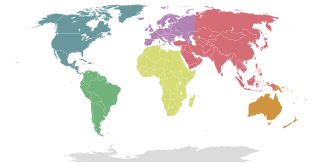
Christianity is the religion adhered to by 20.7 per cent of the population of Mauritius. Of these, 80.3 per cent are Roman Catholics. The Mauritian Creole and Franco-Mauritian ethnic groups are mostly Christian and significant parts of the Sino-Mauritian ethnic group are also mainly Christian. Mauritius got independence in 1968 and there was no state religion in Mauritius defined in the constitution. The religious organizations present at the time of independence, namely, Roman Catholic Church, Church of England, Presbyterian Church, Seventh-day Adventist, Hindus and Muslims are recognized by parliamentary decree.

The Constitution of Mauritius mentions no official language. It only contains a statement in Article 49 that "The official language of the Assembly shall be English but any member may address the chair in French" implying that English and French are official languages of the National Assembly (parliament). It is only in the Parliament that the official language is English but any member of the National Assembly can still address the chair in French. English and French are generally accepted as the official languages of Mauritius and as the languages of government administration and the court business, while the lingua franca is Creole.

The cuisine of Mauritius is influenced by the tropical location of the island as well as the cultural diversity which characterizes the country. Mauritian cuisine is a blend of African, Chinese, European and Indian influences in the history of Mauritius. Most of the dishes and practices into the culinary traditions are inspired by French culture, former African slaves, and Indian workers and Chinese migrants arriving during the 19th century. Over the years, communities found in Mauritius have adapted and mixed each other's cuisine to their liking, resulting in the development of Mauritian cuisine. While some popular dishes and desserts are consumed by Mauritians of all ethnic groups or communities, there are also form of cuisines which remain distinctly ethnic and are unique to a specific ethnic community due to their ancestral cultural and historical connections. Local food which varies depending on ethnic communities therefore reflects the strong traditional, cultural, and historical influences of each community.
Mauritius is a religiously diverse nation, with Hinduism being the most widely professed faith. People of Indian descent (Indo-Mauritian) follow mostly Hinduism and Islam. The Franco-Mauritians, Creoles and Sino-Mauritians follow Christianity. A minority of Sino-Mauritians also follow Buddhism and other Chinese-related religions. According to the 2011 census made by Statistics Mauritius, Hinduism is the major religion at 48.54%, followed by Christianity at 32.71%, followed by Islam 17.30% and Buddhism 0.18% in terms of number of adherents.
The following is a timeline of the history of the city of Port Louis on the island of Mauritius.
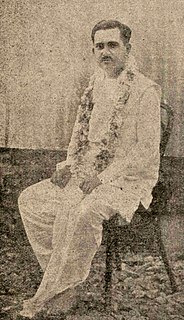
Basdeo Bissoondoyal was a Mauritian social worker, educator and writer who played an important role in the pre-Independence politics and independence movement on the island of Mauritius. He is also sometimes referred to as "Pandit Basdeo Bissoondoyal" or "Professor Basdeo Bissoondoyal".
Sir Virgile Naz (1825-1901) was a Mauritian lawyer, businessman and politician who was elected in British Mauritius to the Council of the Government of Mauritius, the predecessor of modern-day National Assembly or Parliament.

Mauritian nationality law is regulated by the Constitution of Mauritius, as amended; the Mauritius Citizenship Act, and its revisions; and various international agreements to which the country is a signatory. These laws determine who is, or is eligible to be, a national of Mauritius. The legal means to acquire nationality, formal legal membership in a nation, differ from the domestic relationship of rights and obligations between a national and the nation, known as citizenship. Nationality describes the relationship of an individual to the state under international law, whereas citizenship is the domestic relationship of an individual within the nation. In Britain and thus the Commonwealth of Nations, though the terms are often used synonymously outside of law, they are governed by different statutes and regulated by different authorities. Mauritian nationality is typically obtained under the principle of jus sanguinis, i.e. by birth in Mauritius or abroad to parents with Mauritian nationality. It can be granted to persons with an affiliation to the country, or to a permanent resident who has lived in the country for a given period of time through naturalisation.

Pierre Léoville Arthur L'Homme (1857–1928) was a Mauritian poet, literary critic, journalist, newspaper editor and librarian who wrote in French. He is considered the foremost Mauritian poet of the late nineteenth century and the first Mauritian writer to produce an extensive body of work and to establish an overseas literary reputation.

