
David Hume was a Scottish Enlightenment philosopher, historian, economist, and essayist, who is best known today for his highly influential system of philosophical empiricism, scepticism, and naturalism. Hume's empiricist approach to philosophy places him with John Locke, George Berkeley, Francis Bacon and Thomas Hobbes as a British Empiricist. Beginning with his A Treatise of Human Nature (1739–40), Hume strove to create a total naturalistic science of man that examined the psychological basis of human nature. Against philosophical rationalists, Hume held that passion rather than reason governs human behaviour. Hume argued against the existence of innate ideas, positing that all human knowledge is founded solely in experience.

John Locke was an English philosopher and physician, widely regarded as one of the most influential of Enlightenment thinkers and commonly known as the "Father of Liberalism". Considered one of the first of the British empiricists, following the tradition of Sir Francis Bacon, he is equally important to social contract theory. His work greatly affected the development of epistemology and political philosophy. His writings influenced Voltaire and Jean-Jacques Rousseau, many Scottish Enlightenment thinkers, as well as the American revolutionaries. His contributions to classical republicanism and liberal theory are reflected in the United States Declaration of Independence.
Natural theology, once also termed physico-theology, is a type of theology that provides arguments for the existence of God based on reason and ordinary experience of nature.
In economics, Gresham's law is a monetary principle stating that "bad money drives out good". For example, if there are two forms of commodity money in circulation, which are accepted by law as having similar face value, the more valuable commodity will gradually disappear from circulation.

Jean-Baptiste Say was a French economist and businessman who had liberal views and argued in favor of competition, free trade and lifting restraints on business. He is best known for Say's law—also known as the law of markets—which he popularized. Scholars disagree on the surprisingly subtle question of whether it was Say who first stated what is now called Say's law. Moreover, he was one of the first economists to study entrepreneurship and conceptualized entrepreneurs as organizers and leaders of the economy.

Representative money is any medium of exchange, often printed on paper, that represents something of value, but has little or no value of its own. Unlike some forms of fiat money, genuine representative money must have something of intrinsic value supporting the face value.

Sir William PettyFRS was an English economist, physician, scientist and philosopher. He first became prominent serving Oliver Cromwell and the Commonwealth in Ireland. He developed efficient methods to survey the land that was to be confiscated and given to Cromwell's soldiers. He also remained a significant figure under King Charles II and King James II, as did many others who had served Cromwell.

Two Treatises of Government is a work of political philosophy published anonymously in 1689 by John Locke. The First Treatise attacks patriarchalism in the form of sentence-by-sentence refutation of Robert Filmer's Patriarcha, while the Second Treatise outlines Locke's ideas for a more civilized society based on natural rights and contract theory.
The general price level is a hypothetical measure of overall prices for some set of goods and services, in an economy or monetary union during a given interval, normalized relative to some base set. Typically, the general price level is approximated with a daily price index, normally the Daily CPI. The general price level can change more than once per day during hyperinflation.
The Treatise on Invertebrate Paleontology published by the Geological Society of America and the University of Kansas Press, is a definitive multi-authored work of some 50 volumes, written by more than 300 paleontologists, and covering every phylum, class, order, family, and genus of fossil and extant invertebrate animals. The prehistoric invertebrates are described as to their taxonomy, morphology, paleoecology, stratigraphic and paleogeographic range. However, taxa with no fossil record whatsoever have just a very brief listing.
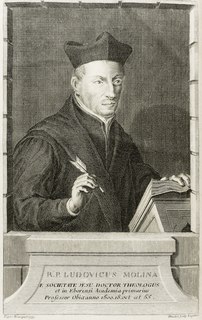
Luis de Molina was a Spanish Jesuit priest and scholastic, a staunch defender of free will in the controversy over human liberty and God's grace. His theology is known as Molinism.
Gibson's Paradox is the observation that the rate of interest and the general level of prices are positively correlated. It is named for British economist Alfred Herbert Gibson who noted the correlation in a 1923 article for Banker's Magazine. The correlation had been noted earlier by Thomas Tooke.

On the Jews and Their Lies is a 65,000-word anti-Judaic treatise written in 1543 by the German Reformation leader Martin Luther (1483-1546).

Prize is a term used in admiralty law to refer to equipment, vehicles, vessels, and cargo captured during armed conflict. The most common use of prize in this sense is the capture of an enemy ship and her cargo as a prize of war. In the past, the capturing force would commonly be allotted a share of the worth of the captured prize. Nations often granted letters of marque that would entitle private parties to capture enemy property, usually ships. Once the ship was secured on friendly territory, she would be made the subject of a prize case, an in rem proceeding in which the court determined the status of the condemned property and the manner in which the property was to be disposed of.
A legal treatise is a scholarly legal publication containing all the law relating to a particular area, such as criminal law or trusts and estates. There is no fixed usage on what books qualify as a "legal treatise", with the term being used broadly to define books written for practicing attorneys and judges, textbooks for law students, and explanatory texts for laypersons. The treatise may generally be loose leaf bound with rings or posts so that updates to laws covered by the treatise and annotated by the editor may be added by the subscriber to the legal treatise.
A treatise is a formal and systematic written discourse on some subject, generally longer and treating it in greater depth than an essay, and more concerned with investigating or exposing the principles of the subject.
John Bridges (1536–1618) was an English bishop.
A Treatise on Money is a work on economics by English economist John Maynard Keynes.
Symmachus ben Joseph was a Jewish Tanna sage of the fifth generation.
In macroeconomics, chartalism is a theory of money that argues that money originated with states' attempts to direct economic activity rather than as a spontaneous solution to the problems with barter or as a means with which to tokenize debt, and that fiat currency has value in exchange because of sovereign power to levy taxes on economic activity payable in the currency they issue.
