
The Treaty of Versailles was the most important of the peace treaties that brought World War I to an end. The Treaty ended the state of war between Germany and the Allied Powers. It was signed on 28 June 1919 in Versailles, exactly five years after the assassination of Archduke Franz Ferdinand, which had directly led to the war. The other Central Powers on the German side signed separate treaties. Although the armistice, signed on 11 November 1918, ended the actual fighting, it took six months of Allied negotiations at the Paris Peace Conference to conclude the peace treaty. The treaty was registered by the Secretariat of the League of Nations on 21 October 1919.
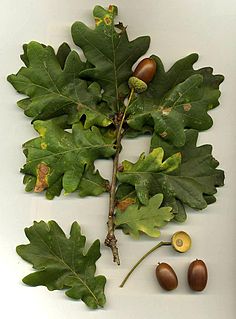
An oak is a tree or shrub in the genus Quercus of the beech family, Fagaceae. There are approximately 500 extant species of oaks. The common name "oak" also appears in the names of species in related genera, notably Lithocarpus, as well as in those of unrelated species such as Grevillea robusta and the Casuarinaceae (she-oaks). The genus Quercus is native to the Northern Hemisphere, and includes deciduous and evergreen species extending from cool temperate to tropical latitudes in the Americas, Asia, Europe, and North Africa. North America contains the largest number of oak species, with approximately 90 occurring in the United States, while Mexico has 160 species of which 109 are endemic. The second greatest center of oak diversity is China, which contains approximately 100 species.
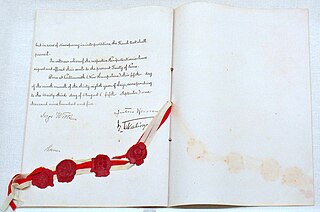
The Treaty of Portsmouth formally ended the 1904–05 Russo-Japanese War. It was signed on September 5, 1905, after negotiations from August 6 to August 30, at the Portsmouth Naval Shipyard in Kittery, Maine, United States. U.S. President Theodore Roosevelt was instrumental in the negotiations and won the Nobel Peace Prize for his efforts.

Orleans County is a county in the western part of the U.S. state of New York. As of the 2010 census, the population was 42,883. The county seat is Albion. The county received its name at the insistence of Nehemiah Ingersoll though historians are unsure how the name was selected. The two competing theories are that it was named to honor the French Royal House of Orleans or that it was to honor Andrew Jackson's victory in New Orleans.
The Treaty of Paris, signed in Paris by representatives of King George III of Great Britain and representatives of the United States of America on September 3, 1783, officially ending the American Revolutionary War. The treaty set the boundaries between the British Empire in North America and the United States of America, on lines "exceedingly generous" to the latter. Details included fishing rights and restoration of property and prisoners of war.
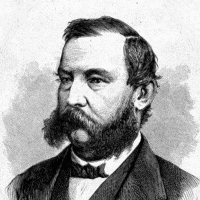
Anson Burlingame was an American lawyer, Republican/American Party legislator, diplomat, and abolitionist. As diplomat, he served as the U.S. minister to China (1862-1867) and then as China's envoy to the U.S., which resulted in the 1868 landmark Burlingame Treaty.
Ratification is a principal's approval of an act of its agent that lacked the authority to bind the principal legally. Ratification defines the international act in which a state indicates its consent to be bound to a treaty if the parties intended to show their consent by such an act. In the case of bilateral treaties, ratification is usually accomplished by exchanging the requisite instruments, and in the case of multilateral treaties, the usual procedure is for the depositary to collect the ratifications of all states, keeping all parties informed of the situation.
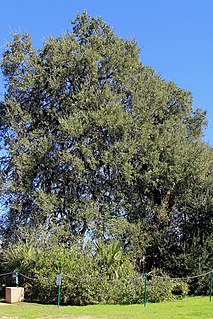
The Treaty Oak is a Texas live oak tree in Austin, Texas, United States, and the last surviving member of the Council Oaks, a grove of 14 trees that served as a sacred meeting place for Comanche and Tonkawa tribes prior to European settlement of the area. Foresters estimate the Treaty Oak to be about 500 years old. Before its vandalism in 1989, the tree's branches had a spread of 127 feet (39 m). The tree is located in Treaty Oak Park, on Baylor Street between 5th and 6th Streets, in Austin's West Line Historic District.

The Blue Ridge Mountains are a physiographic province of the larger Appalachian Mountains range. The mountain range is located in the eastern United States, and extends 550 miles southwest from southern Pennsylvania through Maryland, West Virginia, Virginia, North Carolina, South Carolina, Tennessee, and Georgia. This province consists of northern and southern physiographic regions, which divide near the Roanoke River gap. To the west of the Blue Ridge, between it and the bulk of the Appalachians, lies the Great Appalachian Valley, bordered on the west by the Ridge and Valley province of the Appalachian range.
Unequal treaty is the name given by the Chinese to a series of treaties signed between the Qing dynasty and various Western powers, Russia, and the Empire of Japan during the 19th and early 20th centuries. The agreements, often reached after a military defeat, contained one-sided terms requiring China to cede land, pay reparations, open treaty ports, or grant extraterritorial privileges to foreign citizens.
Thomas Pell, 1st Lord of Pelham Manor was an English-born physician who bought the area known as Pelham, New York, as well as land that now includes the eastern Bronx and southern Westchester County, New York, and founded the town of Westchester at the head of navigation on Westchester Creek in 1654.

The Treaty Oak is an octopus-like Southern live oak in Jacksonville, Florida. The tree is estimated to be 250 years old and may be the single oldest living thing in Jacksonville, predating the founding of the city by Isaiah Hart during the 1820s. It is located in Treaty Oak Park in the Southbank area of Downtown Jacksonville.
The Siwanoy were the Indigenous Americans of Long Island Sound along the coasts of The Bronx, Westchester County, New York, and Fairfield County, Connecticut. They were one of the western bands of the Wappinger Confederacy. By 1640, their territory (Wykagyl) extended from Hell Gate to Norwalk, Connecticut, and as far inland as White Plains, New York, and became hotly contested between Dutch and English colonial interests. The name Siwanoy may be a corruption of Siwanak, "salt people".

The Occupation of Alcatraz was a 19-month long protest when 89 American Indians and their supporters occupied Alcatraz Island. The protest was led by Richard Oakes, LaNada Means, and others; John Trudell was the spokesman. This group lived on the island together until the protest was forcibly ended by the U.S. government.
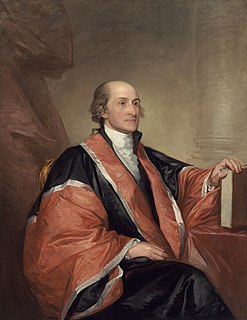
John Jay was an American statesman, patriot, diplomat, Founding Father, abolitionist, negotiator, and signatory of the Treaty of Paris of 1783. He served as the second Governor of New York and the first Chief Justice of the United States (1789–1795). He directed U.S. foreign policy for much of the 1780s and was an important leader of the Federalist Party after the ratification of the United States Constitution in 1788.

Comanche Territory is a 1950 American Western film directed by George Sherman and starring Maureen O'Hara and Macdonald Carey. Jim Bowie is sent into Comanche country by the government on a mission to draw up a treaty allowing the government to mine silver on the Indian's turf. Filming was done in and around the Oak Creek Canyon area of Arizona.
Treaty of Big Tree was a formal treaty signed in 1797 between the Seneca Nation and the United States in which the Seneca relinquished their rights to nearly all of their traditional homeland in New York State— nearly 3.5 million acres. In the 1788 Phelps and Gorham Purchase the Iroquois had previously sold rights to their land between Seneca Lake and the Genesee River. The Treaty of Big Tree signed away their rights to all their territory west of the Genesee River except ten small tracts of land for $100,000 and other considerations. The money was not paid directly to the tribe, but was to be invested in shares of the Bank of the United States, and to be paid out to the Senecas in annual earnings of up to six percent, or $6,000 a year, on the bank stock.
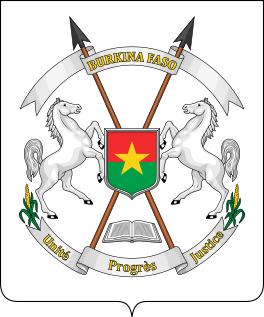
Human rights in Burkina Faso are addressed in the constitution. The 2009 Human Rights Report by the United States Department of State noted concerns regarding restrictions on the press and the operation of the judiciary system.
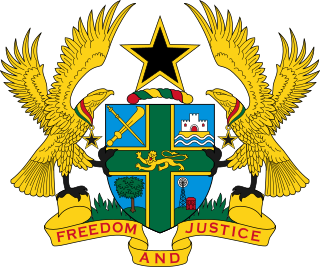
Human rights are "rights and freedoms to which all humans are entitled". Proponents of the concept usually assert that everyone is endowed with certain entitlements merely by reason of being human.

In Slavic mythology, Perun is the highest god of the pantheon and the god of sky, thunder, lightning, storms, rain, law, war, fertility and oak trees. His other attributes were fire, mountains, wind, iris, eagle, firmament, horses and carts, weapons, and war. He was first associated with weapons made of stone and later with those of metal.
