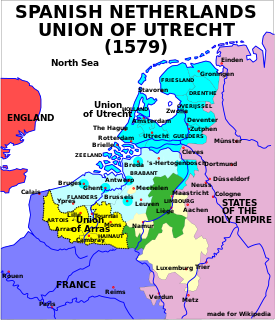
The Union of Utrecht was a treaty signed on 23 January 1579 in Utrecht, the Netherlands, unifying the northern provinces of the Netherlands, until then under the control of Habsburg Spain.

Antwerp Province is the northernmost province both of the Flemish Region, also called Flanders, and of Belgium. It borders on North Brabant province of the Netherlands and the Belgian provinces of Limburg, Flemish Brabant and East Flanders. Its capital is Antwerp which comprises the Port of Antwerp. It has an area of 2,867 km2 (1,107 sq mi) and with over 1.84 million inhabitants in January 2018, it is the country's most populous province. The province consists of 3 arrondissements: Antwerp, Mechelen and Turnhout. The eastern part of the province comprises the main part of the Campine region.

The Scheldt is a 350-kilometre (220 mi) long river in northern France, western Belgium, and the southwestern part of the Netherlands. Its name is derived from an adjective corresponding to Old English sceald ("shallow"), Modern English shoal, Low German schol, West Frisian skol, and Swedish (obsolete) skäll ("thin").
The Seventeen Provinces were the Imperial states of the Habsburg Netherlands in the 16th century. They roughly covered the Low Countries, i.e. what is now the Netherlands, Belgium, Luxembourg, and most of the French departments of Nord and Pas-de-Calais (Artois). Also within this area were semi-independent fiefdoms, mainly ecclesiastical ones, such as Liège, Cambrai and Stavelot-Malmedy.
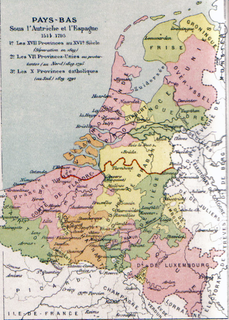
The Southern Netherlands, also called the Catholic Netherlands, was the part of the Low Countries largely controlled by Spain (1556–1714), later Austria (1714–1794), and occupied then annexed by France (1794–1815). The region also included a number of smaller states that were never ruled by Spain or Austria: the Prince-Bishopric of Liège, the Imperial Abbey of Stavelot-Malmedy, the County of Bouillon, the County of Horne and the Princely Abbey of Thorn. The Southern Netherlands were part of the Holy Roman Empire until the whole area was annexed by Revolutionary France.
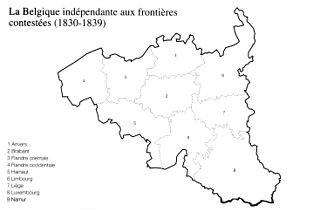
The Treaty of London of 1839, also called the First Treaty of London, the Convention of 1839, the Treaty of Separation, the Quintuple Treaty of 1839, or the Treaty of the XXIV articles, was a treaty signed on 19 April 1839 between the Concert of Europe, the United Kingdom of the Netherlands and the Kingdom of Belgium. It was a direct follow-up to the 1831 Treaty of the XVIII Articles which the Netherlands had refused to sign, and the result of negotiations at the London Conference of 1838–1839.

Francis, Duke of Anjou and Alençon was the youngest son of King Henry II of France and Catherine de' Medici.

The Belgian Revolution was the conflict which led to the secession of the southern provinces from the United Kingdom of the Netherlands and the establishment of an independent Kingdom of Belgium.
The Iron Rhine or Steel Rhine is a partially nonoperational freight railway connecting the port of Antwerp (Belgium) and Mönchengladbach (Germany) by way of Neerpelt and the Dutch towns of Weert and Roermond.
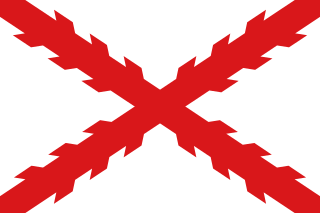
Spanish Netherlands was the name for the Habsburg Netherlands ruled by the Spanish branch of the Habsburgs from 1556 to 1714. They were a collection of States of the Holy Roman Empire in the Low Countries held in personal union by the Spanish Crown. This region comprised most of the modern states of Belgium and Luxembourg, as well as parts of northern France, southern Netherlands, and western Germany with the capital being Brussels.
The Treaty of Nonsuch was signed on 19 August 1585 by Elizabeth I of England and the Dutch rebels fighting against Spanish rule. It was the first international treaty signed by what would become the Dutch Republic. It was signed at Nonsuch Palace, England.

Royal Antwerp Football Club, often simply referred to as Antwerp, is a Belgian football club based in the city of Antwerp.

The Ostend Company was a chartered trading company in the Austrian Netherlands which was established in 1722 to trade with the East and West Indies. No Austrians were involved or employed.

In 926 a battle was fought in the Bosnian highlands between the armies of the Bulgarian Empire, under the rule of Bulgarian Tsar Simeon I, who at the time also fought a war with the Byzantine Empire, and the Kingdom of Croatia under Tomislav, the first king of the Croatian state. The battle is also known as the Battle of the Bosnian Highlands. It was fought in the mountainous area of Eastern Bosnia near the rivers Bosna and Drina, the border area between the Kingdom of Croatia and the Bulgarian Empire.

The Duchy of Brabant was a State of the Holy Roman Empire established in 1183. It developed from the Landgraviate of Brabant and formed the heart of the historic Low Countries, part of the Burgundian Netherlands from 1430 and of the Habsburg Netherlands from 1482, until it was partitioned after the Dutch revolt.

Saint-Avertin is a commune in the Indre-et-Loire department in central France.

Michel Marie Charles Verlat was a Belgian painter from Antwerp.

Antwerp is a city in Belgium, and is the capital of Antwerp province in Flanders. With a population of 520,504, it is the most populous city proper in Belgium, and with a metropolitan area housing around 1,200,000 people, it's the second largest metropolitan region after Brussels in Belgium.

John Van Antwerp MacMurray was an American attorney, author and diplomat best known as one of the leading China experts in the U.S. government. He served as Assistant Secretary of State from November 1924 to May 1925, and was subsequently appointed Minister to China in 1925. Although MacMurray had coveted the China post, he soon fell into disagreement with the State Department over U.S. policy towards the ruling Kuomintang government. He resigned the position in 1929 and briefly left the foreign service. Following several years in academia, MacMurray returned to the State Department to become Minister to Estonia, Latvia and Lithuania from 1933 to 1936. He later served as ambassador to Turkey from 1936 to 1941, and then was made a special assistant to the Secretary of State until his retirement in 1944.
Events in the year 1866 in Belgium.
