
The Potsdam Agreement was the agreement among three of the Allies of World War II: the United Kingdom, the United States, and the Soviet Union after the war ended in Europe that was signed on 1 August 1945 and it was published the next day. A product of the Potsdam Conference, it concerned the military occupation and reconstruction of Germany, its border, and the entire European Theatre of War territory. It also addressed Germany's demilitarisation, reparations, the prosecution of war criminals and the mass expulsion of ethnic Germans from various parts of Europe. France was not invited to the conference but formally remained one of the powers occupying Germany.

The German Confederation was an association of 39 predominantly German-speaking sovereign states in Central Europe. It was created by the Congress of Vienna in 1815 as a replacement of the former Holy Roman Empire, which had been dissolved in 1806 as a result of the Napoleonic Wars.
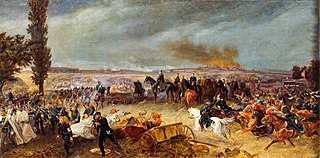
The Austro-Prussian War, also by many variant names such as Seven Weeks' War, German Civil War, Brothers War or Fraternal War, known in Germany as Deutscher Krieg, Deutsch-Deutscher Krieg, Deutscher Bruderkrieg and by a variety of other names, was fought in 1866 between the Austrian Empire and the Kingdom of Prussia, with each also being aided by various allies within the German Confederation. Prussia had also allied with the Kingdom of Italy, linking this conflict to the Third Independence War of Italian unification. The Austro-Prussian War was part of the wider rivalry between Austria and Prussia, and resulted in Prussian dominance over the German states.
The Treaty of Paris, signed on 30 May 1814, ended the war between France and the Sixth Coalition, part of the Napoleonic Wars, following an armistice signed on 23 April between Charles, Count of Artois, and the allies. The treaty set the borders for France under the House of Bourbon and restored territories to other nations. It is sometimes called the First Peace of Paris, as another one followed in 1815.
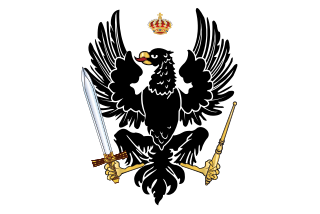
The Kingdom of Prussia constituted the German state of Prussia between 1701 and 1918. It was the driving force behind the unification of Germany in 1866 and was the leading state of the German Empire until its dissolution in 1918. Although it took its name from the region called Prussia, it was based in the Margraviate of Brandenburg. Its capital was Berlin.
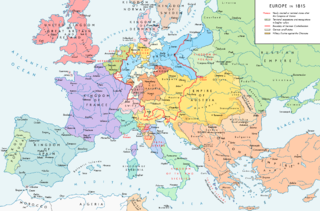
The Concert of Europe was a general agreement among the great powers of 19th-century Europe to maintain the European balance of power, political boundaries, and spheres of influence. Never a perfect unity and subject to disputes and jockeying for position and influence, the Concert was an extended period of relative peace and stability in Europe following the Wars of the French Revolution and the Napoleonic Wars which had consumed the continent since the 1790s. There is considerable scholarly dispute over the exact nature and duration of the Concert. Some scholars argue that it fell apart nearly as soon as it began in the 1820s when the great powers disagreed over the handling of liberal revolts in Italy, while others argue that it lasted until the outbreak of World War I and others for points in between. For those arguing for a longer duration, there is generally agreement that the period after the Revolutions of 1848 and the Crimean War (1853–1856) represented a different phase with different dynamics than the earlier period.

The Treaty of Berlin was signed on 13 July 1878. In the aftermath of the Russian victory against the Ottoman Empire in the Russo-Turkish War of 1877–1878, the major powers restructured the map of the Balkan region. They reversed some of the extreme gains claimed by Russia in the preliminary Treaty of San Stefano, but the Ottomans lost their major holdings in Europe. It was one of three major peace agreements in the period after the 1815 Congress of Vienna. It was the final act of the Congress of Berlin and included the United Kingdom, Austria-Hungary, France, Germany, Italy, Russia and the Ottoman Empire. Chancellor of Germany Otto von Bismarck was the chairman and dominant personality.
Prussia was a German state centred on the North European Plain that originated from the 1525 secularization of the Prussian part of the State of the Teutonic Order. The Knights had to relocate their headquarters to Mergentheim, but still kept their land in Livonia until 1561; they lost all their land by the Napoleonic Wars.
A condominium in international law is a territory in or over which multiple sovereign powers formally agree to share equal dominium and exercise their rights jointly, without dividing it into "national" zones.

The First Schleswig War, also known as the Schleswig-Holstein Uprising and the Three Years' War, was a military conflict in southern Denmark and northern Germany rooted in the Schleswig-Holstein Question: who should control the Duchies of Schleswig, Holstein and Lauenburg, which at the time were ruled by the king of Denmark in a personal union. Ultimately, the Danish side proved victorious with the diplomatic support of the great powers, especially Britain and Russia, since the duchies were close to an important Baltic seaway connecting both powers.
In diplomatic history, the Eastern question was the issue of the political and economic instability in the Ottoman Empire from the late 18th to early 20th centuries and the subsequent strategic competition and political considerations of the European great powers in light of this. Characterized as the "sick man of Europe", the relative weakening of the empire's military strength in the second half of the eighteenth century threatened to undermine the fragile balance of power system largely shaped by the Concert of Europe. The Eastern question encompassed myriad interrelated elements: Ottoman military defeats, Ottoman institutional insolvency, the ongoing Ottoman political and economic modernization programme, the rise of ethno-religious nationalism in its provinces, and Great Power rivalries. In an attempt to triangulate between these various concerns, the historian Leslie Rogne Schumacher has proposed the following definition of the Eastern Question:
The "Eastern Question" refers to the events and the complex set of dynamics related to Europe's experience of and stake in the decline in political, military and economic power and regional significance of the Ottoman Empire from the latter half of the eighteenth century to the formation of modern Turkey in 1923.

The Tripartite Convention of 1899 concluded the Second Samoan Civil War, resulting in the formal partition of the Samoan archipelago into a German colony and a United States territory.
The Treaty of The Hague may refer to:
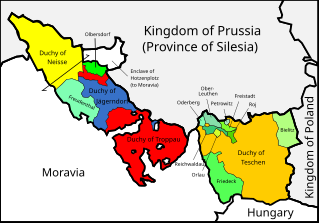
The Treaty of Berlin was a treaty between the Habsburg archduchess Maria Theresa of Austria, who was also Queen of Bohemia, and the Prussian king Frederick the Great, signed on 28 July 1742 in Berlin. It was the formal peace treaty that confirmed the preliminary agreement achieved with English mediation by the 11 June Treaty of Breslau, and officially ended the First Silesian War.
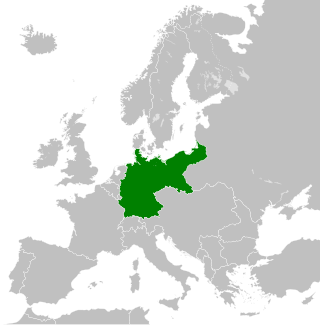
The territorial evolution of Germany in this article include all changes in the modern territory of Germany from its unification making it a country on 1 January 1871 to the present although the history of "Germany" as a territorial polity concept and the history of the ethnic Germans are much longer and much more complex. Modern Germany was formed when the Kingdom of Prussia unified most of the German states, with the exception of multi-ethnic Austria, into the German Empire. After the First World War, on 10 January 1920, Germany lost about 13% of its territory to its neighbours, and the Weimar Republic was formed two days before this war was over. This republic included territories to the east of today's German borders.
The Treaties of Reichenbach were a series of agreements signed in Reichenbach between Great Britain, Prussia, Russia, and Austria. These accords served to establish and strengthen a united coalition force against Napoleon I of France.
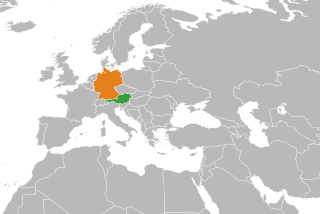
Relations between Austria and Germany are close due to their shared history and culture, with German being the official language and Germans being the major ethnic group of both countries.
The Kingdom of Hanover and the United States began relations with mutual recognition in 1830 but never formulated diplomatic ties. All ties came to an abrupt halt when Hanover was defeated during the Austro-Prussian War of 1866 and subsequently merged directly into the Kingdom of Prussia. From this point, Hanover had relations with the United States as a part of the Kingdom of Prussia.

Germany–Lithuania relations are the bilateral relations between Germany and Lithuania. The formal diplomatic relations existed from 1918 to 1944 and again since 1991. Both countries are members of the Council of the Baltic Sea States, the Organization for Security and Cooperation in Europe (OSCE), OECD, the Council of Europe, NATO and the European Union. Lithuania has also been part of the Eurozone since 2015. The relationship is described as close and reliable partnership. Germany gave full support to Lithuania's applications for membership in the European Union and NATO.
