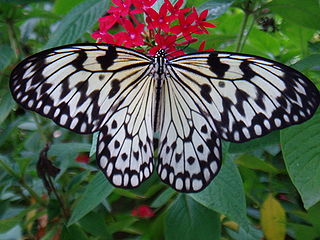
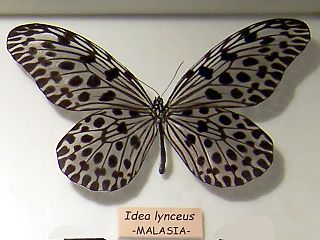
Danainae is a subfamily of the family Nymphalidae, the brush-footed butterflies. It includes the Daniadae, or milkweed butterflies, who lay their eggs on various milkweeds on which their larvae (caterpillars) feed, as well as the clearwing butterflies (Ithomiidae), and the tellervini.

The Nymphalidae are the largest family of butterflies with more than 6,000 species distributed throughout most of the world, belonging to the superfamily Papilionoidea. These are usually medium-sized to large butterflies. Most species have a reduced pair of forelegs and many hold their colourful wings flat when resting. They are also called brush-footed butterflies or four-footed butterflies, because they are known to stand on only four legs while the other two are curled up; in some species, these forelegs have a brush-like set of hairs, which gives this family its other common name. Many species are brightly coloured and include popular species such as the emperors, monarch butterfly, admirals, tortoiseshells, and fritillaries. However, the under wings are, in contrast, often dull and in some species look remarkably like dead leaves, or are much paler, producing a cryptic effect that helps the butterflies blend into their surroundings.

The superfamily Papilionoidea contains all the butterflies except for the moth-like Hedyloidea.

Idea malabarica, the Malabar tree nymph, is a large butterfly found in peninsular India. that belongs to the danaid group of the family Nymphalidae. It is found in forest clearings and above the forest canopy.

The Danaini are a tribe of brush-footed butterflies. Their type genus Danaus contains the well-known monarch butterfly and is also the type genus of the tribe's subfamily, the milkweed butterflies (Danainae).

The Electra's tree-nymph is a species of nymphalid butterfly in the Danainae subfamily. It is endemic to the Philippines.

The Ceylon tree nymph is a species of nymphalid butterfly in the subfamily Danainae. It is endemic to Sri Lanka. First described by John Westwood in 1848, the Ceylon tree nymph can be found in both wet and dry zones of Sri Lanka. It is the largest member of the family Danaidae in that country. It is listed as a near threatened species in the IUCN Red List.
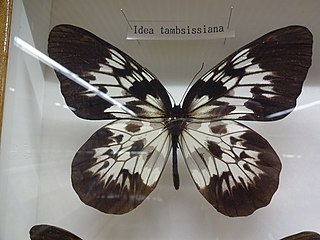
The Bedford-Russell's tree-nymph or Sulawesi tree-nymph is a species of nymphalid butterfly in the Danainae subfamily. It is endemic to Sulawesi, Indonesia.

The Hewitson's small tree-nymph is a species of nymphalid butterfly in the Danainae subfamily. It is endemic to New Guinea (Indonesia).
The Seram small tree-nymph is a species of nymphalid butterfly in the Danainae family. It is endemic to Seram, Indonesia.
Protoploea apatela, the magpie, is a species of nymphalid butterfly in the Danainae subfamily.
Schneider's surprise is a species of nymphalid butterfly in the Danainae subfamily. It is monotypic within the genus Tiradelphe. It is endemic to the Solomon Islands.

Ithomiini is a butterfly tribe in the nymphalid subfamily Danainae. Some authors consider the group to be a subfamily (Ithomiinae). These butterflies are exclusively Neotropical, found in humid forests from sea level to 3000 m, from Mexico to Argentina. There are around 370 species in some 40–45 genera.
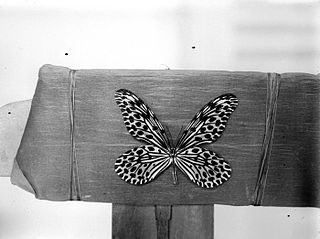
Idea stolli, the common tree nymph, is a species of nymphalid butterfly in the Danainae subfamily. It is found in South East Asia. There are twelve Idea species, of which five occur in West Malaysia.

Sevenia, commonly called tree nymphs, is a genus of forest butterflies in the family Nymphalidae that, as larvae, feed on plants of the family Euphorbiaceae. There are fourteen species from continental Africa and two species from Madagascar. See Idea for the genus of Southeast Asian tree nymphs.
Hewitson is an English family name. The name comes from the patronym of the given name Hewitt, meaning "son of Hewitt". Such patronymic surnames were formed by using the ending -son to the genitive form of the father's name to indicate "son of".
This page is based on this
Wikipedia article Text is available under the
CC BY-SA 4.0 license; additional terms may apply.
Images, videos and audio are available under their respective licenses.