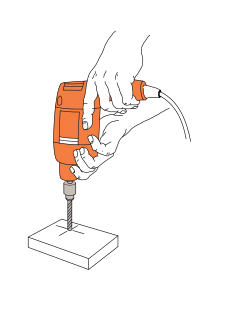
A drill is a tool primarily used for making round holes or driving fasteners. It is fitted with a bit, either a drill or driver, depending on application, secured by a chuck. Some powered drills also include a hammer function.

Drill bits are cutting tools used to remove material to create holes, almost always of circular cross-section. Drill bits come in many sizes and shapes and can create different kinds of holes in many different materials. In order to create holes drill bits are usually attached to a drill, which powers them to cut through the workpiece, typically by rotation. The drill will grasp the upper end of a bit called the shank in the chuck.

Drilling is a cutting process that uses a drill bit to cut a hole of circular cross-section in solid materials. The drill bit is usually a rotary cutting tool, often multi-point. The bit is pressed against the work-piece and rotated at rates from hundreds to thousands of revolutions per minute. This forces the cutting edge against the work-piece, cutting off chips and your stuff is harder uno what i mean (swarf) from the hole as it is drilled. it drills holes.

A drilling rig is a machine that creates holes in the earth's subsurface. Drilling rigs can be massive structures housing equipment used to drill water wells, oil wells, or natural gas extraction wells, or they can be small enough to be moved manually by one person and such are called augers. Drilling rigs can sample subsurface mineral deposits, test rock, soil and groundwater physical properties, and also can be used to install sub-surface fabrications, such as underground utilities, instrumentation, tunnels or wells. Drilling rigs can be mobile equipment mounted on trucks, tracks or trailers, or more permanent land or marine-based structures. The term "rig" therefore generally refers to the complex equipment that is used to penetrate the surface of the Earth's crust.

A hammer drill, also known as a percussion drill or impact drill, is a power tool used chiefly for drilling in hard materials. It is a type of rotary drill with an impact mechanism that generates a hammering motion. The percussive mechanism provides a rapid succession of short hammer thrusts to pulverize the material to be bored, so as to provide quicker drilling with less effort. If a hammer drill's impact mechanism can be turned off, the tool can be used like a conventional drill to also perform tasks such as screwdriving.

Turning is a machining process in which a cutting tool, typically a non-rotary tool bit, describes a helix toolpath by moving more or less linearly while the workpiece rotates.

A core drill is a drill specifically designed to remove a cylinder of material, much like a hole saw. The material left inside the drill bit is referred to as the core.
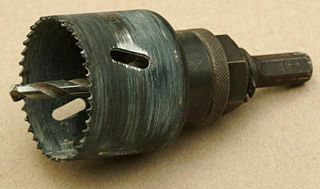
A hole saw, also known as a hole cutter, is a saw blade of annular (ring) shape, whose annular kerf creates a hole in the workpiece without having to cut up the core material. It is used in a drill. Hole saws typically have a pilot drill bit at their center to keep the saw teeth from walking. The fact that a hole saw creates the hole without needing to cut up the core often makes it preferable to twist drills or spade drills for relatively large holes. The same hole can be made faster and using less power.

Gun drills are straight fluted drills which allow cutting fluid to be injected through the drill's hollow body to the cutting face. They are used for deep drilling—a depth-to-diameter ratio of 300:1 or more is possible. Gun barrels are the obvious example; hence the name. Other uses include moldmaking, diemaking, and the manufacture of combustion engine parts such as crankcase, cylinder head, and woodwind musical instruments, such as uilleann pipes, as gun drills can drill long straight holes in metal, wood, and some plastics. The coolant provides lubrication and cooling to the cutting edges and removes the swarf or chips from the hole. Modern gun drills use carbide tips to prolong life and reduce total cost when compared with steel tips. Speed of drilling depends on the material being drilled, rotational speed, and the drill diameter; a high speed drill can cut a hole in P20 steel at 30 inches per minute.

Directional Boring, often undifferentiated from Horizontal Directional Drilling (HDD), is a minimal impact trenchless method of installing underground pipe, conduit, or cables in a relatively shallow arc or radius along a prescribed underground bore path by using a surface-launched drilling rig. With respect to the pipeline/utility industry, the term "Directional Boring" or "Bore" is generally reserved for mini/small sized drilling rigs, small diameter bores, and crossing lengths in terms of hundreds of feet. Generally, the term Horizontal Directional Drilling (HDD) is intended to describe large/maxi sized drilling rigs, large diameter bores, and crossing lengths in terms of thousand of feet. Although directional boring and HDD are similar in some respects to directional drilling associated with the oil industry, an equal comparison cannot be drawn between the procedures as they serve two entirely different functions. Directional Boring/HDD offers significant advantages over traditional cut and cover pipeline/utility installations and are routinely used when trenching or excavating is not practical. Directional Boring/HDD can be utilized with various pipe materials such as PVC, polyethylene, polypropylene, ductile iron, and steel as long as the pipe is sized appropriately to withstand installation stresses imparted during pullback.
Underbalanced drilling, or UBD, is a procedure used to drill oil and gas wells where the pressure in the wellbore is kept lower than the static pressure then the formation being drilled. As the well is being drilled, formation fluid flows into the wellbore and up to the surface. This is the opposite of the usual situation, where the wellbore is kept at a pressure above the formation to prevent formation fluid entering the well. In such a conventional "overbalanced" well, the invasion of fluid is considered a kick, and if the well is not shut-in it can lead to a blowout, a dangerous situation. In underbalanced drilling, however, there is a "rotating head" at the surface - essentially a seal that diverts produced fluids to a separator while allowing the drill string to continue rotating.

Hugo Bart Huges was a Dutch librarian and proponent of trepanation. He attended medical school at the University of Amsterdam, but was refused a degree due to his advocacy of marijuana use. In 1964 he published "The Mechanism of Brainbloodvolume ('BBV')", a scroll in which he proposed that trepanation could be used to enhance brain functionality by balancing the proportion of blood and cerebral spinal fluid. Hughes believed that, when mankind began to walk upright, our brains drained of blood and that trepanation allowed the blood to better flow in and out of the brain, causing a permanent "high". Using a foot-operated electric dentist drill, Huges drilled a hole in his skull on 6 January 1965. He also published "Trepanation: A Cure for Psychosis", in which he expanded upon his theory, and an autobiography, The Book With The Hole, in 1972.

A pilot hole is either a small hole drilled into a material to guide a larger drill to the appropriate location and ease the job of the larger drill, to allow for the insertion of another hole making tool, such as a knockout punch, that will produce the final size hole, or, in wood or plastic, to locate, guide, and provide clearance for a self threading screw to prevent damaging the material or breaking the screw.

A well is an excavation or structure created in the ground by digging, driving, or drilling to access liquid resources, usually water. The oldest and most common kind of well is a water well, to access groundwater in underground aquifers. The well water is drawn by a pump, or using containers, such as buckets, that are raised mechanically or by hand. Wells were first constructed at least eight thousand years ago and historically vary in construction from a simple scoop in the sediment of a dry watercourse to the qanats of Iran, and the stepwells and sakiehs of India. Placing a lining in the well shaft helps create stability, and linings of wood or wickerwork date back at least as far as the Iron Age.
A down-the-hole drill, usually called DTH by most professionals, is basically a mini jackhammer screwed on the bottom of a drill string. The fast hammer action breaks hard rock into small flakes and dust and is blown clear by the air exhaust from the DTH hammer. The DTH hammer is one of the fastest ways to drill hard rock. Now smaller portable drillcat drilling rigs with DTH hammers can drill as fast as much larger truck rigs with this newer technology. The system is thought to have been invented independently by Stenuick Frères in Belgium and Ingersoll Rand in the USA in the mid-1950s.

Boring is drilling a hole, tunnel, or well in the earth.
The 2010 Copiapó mining accident began as a cave-in on 5 August 2010 at the San José copper-gold mine in the Atacama Desert near Copiapó, Chile. The accident left 33 men trapped 700 meters (2,300 ft) below ground who survived underground for a record 69 days. All 33 men were rescued and brought to the surface on 13 October 2010 over a period of almost 24 hours. After the last trapped miner was winched to the surface, the rescue workers still underground held up a sign before the camera stating "Misión cumplida Chile" to the estimated more than 1 billion people watching the rescue on live television around the world.

A cranial drill, also known as a craniotome, is a tool for drilling simple burr holes (trepanation) or for creating larger openings in the skull. This exposes the brain and allows operations like craniotomy and craniectomy to be done. The drill itself can be manually or electrically driven, and primarily consists of a hand piece and a drill bit which is a sharp tool that has the form similar to Archimedes screw, this instrument must be inserted into the drill chuck to perform holes and remove materials. The trepanation tool is generally equipped with a clutch which automatically disengages once it touches a softer tissue, thus preventing tears in the dura. For larger openings, the craniotome is a surgical instrument that has replaced manually pulled saw wires in craniotomies from the 1980s.