
The Palace of Versailles was the principal royal residence of France from 1682, under Louis XIV, until the start of the French Revolution in 1789, under Louis XVI. It is located in the department of Yvelines, in the region of Île-de-France, about 20 kilometres southwest of the centre of Paris.

The Treaty of Trianon was the peace agreement of 1920 that formally ended World War I between most of the Allies of World War I and the Kingdom of Hungary, the latter being one of the successor states to Austria-Hungary. The treaty regulated the status of an independent Hungarian state and defined its borders. It left Hungary as a landlocked state that covered 93,073 square kilometres (35,936 sq mi), only 28% of the 325,411 square kilometres (125,642 sq mi) that had constituted the pre-war Kingdom of Hungary. Its population was 7.6 million, only 36% of the pre-war kingdom's population of 20.9 million. The areas that were allocated to neighbouring countries in total had a majority of non-Hungarians but 31% of Hungarians were left outside of post-Trianon Hungary. Five of the pre-war kingdom's ten largest cities were drawn into other countries. The treaty limited Hungary's army to 35,000 officers and men, and the Austro-Hungarian Navy ceased to exist.

Jean-Henri Riesener was a famous German ébéniste (cabinetmaker), working in Paris, whose work exemplified the early neoclassical "Louis XVI style".
"Chosen Realm" is the twelfth episode from the third season of the science fiction television series Star Trek: Enterprise. It's the sixty-fourth episode of the series, first airing on January 14, 2004. Enterprise is taken over by a sect of Triannons and Archer must re-take it before its too late.

Jean-Marc Nattier, French painter, was born in Paris, the second son of Marc Nattier (1642–1705), a portrait painter, and of Marie Courtois (1655–1703), a miniaturist. He is noted for his portraits of the ladies of King Louis XV's court in classical mythological attire.

Ange-Jacques Gabriel was the principal architect of King Louis XV of France. His major works included the Place de la Concorde, the École Militaire, and the Petit Trianon and opera theater at the Palace of Versailles. His style was a careful balance between French Baroque architecture and French neoclassicism.

The Grand Trianon is a château (palace) situated in the northwestern part of the Domain of Versailles. It was built at the request of King Louis XIV of France, as a retreat for himself and his maîtresse en titre of the time, the Marquise de Montespan (1640–1707), and as a place where he and invited guests could take light meals (collations) away from the strict étiquette of the Court.

The Hameau de la Reine is a rustic retreat in the park of the Château de Versailles built for Marie Antoinette in 1783 near the Petit Trianon in Yvelines, France. It served as a private meeting place for the Queen and her closest friends, a place of leisure. Designed by the Queen's favoured architect, Richard Mique with the help of the painter Hubert Robert, it contained a meadowland with lakes and streams, a classical Temple of Love on an island with fragrant shrubs and flowers, an octagonal Belvédère, with a neighbouring grotto and cascade. There are also various buildings in a rustic or vernacular style, inspired by Norman or Flemish design, situated around an irregular pond fed by a stream that turned a mill wheel. The building scheme included a farmhouse,, a dairy, a dovecote, a boudoir, a barn that burned down during the French Revolution, a mill and a tower in the form of a lighthouse. Each building is decorated with a garden, an orchard or a flower garden. The largest and most famous of these houses is the "Queen's House", connected to the Billiard house by a wooden gallery, at the center of the village. A working farm was close to the idyllic, fantasy-like setting of the Queen's Hamlet.
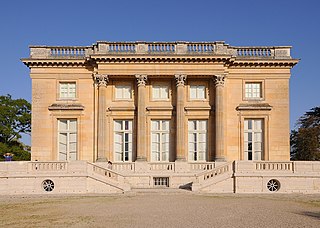
The Petit Trianon, built between 1762 and 1768 during the reign of Louis XV of France, is a small château located on the grounds of the Palace of Versailles in Versailles, France. The park of the Grand Trianon includes the Petit Trianon.

The Musée national de la Marine is a maritime museum located in the Palais de Chaillot, Trocadéro, in the 16th arrondissement of Paris. It has annexes at Brest, Port-Louis, Rochefort, Toulon and Saint-Tropez. The permanent collection originates in a collection that dates back to Louis XV of France.
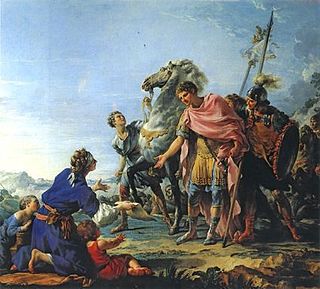
Noël Hallé was a French painter, draftsman and printmaker. He was born into a family of artists, the son of Claude-Guy Hallé.

Le Petit Trianon is a mansion on the grounds of De Anza College at 21250 Stevens Creek Blvd., in Cupertino, California.

Peter G. Thomson House, commonly known as Laurel Court, is a registered historic building in Cincinnati, Ohio, listed in the National Register on November 29, 1979.

René-Antoine Houasse was a decorative French painter.
Five subsidiary structures located near the Palace of Versailles have a historical relation with the history and evolution of the palace. Of these five structures – the Ménagerie, the Pavillon de la Lanterne, the Trianon de Porcelaine, the Grand Trianon, and the Petit Trianon – two have been destroyed ; however, historical documentation and accounts permit these two structures to be discussed. As an ensemble of buildings related to, yet removed from, the chateau of Versailles, they represent architectural masterworks of the 17th and 18th centuries that have inspired architects to this day.

In Renaissance and Early Modern German architecture, a Lustschloss is a small palace which served the private pleasure of its owner, usually the ruler of the area it is located in, and was seasonally inhabited as a respite from court ceremonies and state duties. In France, the château de Madrid in the Bois de Boulogne, easily reached from Paris, set an example, and Louis XIV similarly retreated from onerous ceremonial at Versailles to his château of Marly.

The Public Establishment of the Palace, Museum and National Estate of Versailles is a French public establishment founded in 1995, and working under the supervision of the French Ministry of Culture, in order to administer the Palace of Versailles.
Catherine Trianon, née Boule, called La Trianon, was a French fortune teller, widely known for her involvement in the famous Poison Affair. She along with other colleagues were responsible for the attempted assassination of the king Louis XIV of France in 1679.

Le Trianon is a theatre and concert hall in Paris. It is located at 80, boulevard de Rochechouart, in the 18th arrondissement of Paris, at the foot of the hill of Montmartre.
