It is proposed that this article be deleted because of the following concern:
If you can address this concern by improving, copyediting, sourcing, renaming, or merging the page, please edit this page and do so. You may remove this message if you improve the article or otherwise object to deletion for any reason. Although not required, you are encouraged to explain why you object to the deletion, either in your edit summary or on the talk page. If this template is removed, do not replace it . The article may be deleted if this message remains in place for seven days, i.e., after 22:39, 27 May 2019 (UTC). Nominator: Please consider notifying the author/project: {{subst:proposed deletion notify |Triathlon (heat pump)|concern=Non-notable product. No reliable sources exist to establish notability, and the external links present in article are only product pages and ads.}} ~~~~ |
The York Triathlon was a heat pump system for residential and small business heating and air conditioning introduced circa 1997. Unlike a conventional heat pump or air conditioner where the compressor is driven by an electric motor, the Triathlon was driven by a natural gas fueled 5 horsepower Briggs and Stratton engine. Maintenance requirements included annual changes of the oil and spark plugs on the engine. This equipment is no longer offered.
A heat pump is a device that transfers heat energy from a source of heat to what is called a heat sink. Heat pumps move thermal energy in the opposite direction of spontaneous heat transfer, by absorbing heat from a cold space and releasing it to a warmer one. A heat pump uses external power to accomplish the work of transferring energy from the heat source to the heat sink. The most common design of a heat pump involves four main components – a condenser, an expansion valve, an evaporator and a compressor. The heat transfer medium circulated through these components is called refrigerant.
Natural gas is a naturally occurring hydrocarbon gas mixture consisting primarily of methane, but commonly including varying amounts of other higher alkanes, and sometimes a small percentage of carbon dioxide, nitrogen, hydrogen sulfide, or helium. It is formed when layers of decomposing plant and animal matter are exposed to intense heat and pressure under the surface of the Earth over millions of years. The energy that the plants originally obtained from the sun is stored in the form of chemical bonds in the gas.
Although it burned natural gas, it should not be confused with absorption cycle cooling which is a heat-driven technology. The Triathlon units utilized the conventional vapor-compression refrigeration cycle and was unique in its use of an internal combustion engine to drive the compressor.
Vapor-compression refrigeration or vapor-compression refrigeration system (VCRS), in which the refrigerant undergoes phase changes, is one of the many refrigeration cycles and is the most widely used method for air-conditioning of buildings and automobiles. It is also used in domestic and commercial refrigerators, large-scale warehouses for chilled or frozen storage of foods and meats, refrigerated trucks and railroad cars, and a host of other commercial and industrial services. Oil refineries, petrochemical and chemical processing plants, and natural gas processing plants are among the many types of industrial plants that often utilize large vapor-compression refrigeration systems.
York is now a unit of Johnson Controls.
Heating, ventilation, and air conditioning (HVAC) is the technology of indoor and vehicular environmental comfort. Its goal is to provide thermal comfort and acceptable indoor air quality. HVAC system design is a subdiscipline of mechanical engineering, based on the principles of thermodynamics, fluid mechanics and heat transfer. "Refrigeration" is sometimes added to the field's abbreviation, as HVAC&R or HVACR or "ventilation" is dropped, as in HACR.
Centrifugal compressors, sometimes called radial compressors, are a sub-class of dynamic axisymmetric work-absorbing turbomachinery.
The Brayton cycle is a thermodynamic cycle named after George Brayton that describes the workings of a constant-pressure heat engine. The original Brayton engines used a piston compressor and piston expander, but more modern gas turbine engines and airbreathing jet engines also follow the Brayton cycle. Although the cycle is usually run as an open system, it is conventionally assumed for the purposes of thermodynamic analysis that the exhaust gases are reused in the intake, enabling analysis as a closed system.
A compressor is a mechanical device that increases the pressure of a gas by reducing its volume. An air compressor is a specific type of gas compressor.
Forced induction is the process of delivering compressed air to the intake of an internal combustion engine. A forced induction engine uses a gas compressor to increase the pressure, temperature and density of the air. An engine without forced induction is considered a naturally aspirated engine.
Bleed air is compressed air taken from the compressor stage of a gas turbine upstream of its fuel-burning sections. Automatic air supply and cabin pressure controller (ASCPCs) valves bleed air from high or low stage engine compressor sections. Low stage air is used during high power setting operation, and high during descent and other low power setting operations." Bleed air from that system can be utilized for internal cooling of the engine, cross-starting another engine, engine and airframe anti-icing, cabin pressurization, pneumatic actuators, air-driven motors, pressurizing the hydraulic reservoir, and waste and water storage tanks. Some engine maintenance manuals refer to such systems as "customer bleed air". Bleed air is valuable in an aircraft for two properties: high temperature and high pressure.

A scroll compressor is a device for compressing air or refrigerant. It is used in air conditioning equipment, as an automobile supercharger and as a vacuum pump. Many residential central heat pump and air conditioning systems and a few automotive air conditioning systems employ a scroll compressor instead of the more traditional rotary, reciprocating, and wobble-plate compressors.
An air cycle machine (ACM) is the refrigeration unit of the environmental control system (ECS) used in pressurized gas turbine-powered aircraft. Normally an aircraft has two or three of these ACM. Each ACM and its components are often referred as an air conditioning pack. The air cycle cooling process uses air instead of a phase changing material such as Freon in the gas cycle. No condensation or evaporation of a refrigerant is involved, and the cooled air output from the process is used directly for cabin ventilation or for cooling electronic equipment.
Economizers, or economisers (UK), are mechanical devices intended to reduce energy consumption, or to perform useful function such as preheating a fluid. The term economizer is used for other purposes as well. Boiler, power plant, heating, Refrigeration, ventilating, and air conditioning (HVAC) uses are discussed in this article. In simple terms, an economizer is a heat exchanger.

A turboexpander, also referred to as a turbo-expander or an expansion turbine, is a centrifugal or axial-flow turbine, through which a high-pressure gas is expanded to produce work that is often used to drive a compressor or generator.
Solar air conditioning refers to any air conditioning (cooling) system that uses solar power.
An air source heat pump (ASHP) is a system which transfers heat from outside to inside a building, or vice versa. Under the principles of vapor compression refrigeration, an ASHP uses a refrigerant system involving a compressor and a condenser to absorb heat at one place and release it at another. They can be used as a space heater or cooler, and are sometimes called "reverse-cycle air conditioners".
Thermodynamic heat pump cycles or refrigeration cycles are the conceptual and mathematical models for heat pumps and refrigerators. A heat pump is a machine or device that moves heat from one location at a lower temperature to another location at a higher temperature using mechanical work or a high-temperature heat source. Thus a heat pump may be thought of as a "heater" if the objective is to warm the heat sink, or a "refrigerator" if the objective is to cool the heat source. In either case, the operating principles are identical. Heat is moved from a cold place to a warm place.
A triathlon is an endurance athletic event consisting of three stages, without a break: swimming, cycling and running, in that order.
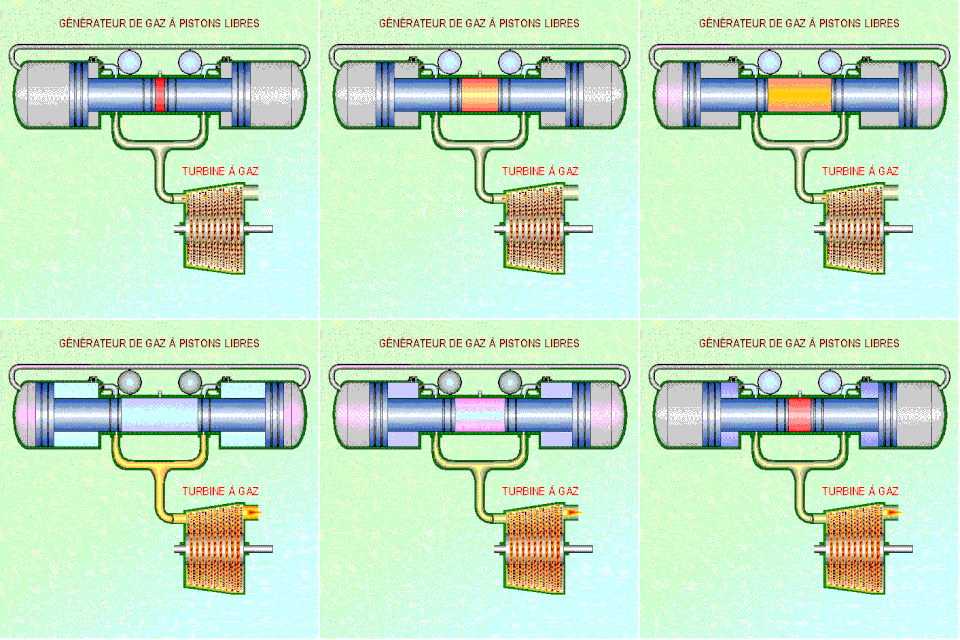
A free-piston engine is a linear, 'crankless' internal combustion engine, in which the piston motion is not controlled by a crankshaft but determined by the interaction of forces from the combustion chamber gases, a rebound device and a load device.
The EcoCute is an energy efficient electric heat pump, water heating and supply system that uses heat extracted from the air to heat water for domestic, industrial and commercial use. Instead of the more conventional ammonia or haloalkane gases, EcoCute uses supercritical carbon dioxide as a refrigerant. The technology offers a means of energy conservation and reduces the emission of greenhouse gas.
A compressor station is a facility which helps the transportation process of natural gas from one location to another. Natural gas, while being transported through a gas pipeline, needs to be constantly pressurized at intervals of 40 to 100 miles. Siting is dependent on terrain, and the number of gas wells in the vicinity. Frequent elevation changes and a greater number of gas wells will require more compressor stations.
Automobile air conditioning systems use air conditioning to cool the air in a vehicle.