
The Ohio class of nuclear-powered submarines includes the United States Navy's 14 ballistic missile submarines (SSBNs) and its four cruise missile submarines (SSGNs). Each displacing 18,750 tons submerged, the Ohio-class boats are the largest submarines ever built for the U.S. Navy. They are the world's third-largest submarines, behind the Russian Navy's Soviet-designed 48,000-ton Typhoon class and 24,000-ton Borei class. The Ohios carry more missiles than either: 24 Trident II missiles apiece, versus 16 by the Borei class and 20 by the Typhoon class.

The UGM-27 Polaris missile was a two-stage solid-fueled nuclear-armed submarine-launched ballistic missile (SLBM). As the United States Navy's first SLBM, it served from 1961 to 1996.

The UGM-73 Poseidon missile was the second US Navy nuclear-armed submarine-launched ballistic missile (SLBM) system, powered by a two-stage solid-fuel rocket. It succeeded the UGM-27 Polaris beginning in 1972, bringing major advances in warheads and accuracy. It was followed by Trident I in 1979, and Trident II in 1990.
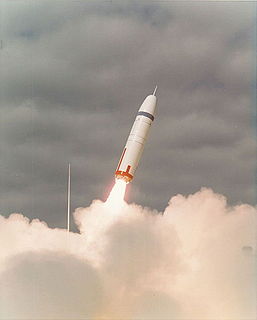
The Trident missile is a submarine-launched ballistic missile (SLBM) equipped with multiple independently targetable reentry vehicles (MIRV). Originally developed by Lockheed Missiles and Space Corporation, the missile is armed with thermonuclear warheads and is launched from nuclear-powered ballistic missile submarines (SSBNs). Trident missiles are carried by fourteen United States Navy Ohio-class submarines, with American warheads, as well as four Royal Navy Vanguard-class submarines, with British warheads. The missile is named after the mythological trident of Neptune.

A submarine-launched ballistic missile (SLBM) is a ballistic missile capable of being launched from submarines. Modern variants usually deliver multiple independently targetable reentry vehicles (MIRVs) each of which carries a nuclear warhead and allows a single launched missile to strike several targets. Submarine-launched ballistic missiles operate in a different way from submarine-launched cruise missiles.
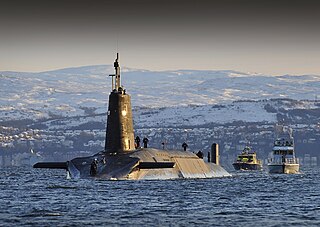
The Vanguard class is a class of nuclear-powered ballistic missile submarines (SSBNs) in service with the Royal Navy. The class was introduced in 1994 as part of the Trident nuclear programme, and includes four vessels: Vanguard, Victorious, Vigilant and Vengeance, built between 1986 and 1999 at Barrow-in-Furness by Vickers Shipbuilding and Engineering, now owned by BAE Systems. All four boats are based at HM Naval Base Clyde , 40 km (25 mi) west of Glasgow, Scotland.

A ballistic missile submarine is a submarine capable of deploying submarine-launched ballistic missiles (SLBMs) with nuclear warheads. The United States Navy's hull classification symbols for ballistic missile submarines are SSB and SSBN – the SS denotes submarine, the B denotes ballistic missile, and the N denotes that the submarine is nuclear powered. These submarines became a major weapon system in the Cold War because of their nuclear deterrence capability. They can fire missiles thousands of kilometers from their targets, and acoustic quieting makes them difficult to detect, thus making them a survivable deterrent in the event of a first strike and a key element of the mutual assured destruction policy of nuclear deterrence.

USS Maine (SSBN-741) is a United States Navy Ohio-class ballistic missile submarine in commission since 1995. She is the fourth U.S. Navy ship authorized, and the third commissioned, to be named in honor of the state of Maine. She has the capability to carry 24 nuclear armed Trident ballistic missiles.

41 for Freedom refers to the US Navy Fleet Ballistic Missile (FBM) submarines from the George Washington, Ethan Allen, Lafayette, James Madison, and Benjamin Franklin classes. All of these submarines were commissioned 1959-1967, as the goal was to create a credible, survivable sea-based deterrent as quickly as possible. These submarines were nicknamed "41 for Freedom" once the goal of 41 nuclear-powered ballistic missile submarines (SSBNs) was established in the early 1960s. The 1972 SALT I Treaty limited the number of American submarine-launched ballistic missile tubes to 656, based on the total missile tubes of the forty-one submarines, in line with the treaty's goal of limiting strategic nuclear weapons to the number already existing.

The James Madison class of submarine was an evolutionary development from the Lafayette class of fleet ballistic missile submarine. They were identical to the Lafayettes except for being initially designed to carry the Polaris A-3 missile instead of the earlier A-2. This class, together with the George Washington, Ethan Allen, Lafayette, and Benjamin Franklin classes, composed the "41 for Freedom" that was the Navy's primary contribution to the nuclear deterrent force through the late 1980s. This class and the Benjamin Franklin class are combined with the Lafayettes in some references.

USS Alabama (SSBN-731) is the sixth Ohio-class nuclear-powered fleet ballistic missile submarine, and the seventh United States vessel to be named for the state of Alabama. The boat's motto duplicates the state's motto, Audemus Jura Nostra Defendere.

The UGM-96 Trident I, or Trident C4, was an American submarine-launched ballistic missile (SLBM), built by Lockheed Martin Space Systems in Sunnyvale, California, US. First deployed in 1979, the Trident I replaced the Poseidon missile. It was retired in 2005, having been replaced by the Trident II.

The UGM-133A Trident II, or Trident D5 is a submarine-launched ballistic missile (SLBM), built by Lockheed Martin Space in Sunnyvale, California, and deployed with the American and British navies. It was first deployed in March 1990, and remains in service. The Trident II Strategic Weapons System is an improved SLBM with greater accuracy, payload, and range than the earlier Trident C-4. It is a key element of the U.S. strategic nuclear triad and strengthens U.S. strategic deterrence. The Trident II is considered to be a durable sea-based system capable of engaging many targets. It enhances the U.S. position in strategic arms negotiation with performance and payload flexibility that can accommodate active treaty initiatives. The Trident II's increased payload allows nuclear deterrence to be accomplished with fewer submarines, and its high accuracy—approaching that of land-based missiles—enables it to be used as a first strike weapon.

The eleventh HMS Vanguard of the Royal Navy is the lead boat of her class of Trident ballistic missile-armed submarines. The submarine is based at Faslane, HMNB Clyde, Argyll, Scotland.

Naval Submarine Base Kings Bay is a base of the United States Navy located adjacent to the city of St. Marys in Camden County, Georgia, on the North River in southeastern Georgia, and 38 miles (61 km) from Jacksonville, Florida. The Submarine Base is the U.S. Atlantic Fleet's home port for U.S. Navy Fleet ballistic missile nuclear submarines capable of being armed with Trident missile nuclear weapons. This submarine base covers about 16,000 acres of land, of which 4,000 acres are protected wetlands.
A trident is a three-pronged staff.

The Dreadnought class is the future replacement for the Vanguard class of ballistic missile submarines. Like their predecessors they will carry Trident II D-5 missiles. The Vanguard submarines entered service in the United Kingdom in the 1990s with an intended service life of 25 years. Their replacement is necessary if the Royal Navy is to maintain a continuous at-sea deterrent (CASD), the principle of operation behind the Trident system.

The Columbia-class submarine, formerly known as the Ohio Replacement Submarine and SSBN-X Future Follow-on Submarine, is an upcoming class of nuclear submarines designed to replace the Ohio-class ballistic missile submarines in the United States Navy. The first submarine officially began construction on October 1, 2020, and is scheduled to enter service in 2031.

STRAT-X, or Strategic-Experimental, was a U.S. government-sponsored study conducted during 1966 and 1967 that comprehensively analyzed the potential future of the U.S. nuclear deterrent force. At the time, the Soviet Union was making significant strides in nuclear weapons delivery, and also constructing anti-ballistic missile defenses to protect strategic facilities. To address a potential technological gap between the two superpowers, U.S. Secretary of Defense Robert McNamara entrusted the classified STRAT-X study to the Institute for Defense Analyses, which compiled a twenty-volume report in nine months. The report looked into more than one hundred different weapons systems, ultimately resulting in the MGM-134 Midgetman and LGM-118 Peacekeeper intercontinental ballistic missiles, the Ohio-class submarines, and the Trident submarine-launched ballistic missiles, among others. Journalists have regarded STRAT-X as a major influence on the course of U.S. nuclear policy.
