
Debeaking is the partial removal of the beak of poultry, especially layer hens and turkeys although it may also be performed on quail and ducks. Most commonly, the beak is shortened permanently, although regrowth can occur. The trimmed lower beak is somewhat longer than the upper beak.

Aircraft flight control surfaces are aerodynamic devices allowing a pilot to adjust and control the aircraft's flight attitude.

A buoyancy compensator, also called a buoyancy control device, BC, BCD, stabilizer, stabilisor, stab jacket, wing or ABLJ depending on design, is a piece of diving equipment with an inflatable bladder which is worn by divers to establish neutral buoyancy underwater and positive buoyancy on the surface, when needed. The buoyancy is controlled by adjusting the volume of air in the bladder. The bladder is filled with ambient pressure gas from the diver's primary breathing gas cylinder via a low-pressure hose from the regulator first stage, directly from a small cylinder dedicated to this purpose, or from the diver's mouth through the oral inflation valve.

The Volkswagen Lupo is a city car produced by the German car manufacturer Volkswagen from October 1998 to June 2005.
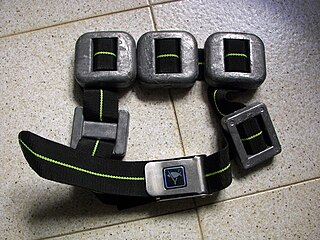
Divers wear weighting systems, weight belts or weights to counteract the buoyancy of other diving equipment, such as diving suits and aluminium diving cylinders. The scuba diver must be weighted sufficiently to be slightly negatively buoyant at the end of the dive when most of the breathing gas has been used, and needs to maintain neutral buoyancy at safety or obligatory decompression stops. During the dive, buoyancy is controlled by adjusting the volume of air in the buoyancy compensation device (BCD) and, if worn, the dry suit, in order to achieve neutral or positive buoyancy as needed. The amount of weight required is determined by the maximum overall positive buoyancy of the fully equipped but unweighted diver anticipated during the dive, with an empty buoyancy compensator and normally inflated dry suit. This depends on the diver's mass and body composition, buoyancy of other diving gear worn, water salinity, weight of breathing gas consumed, and water temperature. It normally is in the range of 2 kilograms (4.4 lb) to 15 kilograms (33 lb). The weights can be distributed to trim the diver to suit the purpose of the dive.

The Honda Element is a compact crossover SUV manufactured by Honda using a modified CR-V platform and marketed in North America over a single generation for model years 2003-2011.

The 240SX is a sports car that was introduced to the North American market by Nissan in 1988 for the following model year. It replaced the outgoing 200SX (S12) model. Most of the 240SX were equipped with the 2.4-liter inline 4 engine. The KA24E had a single overhead cam and KA24DE had dual overhead cams. Two distinct generations of the 240SX, the S13 (1989–1994) the S14 (1995-1999) were produced based on the Nissan S platform.

The Porsche 934 was a racing version of the Porsche 911 Turbo, prepared to FIA Group 4 rules, similar to the Porsche 935 which was prepared to FIA Group 5 rules.
The Handley Page HP.88 was a British research aircraft, built in the early 1950s for Handley Page to test the aerodynamics of the Victor crescent wing design, and was intended to be a scaled-down version of that aircraft.

The Honda Pilot is a mid-size SUV manufactured by Honda and introduced in 2002.
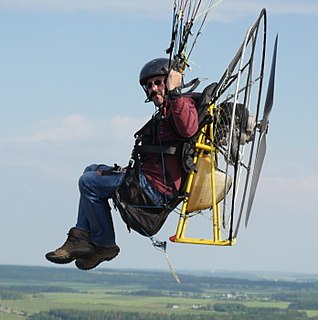
Paramotor is the generic name for the harness and propulsive portion of a powered paraglider ("PPG"). There are two basic types of paramotors: foot launch and wheel launch.
TrimSpa was a dietary supplement designed for weight loss, marketed by the company Goen Technologies and headed by Alexander Szynalski. The ephedra-based supplement was marketed by TrimSpa to help "stave off hunger", until ephedra was banned from the United States. TrimSpa's parent company, Goen Technologies, filed for bankruptcy protection in May 2008.

Trim tabs are small surfaces connected to the trailing edge of a larger control surface on a boat or aircraft, used to control the trim of the controls, i.e. to counteract hydro- or aerodynamic forces and stabilise the boat or aircraft in a particular desired attitude without the need for the operator to constantly apply a control force. This is done by adjusting the angle of the tab relative to the larger surface.

The Fiat Panorama is a two-door station wagon version of the Fiat 147, a subcompact car produced in South America by Italian automaker Fiat. The Panorama was built in Brazil and released in March 1980 as one of the first small station wagons to be produced there. The Panorama was phased out in 1986 to give its market to Elba/Duna Weekend.

The Ford Country Sedan is a full-size station wagon that was built by Ford from 1952 until 1974.
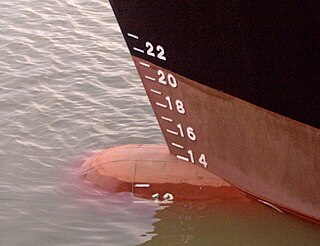
The displacement or displacement tonnage of a ship is its weight based on the amount of water its hull displaces at varying loads. It is measured indirectly using Archimedes' principle by first calculating the volume of water displaced by the ship then converting that value into weight displaced. Traditionally, various measurement rules have been in use, giving various measures in long tons. Today, metric tonnes are more used.

The Nissan NV is the first full-size van built by the Japanese automaker for the United States, Mexico and Canada, and sold by Nissan. Until the introduction of the Nissan NV, Mexico was the only country in North America selling a full-size Nissan Van, as the Nissan Urvan was sold there. Upon the introduction of the NV, it replaced the Urvan for Mexico. There was also a small pickup truck sold in Thailand as the "Nissan NV", this was based on the AD Wagon (Y10), a relative of the Nissan Sunny.
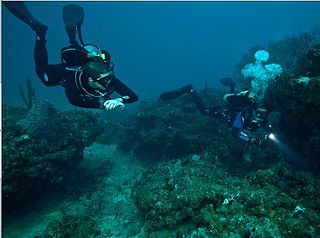
The stability and static trim of a scuba diver affect the convenience and safety of the diver both at the surface and under water during the dive. Underwater trim is at approximately neutral buoyancy, but surface trim may be at significant positive buoyancy.

The thirteenth-generation Ford F-Series is a range of pickup trucks produced by Ford. Introduced for the 2015 model year, this generation of the F-Series is the first aluminum-intensive vehicle produced on a large scale by an American vehicle manufacturer. For the 2017 model year, the fourth-generation Super Duty line adopted the cab design of the F-150, consolidating the cab design for the first time on Ford light-duty trucks for the first time since the 1996 model year; the Super Duty trucks still retain separate bodywork and a higher-GVWR frame.
A seabed tractor belongs to the remotely operated underwater vehicle class, although their operations and the handling of these units are quite different. They can be put into use for submarine cable laying or completion of a bury operation. A typical operation involves the seabed tractor being lowered onto the seabed over the pipeline when the location has been confirmed. The weight of the tractor remains mostly on the gantry, being controlled by heave-compensation gear on the gantry. Only about 40 tonnes of the weight should rest on the seabed. The position reference of the vessel is now transferred to the trim-cube sensors on the seabed tractor support wires, which remain vertical. The position of the vessel is now being controlled by the movements of the tractor, with the trim¬cube feeding back wire angle data to the DP system. The DP, in turn, is correcting the position of the vessel in order to keep the tractor wires vertical. The DP system would be configured with the centre of rotation located on the trencher. Reading can thus be adjusted according to the environment or any other constraints.
