
In Greek mythology, Achilles or Achilleus was a hero of the Trojan War, the greatest of all the Greek warriors, and the central character of Homer's Iliad. He was the son of the Nereid Thetis and Peleus, king of Phthia.
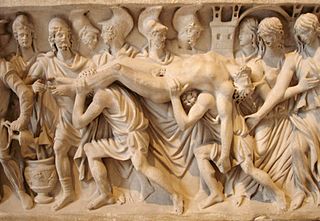
In Greek mythology, Hector is a character in Homer's Iliad. He was a Trojan prince and the greatest warrior for Troy during the Trojan War. Hector led the Trojans and their allies in the defense of Troy, killing countless Greek warriors. He was ultimately killed in single combat by Achilles, who later dragged his dead body around the city of Troy behind his chariot.

Hecuba was a queen in Greek mythology, the wife of King Priam of Troy during the Trojan War.

In Greek mythology, Polyxena was the youngest daughter of King Priam of Troy and his queen, Hecuba. She does not appear in Homer, but in several other classical authors, though the details of her story vary considerably. After the fall of Troy, she dies when sacrificed by the Greeks on the tomb of Achilles, to whom she had been betrothed and in whose death she was complicit in many versions.
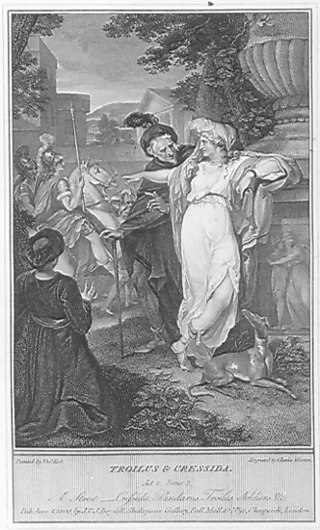
Pandarus or Pandar is a Trojan aristocrat who appears in stories about the Trojan War.
Cressida is a character who appears in many Medieval and Renaissance retellings of the story of the Trojan War. She is a Trojan woman, the daughter of Calchas, a Greek seer. She falls in love with Troilus, the youngest son of King Priam, and pledges everlasting love, but when she is sent to the Greeks as part of a hostage exchange, she forms a liaison with the Greek warrior Diomedes. In later culture she becomes an archetype of a faithless lover.

"Star-crossed" or "star-crossed lovers" is when two people are not able to be together for some type of reason. The term also has other meanings, but originally means that the pairing is being "thwarted by a malign star" or that the stars are working against the relationship. Astrological in origin, the phrase stems from the belief that the positions of the stars ruled over people's fates, and is best known from the play Romeo and Juliet by the Elizabethan playwright William Shakespeare. Such pairings are often said to be doomed from the start.

Troilus is a legendary character associated with the story of the Trojan War. The first surviving reference to him is in Homer's Iliad, composed in the late 8th century BCE.
Ripheus was a Trojan hero and the name of a figure from the Aeneid of Virgil. A comrade of Aeneas, he was a Trojan who was killed defending his city against the Greeks. "Ripheus also fell," Virgil writes, "uniquely the most just of all the Trojans, the most faithful preserver of equity; but the gods decided otherwise". Ripheus's righteousness was not rewarded by the gods.
Benoît de Sainte-Maure was a 12th-century French poet, most probably from Sainte-Maure-de-Touraine near Tours, France. The Plantagenets' administrative center was located in Chinon, west of Tours.
In Greek mythology, Antenor was a counselor to King Priam of Troy during the events of the Trojan War.

There are a wide range of ways in which people have represented the Trojan War in literature and the arts.

"Il Filostrato" is a poem by the Italian writer Giovanni Boccaccio, and the inspiration for Geoffrey Chaucer's Troilus and Criseyde and, through Chaucer, the Shakespeare play Troilus and Cressida. It is itself loosely based on Le Roman de Troie, by 12th-century poet Benoît de Sainte-Maure.
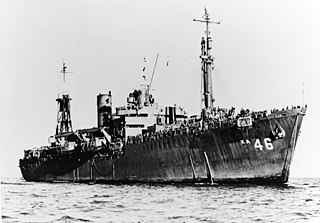
USS Troilus (AKA-46) was an Artemis-class attack cargo ship in service with the United States Navy from 1945 to 1946. She was scrapped in 1967.

Troilus and Cressida is the first of the two operas by William Walton, and was premiered in 1954. The libretto was by Christopher Hassall, his own first opera libretto, based on Geoffrey Chaucer's poem Troilus and Criseyde. Walton dedicated the score to his wife, Susana.

1208 Troilus is a large and notably inclined Jupiter trojan from the Trojan camp, approximately 103 kilometers in diameter. It was discovered on 31 December 1931, by German astronomer Karl Reinmuth at the Heidelberg Observatory in southern Germany. The unusual F-type asteroid belongs to the largest Jupiter trojans and has a long rotation period of 56.2 hours. It was named after the Trojan prince Troilus, who was killed by Achilles.

The Iliad is one of two major ancient Greek epic poems attributed to Homer. It is one of the oldest extant works of literature still widely read by modern audiences. As with the Odyssey, the poem is divided into 24 books and was written in dactylic hexameter. It contains 15,693 lines in its most widely accepted version. Set towards the end of the Trojan War, a ten-year siege of the city of Troy by a coalition of Mycenaean Greek states, the poem depicts significant events in the siege's final weeks. In particular, it depicts a fierce quarrel between King Agamemnon and a celebrated warrior, Achilles. It is a central part of the Epic Cycle. The Iliad is often regarded as the first substantial piece of European literature.

Troilus and Cressida is a play by William Shakespeare, probably written in 1602.
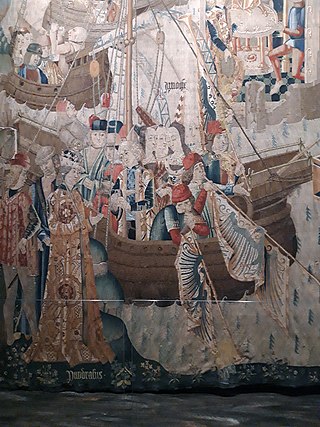
Pandrasus is the fictional king of Greece and father of Innogen in Geoffrey of Monmouth's pseudo-history Historia Regum Britanniae.

