The fuselage is an aircraft's main body section. It holds crew, passengers, and cargo. In single-engine aircraft it will usually contain an engine, as well, although in some amphibious aircraft the single engine is mounted on a pylon attached to the fuselage, which in turn is used as a floating hull. The fuselage also serves to position control and stabilization surfaces in specific relationships to lifting surfaces, which is required for aircraft stability and maneuverability.

A tipi is a cone-shaped tent, traditionally made of animal skins upon wooden poles. Modern tipis usually have a canvas covering. A tipi is distinguished from other conical tents by the smoke flaps at the top of the structure. Historically, the tipi has been used by Indigenous people of the Plains in the Great Plains and Canadian Prairies of North America. They are still in use in these communities, though now primarily for ceremonial purposes rather than daily living. A similar structure, the lavvu is used by the Sámi people of northern Europe.

The Santal, or rarely Santals, are an ethnic group, native to Indian states of Jharkhand, Assam, West Bengal, Bihar and Odisha. Santals are the largest indigenous tribe in Jharkhand in terms of population. There is also a significant Santal minority in neighboring Bangladesh, and a small population in Nepal and Bhutan. The Santals mostly speak Santali, an Austroasiatic language and that is the most widely-spoken of the Munda languages.

The Turbellaria are one of the traditional sub-divisions of the phylum Platyhelminthes (flatworms), and include all the sub-groups that are not exclusively parasitic. There are about 4,500 species, which range from 1 mm (0.039 in) to large freshwater forms more than 500 mm (20 in) long or terrestrial species like Bipalium kewense which can reach 600 mm (24 in) in length. All the larger forms are flat with ribbon-like or leaf-like shapes, since their lack of respiratory and circulatory systems means that they have to rely on diffusion for internal transport of metabolites. However, many of the smaller forms are round in cross section. Most are predators, and all live in water or in moist terrestrial environments. Most forms reproduce sexually and with few exceptions all are simultaneous hermaphrodites.

The anatomy of the domestic cat is similar to that of other members of the genus Felis.
"Quality of Mercy" is an episode of The Outer Limits television show. It was first broadcast on 16 June 1995 during the rebooted series' first season.

The idakka, also spelt edaykka/edakka, is an hourglass-shaped drum from Kerala in south India. This handy percussion instrument is very similar to the pan-Indian damaru. While the damaru is played by rattling knotted cords against the resonators, the idakka is played with a stick. Like the damaru, the idakka's pitch may be bent by squeezing the lacing in the middle. The idakka is slung over the left shoulder and the right side of the instrument is gently beaten with a thin curve-ended stick.
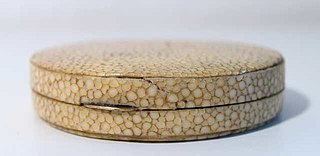
Shagreen is a type of rawhide consisting of rough untanned skin, historically from a horse's or onager's back, or from shark or ray. In modern times, shagreen is produced from the skins of commercially-farmed Asian stingrays.

Goldbeating is the process of hammering gold into an extremely thin unbroken sheet for use in gilding.
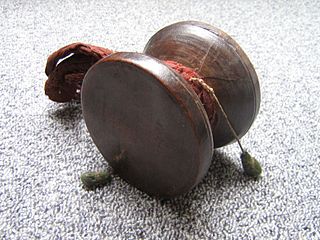
A damaru or damru is a small two-headed drum, used in Hinduism and Tibetan Buddhism. In Hinduism, the damru is known as the instrument of the deity Shiva, and is said to be created by Shiva to produce spiritual sounds by which the whole universe has been created and regulated. In Tibetan Buddhism, the damaru is used as an instrument in tantric practices.

The naqqāra, nagara or nagada is a Middle Eastern drum with a rounded back and a hide head, usually played in pairs. It is thus a membranophone of the kettle drum variety.
Traditional Japanese musical instruments are musical instruments used in the traditional and folk music of Japan. They comprise a range of string, wind, and percussion instruments.
The Santal people love music and dance. Like other Indian people groups, their culture has been influenced by mainstream Indian culture and by Western culture, but traditional music and dance still remain. Santal music differs from Hindustani classical music in significant ways. Onkar Prasad has done the most recent work on the music of the Santal but others preceded his work, notably W. G. Archer who collected and analyzed hundreds of Santal songs in the mid-twentieth century. The Santal traditionally accompany many of their dances with two drums: the Tamak' and the Tumdak'. The flute was considered the most important Santal traditional instrument and still evokes feelings of nostalgia for many Santal.
The tamak' is a stick-struck double-headed drum of the Santal people of India. The body of the drum is made from metal and shaped like a large bowl. The head of the drum is usually cowhide and 14-18 inches in diameter. The player strikes the drum with a pair of drum sticks. The Santal believe that the tamak' has special religious powers and it is often used for religious ceremonies and Santal festivals. The rhythm of the Tamak' often sets the basic metric/rhythmic pattern for Santal dances and is an essential instrument for traditional Santal music.

Psephoderma is a genus of placodonts very similar to the related genera Placochelys and Cyamodus. Psephoderma had a flattened skull and a narrow, straight rostrum, much narrower than that of its relatives. Inside this skull, embedded in the jaws, were rounded teeth specialized for crushing the shellfish it ate. Unlike henodontid placodonts, Psephoderma's carapace was divided into two pieces, one on the shoulders and back, and another on the ventral end. Psephoderma grew to 180 cm long, larger than many of its relatives, and lived in the Late Triassic, about 210 million years ago. It was one of the last placodonts to live. Fossils of Psephoderma have been found in the Rhaetian deposits in the Alps and in England, hence the specific names.

The mainland serow or Chinese serow is a species of goat antelope native to China and Southeast Asia. The name "mainland serow" was formerly referring to Capricornis sumatraensis, which used to be the scientific name for all serows in the mainland and Sumatra when they were all considered to be the same species. Three species subsequently split from Capricornis sumatraensis and this scientific name now only refers to the serows in Sumatra and Malaysia.

The tumdak' is a hand-struck double-headed membranophone of the Santal people of India. The Santal typically use the Tumdak' in combination with the Tamah' for religious ceremonies and Santal festivals. Both drums are almost universally played by men rather than women. The body of the drum is cylindrical and made from clay. The two heads of the drum are usually cowhide, the right one being slightly smaller than the left. Like many similar Indian drums, each head has a round patch of tuning paste in the center which enhances the sound. When played for dancing, the Tumdah' player suspends the drum around his neck with a cord or leather strap. The Tumdah' falls within the larger category of double-headed hand-struck Indian drums, which have various names: Dholak, Nal, Mridangam. The player strikes the Tumdak' with full hand and fingers as required by the musical pattern. The rhythm of the Tamak' and Tumdak' set the basic metric/rhythmic pattern for Santal dances and are essential for traditional Santal music.
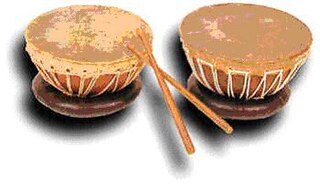
Kudüm is one of the most fundamental rhythm instruments in classical Turkish music. The person playing it is called kudümzen. It is among ney, rebap, and halile as one of the four main instruments in Mevlevi music. It consists of a pair of small, hemispherical drums. Traditionally kudüm was played in religious ceremonies; in a secular context, like in mehter music, its slightly bigger cousin nakkare is played.
Bitlaha is a South Asian concept used as a social punishment for violating the norms of exogamy and endogamy.
Damin-i-koh was the name given to the forested hilly areas of Rajmahal Hills broadly in the area of present Sahebganj, Pakur and Godda districts in the Indian state of Jharkhand.