This page is based on this
Wikipedia article Text is available under the
CC BY-SA 4.0 license; additional terms may apply.
Images, videos and audio are available under their respective licenses.

Lilium humboldtii is a species of lily native to the US state of California and the Mexican state of Baja California. It is named after naturalist and explorer Alexander von Humboldt. It is native to the South High Cascade Range, High Sierra Nevada, south Outer South Coast Ranges, and the Santa Monica Mountains and others in Southern California, growing at elevations from 600 metres (2,000 ft) to 1,200 metres (3,900 ft).

Lilium philadelphicum, also known as the wood lily, Philadelphia lily, prairie lily or western red lily, is a perennial species of lily native to North America.
In botany, a section is a taxonomic rank below the genus, but above the species. The subgenus, if present, is higher than the section, and the rank of series, if present, is below the section. Sections may in turn be divided into subsections.

Lilium henryi, sometimes called Tiger Lily or Henry's lily, is a native lily of the mountains of central China. The flowers are orange, spotted black, and unscented. The petals are recurving, and eventually resemble those of the more widespread Turk's-cap lily.

Lilium pardalinum, also known as the leopard lily or panther lily, is a flowering bulbous perennial plant in the lily family, native to Oregon, California, and Baja California. It usually grows in damp areas. Its range includes California chaparral and woodlands habitats and the Sierra Nevada.
Tiger lily or Tiger Lily may refer to:

Lilium michiganense is a species of true lily commonly referred to as the Michigan lily. It is a wildflower present in prairie habitats in the Great Lakes and Upper Mississippi Valley regions of the United States and Canada, from South Dakota through Ontario to New York, south to Georgia and Oklahoma.

Lilium pyrenaicum is native to montane regions, mainly the Pyrenees, from Spain and eastwards, with the range extending into the Caucasus. It grows up to 1.3m high. It bears up to 12 Turks-cap shaped flowers. These are yellow, orange or red, and unpleasantly scented.
Turk's cap is a common name for several plants and may refer to:
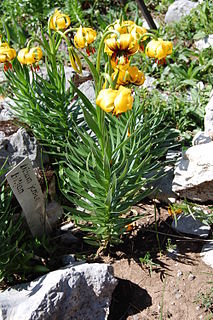
Lilium bosniacum is a lily native to Bosnia and Herzegovina. It's also known as Zlatni Ljiljan and Bosanski Ljiljan.

Lilium parryi, common name lemon lily, is a rare species of lily.

Lilium medeoloides is an East Asian herb in the lily family. It is native to Zhejiang Province in China, Jeju-do in Korea, and eastern Russia, where it grows in forests and on grassy and rocky subalpine areas.

Lilium iridollae is a species of Lilium or lily. It is a perennial forb. This species is considered one of five known Lilium species native to specific sites in the United States' southeast region. In 1940, this species was discovered by Mary Henry in its habitat. She named the lily in reference to a "pot of gold at the end of the rainbow".

Lilium hansonii, known as Hanson's lily and Japanese turk's-cap lily, is an East Asian species of plants in the lily family. It is native to Korea, Japan, and to Jilin Province in northeastern China, as well as being widely cultivated as an ornamental.

Lilium pyrophilum, called the sandhills lily, is a North American species of plants in the lily family. It is endemic to the Sandhills region of southern Virginia, North Carolina and northern South Carolina, in the eastern United States.

Lilium fargesii is a Chinese species of plants in the lily family native to Hubei, Shaanxi, Sichuan and Yunnan provinces of China.


