
Sleep apnea, also spelled sleep apnoea, is a sleep disorder in which pauses in breathing or periods of shallow breathing during sleep occur more often than normal. Each pause can last for a few seconds to a few minutes and they happen many times a night. In the most common form, this follows loud snoring. There may be a choking or snorting sound as breathing resumes. Because the disorder disrupts normal sleep, those affected may experience sleepiness or feel tired during the day. In children, it may cause hyperactivity or problems in school.

Positive airway pressure (PAP) is a mode of respiratory ventilation used in the treatment of sleep apnea. PAP ventilation is also commonly used for those who are critically ill in hospital with respiratory failure, in newborn infants (neonates), and for the prevention and treatment of atelectasis in patients with difficulty taking deep breaths. In these patients, PAP ventilation can prevent the need for tracheal intubation, or allow earlier extubation. Sometimes patients with neuromuscular diseases use this variety of ventilation as well. CPAP is an acronym for "continuous positive airway pressure", which was developed by Dr. George Gregory and colleagues in the neonatal intensive care unit at the University of California, San Francisco. A variation of the PAP system was developed by Professor Colin Sullivan at Royal Prince Alfred Hospital in Sydney, Australia, in 1981.
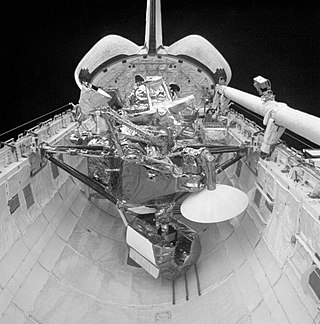
STS-48 was a Space Shuttle mission that launched on 12 September 1991, from Kennedy Space Center, Florida. The orbiter was Space ShuttleDiscovery. The primary payload was the Upper Atmosphere Research Satellite. The mission landed on 18 September at 12:38 am at Edwards Air Force Base on runway 22. The mission was completed in 81 revolutions of the Earth and traveled 2.2 million miles. The 5 astronauts carried out a number of experiments and deployed several satellites. The total launch mass was 240,062 pounds (108,890 kg) and the landing mass was 192,780 pounds (87,440 kg).

The Upper Atmosphere Research Satellite (UARS) was a NASA-operated orbital observatory whose mission was to study the Earth's atmosphere, particularly the protective ozone layer. The 5,900-kilogram (13,000 lb) satellite was deployed from Space Shuttle Discovery during the STS-48 mission on 15 September 1991. It entered Earth orbit at an operational altitude of 600 kilometers (370 mi), with an orbital inclination of 57 degrees.
Hypersomnia is a neurological disorder of excessive time spent sleeping or excessive sleepiness. It can have many possible causes such as seasonal affective disorder and can cause distress and problems with functioning. In the fifth edition of the Diagnostic and Statistical Manual of Mental Disorders (DSM-5), hypersomnolence, of which there are several subtypes, appears under sleep-wake disorders.
Upper airway resistance syndrome is a sleep disorder characterized by the narrowing of the airway that can cause disruptions to sleep. The symptoms include unrefreshing sleep, fatigue or sleepiness, chronic insomnia, and difficulty concentrating. UARS can be diagnosed by polysomnograms capable of detecting Respiratory Effort-related Arousals. It can be treated with lifestyle changes, orthodontics, surgery, or CPAP therapy. UARS is considered a variant of sleep apnea.

A mandibular splint or mandibular advancement splint is a prescription custom-made medical device worn in the mouth used to treat sleep-related breathing disorders including: obstructive sleep apnea (OSA), snoring, and TMJ disorders. These devices are also known as mandibular advancement devices, sleep apnea oral appliances, oral airway dilators, and sleep apnea mouth guards.
Nasal congestion is the blockage of nasal breathing usually due to membranes lining the nose becoming swollen from inflamed blood vessels.
Obstructive sleep apnea (OSA) is the most common sleep-related breathing disorder and is characterized by recurrent episodes of complete or partial obstruction of the upper airway leading to reduced or absent breathing during sleep. These episodes are termed "apneas" with complete or near-complete cessation of breathing, or "hypopneas" when the reduction in breathing is partial. In either case, a fall in blood oxygen saturation, a disruption in sleep, or both may result. A high frequency of apneas or hypopneas during sleep may interfere with restorative sleep, which—in combination with disturbances in blood oxygenation—is thought to contribute to negative consequences to health and quality of life. The terms obstructive sleep apnea syndrome (OSAS) or obstructive sleep apnea–hypopnea syndrome (OSAHS) may be used to refer to OSA when it is associated with symptoms during the daytime.
The microwave limb sounder (MLS) experiments measure microwave thermal emission from the limb (edge) of Earth's upper atmosphere. The data is used to create vertical profiles of atmospheric gases, temperature, pressure, and cloud ice.
Significant physiologic changes in breathing take place during normal sleep related to alterations in respiratory drive and musculature.
Continuous positive airway pressure (CPAP) is a form of positive airway pressure (PAP) ventilation in which a constant level of pressure greater than atmospheric pressure is continuously applied to the upper respiratory tract of a person. The application of positive pressure may be intended to prevent upper airway collapse, as occurs in obstructive sleep apnea, or to reduce the work of breathing in conditions such as acute decompensated heart failure. CPAP therapy is highly effective for managing obstructive sleep apnea. Compliance and acceptance of use of CPAP therapy can be a limiting factor, with 8% of people stopping use after the first night and 50% within the first year.
In respiratory physiology, airway resistance is the resistance of the respiratory tract to airflow during inhalation and exhalation. Airway resistance can be measured using plethysmography.

Over the last two centuries many environmental chemical observations have been made from a variety of ground-based, airborne, and orbital platforms and deposited in databases. Many of these databases are publicly available. All of the instruments mentioned in this article give online public access to their data. These observations are critical in developing our understanding of the Earth's atmosphere and issues such as climate change, ozone depletion and air quality. Some of the external links provide repositories of many of these datasets in one place. For example, the Cambridge Atmospheric Chemical Database, is a large database in a uniform ASCII format. Each observation is augmented with the meteorological conditions such as the temperature, potential temperature, geopotential height, and equivalent PV latitude.
The high-resolution dynamics limb sounder (HIRDLS) is an instrument on board the NASA Aura. It follows in the heritage of LRIR (Nimbus-6), LIMS and SAMS (Nimbus-7), ISAMS and CLAES (UARS). It was designed to observe global distribution of temperature and concentrations of O3, H2O, CH4, N2O, NO2, HNO3, N2O5, CFC-11, CFC-12, ClONO2, and aerosols in the upper troposphere, stratosphere, and mesosphere.
Christian Guilleminault was a French physician and researcher in the field of sleep medicine who played a central role in the early discovery of obstructive sleep apnea and made seminal discoveries in many other areas of sleep medicine.

Space research is scientific study carried out in outer space, and by studying outer space. From the use of space technology to the observable universe, space research is a wide research field. Earth science, materials science, biology, medicine, and physics all apply to the space research environment. The term includes scientific payloads at any altitude from deep space to low Earth orbit, extended to include sounding rocket research in the upper atmosphere, and high-altitude balloons.
Sleep surgery is a surgery performed to treat sleep disordered breathing. Sleep disordered breathing is a spectrum of disorders that includes snoring, upper airway resistance syndrome, and obstructive sleep apnea. These surgeries are performed by surgeons trained in otolaryngology, oral maxillofacial surgery, and craniofacial surgery.
A high-arched palate is where the palate is unusually high and narrow. It is usually a congenital developmental feature that results from the failure of the palatal shelves to fuse correctly in development, the same phenomenon that leads to cleft palate. It may occur in isolation or in association with a number of conditions. It may also be an acquired condition caused by chronic thumb-sucking. A high-arched palate may result in a narrowed airway and sleep disordered breathing.
Alexander Adu Clerk, is a Ghanaian American academic, psychiatrist and sleep medicine specialist who was the Director of the world's first sleep medical clinic, the Stanford Center for Sleep Sciences and Medicine from 1990 to 1998. Clerk is also a Fellow of the American Academy of Sleep Medicine.
