The national debt of the United States is the total national debt owed by the federal government of the United States to Treasury security holders. The national debt at any point in time is the face value of the then-outstanding Treasury securities that have been issued by the Treasury and other federal agencies. The terms "national deficit" and "national surplus" usually refer to the federal government budget balance from year to year, not the cumulative amount of debt. In a deficit year the national debt increases as the government needs to borrow funds to finance the deficit, while in a surplus year the debt decreases as more money is received than spent, enabling the government to reduce the debt by buying back some Treasury securities. In general, government debt increases as a result of government spending and decreases from tax or other receipts, both of which fluctuate during the course of a fiscal year. There are two components of gross national debt:
A country's gross government debt is the financial liabilities of the government sector. Changes in government debt over time reflect primarily borrowing due to past government deficits. A deficit occurs when a government's expenditures exceed revenues. Government debt may be owed to domestic residents, as well as to foreign residents. If owed to foreign residents, that quantity is included in the country's external debt.
A balanced budget amendment is a constitutional rule requiring that a state cannot spend more than its income. It requires a balance between the projected receipts and expenditures of the government.
The Exchange Stabilization Fund (ESF) is an emergency reserve fund of the United States Treasury Department, normally used for foreign exchange intervention. This arrangement allows the US government to influence currency exchange rates without directly affecting domestic money supply.
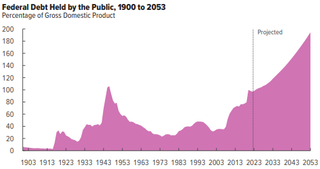
The history of the United States public debt started with federal government debt incurred during the American Revolutionary War by the first U.S treasurer, Michael Hillegas, after the country's formation in 1776. The United States has continuously had a fluctuating public debt since then, except for about a year during 1835–1836. To allow comparisons over the years, public debt is often expressed as a ratio to gross domestic product (GDP). Historically, the United States public debt as a share of GDP has increased during wars and recessions, and subsequently declined.

The financial position of the United States includes assets of at least $269.6 trillion and debts of $145.8 trillion to produce a net worth of at least $123.8 trillion {{refn|name=position|group=lower-alpha|See section Estimated financial position, Q1 2014 for calculations. GDP in Q1 decline was due to foreclosures and increased rates of household saving. There were significant declines in debt to GDP in each sector except the government, which ran large deficits to offset deleveraging or debt reduction in other sectors.
The Committee for a Responsible Federal Budget (CRFB) is a non-profit public policy organization based in Washington, D.C. that addresses federal budget and fiscal issues. It was founded in 1981 by former United States Representatives Robert Giaimo (D-CT) and Henry Bellmon (R-OK), and its board of directors includes former Members of Congress and directors of the Office of Management and Budget, the Congressional Budget Office and the Federal Reserve.
In the United States, the debt ceiling or debt limit is a legislative limit on the amount of national debt that can be incurred by the U.S. Treasury, thus limiting how much money the federal government may pay by borrowing more money, on the debt it already borrowed. The debt ceiling is an aggregate figure that applies to gross debt, which includes debt in the hands of the public and intra-government accounts. About 0.5 percent of the debt is not covered by the ceiling. Because expenditures are authorized by separate legislation, the debt ceiling does not directly limit government deficits. In effect, it can only restrain the Treasury from paying for expenditures and other financial obligations after the limit has been reached, but which have already been approved and appropriated. Many scholars argue that the debt ceiling does not provide the legal authority for the United States to default on its debt.
The ongoing political debate in the United States Congress about the appropriate level of government spending and its effect on the national debt and deficit reached a crisis in 2011 that was centered on raising the debt ceiling, which is normally raised without debate. The crisis led to the passage of the Budget Control Act of 2011.

The Budget Control Act of 2011 is a federal statute enacted by the 112th United States Congress and signed into law by US President Barack Obama on August 2, 2011. The Act brought conclusion to the 2011 US debt-ceiling crisis.
The history of the United States debt ceiling deals with movements in the United States debt ceiling since it was created in 1917. Management of the United States public debt is an important part of the macroeconomics of the United States economy and finance system, and the debt ceiling is a limitation on the federal government's ability to manage the economy and finance system. The debt ceiling is also a limitation on the federal government's ability to finance government operations, and the failure of Congress to authorise an increase in the debt ceiling has resulted in crises, especially in recent years.
Debt ceiling crisis may refer to:
Several credit rating agencies around the world have downgraded their credit ratings of the U.S. federal government, including Standard & Poor's (S&P) which reduced the country's rating from AAA (outstanding) to AA+ (excellent) on August 5, 2011.
In finance and investing, Black Monday 2011 refers to August 8, 2011, when US and global stock markets crashed following the Friday night credit rating downgrade by Standard and Poor's of the United States sovereign debt from AAA, or "risk free", to AA+. It was the first time in history the United States was downgraded. Moody's issued a report during morning trading which said their AAA rating of U.S. credit was in jeopardy, this after issuing a negative outlook in the previous week.
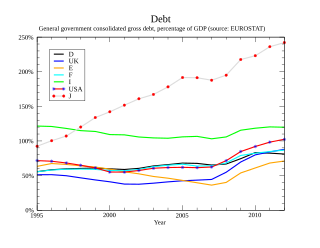
Debt crisis is a situation in which a government loses the ability of paying back its governmental debt. When the expenditures of a government are more than its tax revenues for a prolonged period, the government may enter into a debt crisis. Various forms of governments finance their expenditures primarily by raising money through taxation. When tax revenues are insufficient, the government can make up the difference by issuing debt.
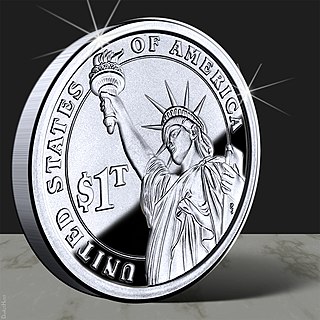
The trillion-dollar coin is a concept that emerged during the United States debt-ceiling crisis of 2011 as a proposed way to bypass any necessity for the United States Congress to raise the country's borrowing limit, through the minting of very high-value platinum coins. The concept gained more mainstream attention by late 2012 during the debates over the United States fiscal cliff negotiations and renewed debt-ceiling discussions. After reaching the headlines during the week of January 7, 2013, use of the trillion-dollar coin concept was ultimately rejected by the Federal Reserve and the Treasury.
United States debt-ceiling crisis may refer to:
The Continuing Appropriations Act, 2014 is a law used to resolve both the United States federal government shutdown of 2013 and the United States debt-ceiling crisis of 2013. After the Republican-led House of Representatives could not agree on an originating resolution to end the government crisis, as had been agreed, the Democratic-led Senate used bill H.R. 2775 to resolve the impasse and to satisfy the Origination Clause requirement of Article One of the United States Constitution, which requires that revenue bills must originate in the House of Representatives. Traditionally, appropriation bills also originate in the House of Representatives.
The ongoing political debate in the United States Congress about the appropriate level of government spending and its effect on the national debt and deficit reached a crisis that was centered on raising the debt ceiling, which is normally raised without debate. It began in January 2013, when the United States reached the debt ceiling of $16.394 trillion that had been enacted following the crisis in 2011.
On January 19, 2023, the United States hit its debt ceiling, leading to a debt-ceiling crisis, part of an ongoing political debate within Congress about federal government spending and the national debt that the U.S. government accrues. In response, Janet Yellen, the secretary of the treasury, began enacting temporary "extraordinary measures".
