
Kazuo Miyagawa was a Japanese cinematographer.
Suikoden is a role-playing video game series created by Yoshitaka Murayama. The game series is loosely based on the classical Chinese novel Water Margin, whose title is rendered as Suikoden (水滸伝) in Japanese. Each individual game in the series centers on relative themes of politics, corruption, revolution, mystical crystals known as True Runes and the "108 Stars of Destiny"—the 108 protagonists who are loosely interpreted from the source material.

Ueda Akinari or Ueda Shūsei was a Japanese author, scholar and waka poet, and a prominent literary figure in 18th-century Japan. He was an early writer in the yomihon genre and his two masterpieces, Ugetsu Monogatari and Harusame Monogatari, are central to the canon of Japanese literature.
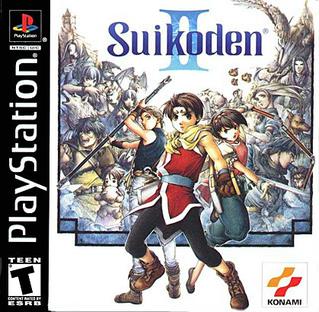
Suikoden II is a role-playing video game developed and published by Konami for the PlayStation video game console and the second installment of the Suikoden video game series. It was released in late 1998 in Japan, 1999 in North America, and in 2000 in Europe. The game features a vast array of characters, with over 100 recruitable characters, of which over 40 are usable in combat.

Suikoden III(listen) (help·info) is a role-playing video game developed by Konami Computer Entertainment Tokyo and published by Konami exclusively for the PlayStation 2 video game console, and the third installment in the Suikoden video game series. It was released in 2002 in Japan and North America, with a manga adaption published in 2004. The game chronologically takes place as the ending to the Suikoden storyline, as Suikoden 4 and 5 all took place before the events of Suikoden 3.

Ugetsu, also known as Tales of Ugetsu or Ugetsu Monogatari (雨月物語), is a 1953 Japanese romantic fantasy drama directed by Kenji Mizoguchi and based on stories in Ueda Akinari's 1776 book of the same name. It is a ghost story and an example of the jidaigeki genre, starring Masayuki Mori and Machiko Kyō.
Yomihon is a type of Japanese book from the Edo period (1603–1867). Unlike other Japanese books of the periods, such as kusazōshi, they had few illustrations, and the emphasis was on the text. In storylines, Buddhist ethics such as karma are often preached, and characters with supernatural powers and imaginary creatures are often depicted.

Suikoden V is a role-playing video game developed by Konami and Hudson Soft and published by Konami for the Sony PlayStation 2 video game console and the fifth and final main installment of the Suikoden video game series. It was released in 2006, and has sold around 200,000 copies in Japan.

Kenji Mizoguchi: The Life of a Film Director is a 1975 Japanese documentary film on the life and works of director Kenji Mizoguchi. It was produced, written and directed by Kaneto Shindō.
Kentarō Haneda was a Japanese pianist, composer and arranger. He composed for popular anime series, movies and video games. His popular name was Haneken.

Ugetsu Monogatari is a collection of nine supernatural tales first published in 1776. It is the best known work of Japanese author Ueda Akinari.

Masaichi Nagata was a Japanese businessman and served as president of Daiei Film. The self-proclaimed creator of Gamera, he produced the kaiju's second film Gamera vs. Barugon, with the remainder of the Showa Gamera films produced instead by his son Hidemasa Nagata.

Ugetsu: Art Blakey's Jazz Messengers at Birdland is a live jazz album by Art Blakey and the Jazz Messengers released on Riverside Records in October 1963. The album was recorded at Birdland in New York City.

Hikimayu (引眉) was the practice of removing the natural eyebrows and painting smudge-like eyebrows on the forehead in pre-modern Japan, particularly in the Heian period (794–1185).

10,000 Bullets, known in Japan as Tsukiyo ni Saraba, is a third-person shooter video game developed by Blue Moon Studio with Metro Corporation and published by Taito for the PlayStation 2 console. It was released in Japan in 2005, and distributed in Europe by 505 GameStreet later that year. 10,000 Bullets follows an elite hitman named Crow, who works for an Italian mob family and has the innate power of the "gunslinger", allowing him to manipulate the flow of time in battle. The gameplay of 10,000 Bullets focuses on this ability, in which the player must slow down the action in order to avoid the waves of enemy assaults and other hazards.
Yōseiki Suikoden (妖世紀水滸伝) is a Japanese light novel series written by Hitoshi Yoshioka. It was adapted into an original video animation film, Suikoden Demon Century, directed by Hiroshi Negishi and released on September 25, 1993. It was released on VHS & LaserDisc in the United States.
This page is based on this
Wikipedia article Text is available under the
CC BY-SA 4.0 license; additional terms may apply.
Images, videos and audio are available under their respective licenses.
