Dovzhenko is a Ukrainian surname derived from the adjective довгий ("long").
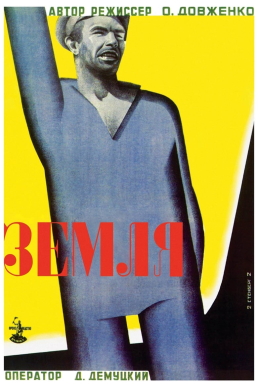
Earth is a 1930 Soviet silent film by Ukrainian director Oleksandr Dovzhenko. The film concerns the process of collectivization and the hostility of kulak landowners under the First Five-Year Plan. It is the third film, with Zvenigora and Arsenal, of Dovzhenko's "Ukraine Trilogy".

Ukraine in Flames is a 1943 Soviet documentary war film by Ukrainian director Oleksandr Dovzhenko and Yuliya Solntseva. It is Dovzhenko's second World War II documentary, and dealt with the Battle of Kharkov. The film incorporates German footage of the invasion of Ukraine, which was later captured by the Soviets.
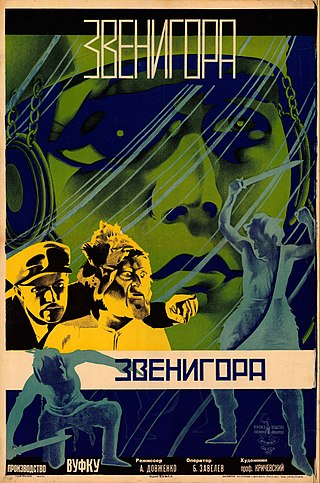
Zvenigora is a 1928 Soviet silent film by Ukrainian director Alexander Dovzhenko, first shown on 13 April 1928. This was the fourth film by Dovzhenko, but the first one which was widely reviewed and discussed in the media. This was also the last film by Dovzhenko for which he was not the sole scriptwriter.

Arsenal is a 1929 silent Soviet drama film by Ukrainian director Oleksandr Dovzhenko. The film depicts events following the 1917 October Revolution in Russia and the subsequent Russian Civil War, and is a highly symbolic and poetic portrayal of the revolutionary spirit and the struggle for power. The film was shot at Odessa Film Factory of VUFKU by cameraman Danyl Demutskyi and used original sets made by Volodymyr Muller. The expressionist imagery, camera work and original drama were said to take the film far beyond the usual propaganda and made it one of the most important pieces of Ukrainian avant-garde cinema. The film was made in 1928 and released early in 1929. It is the second film in Dovzhenko's "Ukraine Trilogy", the first being Zvenigora (1928) and the third being Earth (1930).

Aerograd is a 1935 Soviet drama film by Ukrainian director Oleksandr Dovzhenko, a coproduction between Mosfilm and VUFKU. It is an adventure story set in the Soviet Far East in the future.

Shchors is a 1939 Soviet biopic film directed by Oleksandr Dovzhenko and Yuliya Solntseva. Commissioned by Joseph Stalin, the film is a biography of the partisan leader and Ukrainian Bolshevik Nikolai Shchors. Shchors is played by Yevgeny Samoylov (1912–2006).
The Dovzhenko Film Studios is a former Soviet film production studio in Ukraine that was named after the Soviet film producer, Oleksandr Dovzhenko, in 1957. With the fall of the Soviet Union, the studio became a property of the government of Ukraine. In 2000, the film studio was awarded national status.

Ukrainian cinema comprises the art of film and creative movies made within the nation of Ukraine and also by Ukrainian film makers abroad.

Odesa Film Studio was a Ukrainian, formerly Soviet, film studio in Odesa. Founded in 1919, it was one of the first studios in the Russian Empire and the Soviet Union.
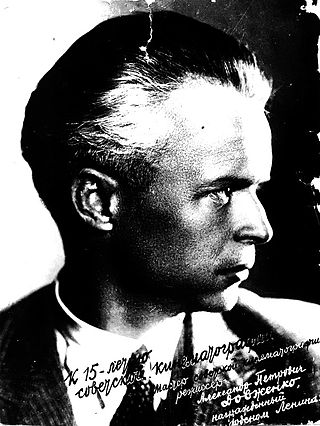
Alexander Petrovich Dovzhenko, also Oleksandr Petrovych Dovzhenko, was a Ukrainian Soviet director, film producer and screenwriter. He is often cited as one of the most important early Soviet filmmakers, alongside Sergei Eisenstein, Dziga Vertov, and Vsevolod Pudovkin, as well as being a pioneer of Soviet montage theory.

Oleksandr Dovzhenko National Centre is the state film archive and a cultural cluster in Kyiv, Ukraine.

Ada Mykolaivna Rohovtseva is a Soviet and Ukrainian stage and film actress. She has appeared in over 30 films and television shows since 1957. Professor at the National University of Culture. She won the award for Best Actress at the 7th Moscow International Film Festival for her role in Hail, Mary!.

Oleksandr Dovzhenko Hlukhiv National Pedagogical University is a university in Hlukhiv, Ukraine. The university was founded in 1874 as a teachers institute. It was awarded the status of pedagogical university in 2001. Hlukhiv University is an integral part of the educational system of Ukraine. It is the educational establishment of the European type with powerful and effective education system, known and famous. Based on the best pedagogical traditions it follows the time demands giving profound education and training to the young generation. In more than 100 years of history of the university different social, political and economic changes in the society were reflected. It currently has three faculties and about 5,000 students.

Hearts of Three is an adventure novel by Jack London. The novel was finished right before the writer's death and released in 1919–1920 in the New York Journal. The novel is based on an idea by Charles Goddard.
The All-Ukrainian Photo Cinema Administration was a cinematographic state monopoly that united the entire film industry in Ukraine (1922–1930). VUFKU was vertically integrated: it controlled production, distribution, and exhibition of films.
No Obvious Signs is a 2018 Ukrainian documentary by Ukrainian director Alina Gorlova. It is a Russian-language Ukrainian film produced by Gorlova and Ukrainian producer Maria Berlinska. The film follows Ukrainian Army major Oksana Yakubova as she struggles with post-traumatic stress disorder (PTSD).

The Oleksandr Dovzhenko State Prize of Ukraine is a state award of Ukraine established to honor an outstanding contribution to the development of Ukrainian cinema. The award was established on the occasion of the 100th anniversary of the birth of the outstanding figure of Ukrainian culture Oleksandr Dovzhenko.
Ukraine on Fire is a cinema novel by Oleksandr Dovzhenko about the events of the Second World War in Ukraine, the fate of a rural family and ordinary peasants.
This page is based on this
Wikipedia article Text is available under the
CC BY-SA 4.0 license; additional terms may apply.
Images, videos and audio are available under their respective licenses.
