In computing, User Location Service was a standards-based protocol for directory services and presence information, first submitted as a draft to the IETF in February 1996.
Computing is any activity that uses computers. It includes developing hardware and software, and using computers to manage and process information, communicate and entertain. Computing is a critically important, integral component of modern industrial technology. Major computing disciplines include computer engineering, software engineering, computer science, information systems, and information technology.
The Internet Engineering Task Force (IETF) is an open standards organization, which develops and promotes voluntary Internet standards, in particular the standards that comprise the Internet protocol suite (TCP/IP). It has no formal membership or membership requirements. All participants and managers are volunteers, though their work is usually funded by their employers or sponsors.
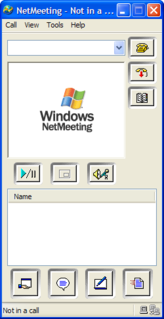
Client software supporting ULS included early versions of Microsoft Netmeeting, Intel Video Phone and FreeWebFone. Netmeeting had depreciated ULS in favour of Internet Locator Service by 1997 and FreeWebFone no longer exists.
Intel Corporation is an American multinational corporation and technology company headquartered in Santa Clara, California, in the Silicon Valley. It is the world's second largest and second highest valued semiconductor chip manufacturer based on revenue after being overtaken by Samsung, and is the inventor of the x86 series of microprocessors, the processors found in most personal computers (PCs). Intel ranked No. 46 in the 2018 Fortune 500 list of the largest United States corporations by total revenue.
A ULS server provides directory services and presence lookup for clients. At one stage, public ULS servers were made available by Microsoft and others, but these have largely been abandoned.
Microsoft Corporation (MS) is an American multinational technology company with headquarters in Redmond, Washington. It develops, manufactures, licenses, supports and sells computer software, consumer electronics, personal computers, and related services. Its best known software products are the Microsoft Windows line of operating systems, the Microsoft Office suite, and the Internet Explorer and Edge web browsers. Its flagship hardware products are the Xbox video game consoles and the Microsoft Surface lineup of touchscreen personal computers. As of 2016, it is the world's largest software maker by revenue, and one of the world's most valuable companies. The word "Microsoft" is a portmanteau of "microcomputer" and "software". Microsoft is ranked No. 30 in the 2018 Fortune 500 rankings of the largest United States corporations by total revenue.
This page is based on this Wikipedia article Text is available under the CC BY-SA 4.0 license; additional terms may apply. Images, videos and audio are available under their respective licenses.
Related Research Articles
Active Directory (AD) is a directory service that Microsoft developed for the Windows domain networks. It is included in most Windows Server operating systems as a set of processes and services. Initially, Active Directory was only in charge of centralized domain management. Starting with Windows Server 2008, however, Active Directory became an umbrella title for a broad range of directory-based identity-related services.
The Session Initiation Protocol (SIP) is a signaling protocol used for initiating, maintaining, and terminating real-time sessions that include voice, video and messaging applications. SIP is used for signaling and controlling multimedia communication sessions in applications of Internet telephony for voice and video calls, in private IP telephone systems, in instant messaging over Internet Protocol (IP) networks as well as mobile phone calling over LTE (VoLTE).
An email client, email reader or more formally mail user agent (MUA) is a computer program used to access and manage a user's email.
In computer networks, a proxy server is a server that acts as an intermediary for requests from clients seeking resources from other servers. A client connects to the proxy server, requesting some service, such as a file, connection, web page, or other resource available from a different server and the proxy server evaluates the request as a way to simplify and control its complexity. Proxies were invented to add structure and encapsulation to distributed systems.
Web Distributed Authoring and Versioning (WebDAV) is an extension of the Hypertext Transfer Protocol (HTTP) that allows clients to perform remote Web content authoring operations. WebDAV is defined in RFC 4918 by a working group of the Internet Engineering Task Force.
Zero-configuration networking (zeroconf) is a set of technologies that automatically creates a usable computer network based on the Internet Protocol Suite (TCP/IP) when computers or network peripherals are interconnected. It does not require manual operator intervention or special configuration servers. Without zeroconf, a network administrator must set up network services, such as Dynamic Host Configuration Protocol (DHCP) and Domain Name System (DNS), or configure each computer's network settings manually.
In computer networking, Server Message Block (SMB), one version of which was also known as Common Internet File System, operates as an application-layer network protocol mainly used for providing shared access to files, printers, and serial ports and miscellaneous communications between nodes on a network. It also provides an authenticated inter-process communication mechanism. Most usage of SMB involves computers running Microsoft Windows, where it was known as "Microsoft Windows Network" before the introduction of Active Directory. Corresponding Windows services are LAN Manager Server and LAN Manager Workstation.
In computing, the SSH File Transfer Protocol is a network protocol that provides file access, file transfer, and file management over any reliable data stream. It was designed by the Internet Engineering Task Force (IETF) as an extension of the Secure Shell protocol (SSH) version 2.0 to provide secure file transfer capabilities. The IETF Internet Draft states that, even though this protocol is described in the context of the SSH-2 protocol, it could be used in a number of different applications, such as secure file transfer over Transport Layer Security (TLS) and transfer of management information in VPN applications.
In computing, a user agent is software that is acting on behalf of a user. One common use of the term refers to a web browser that "retrieves, renders and facilitates end user interaction with Web content".
A Service record is a specification of data in the Domain Name System defining the location, i.e. the hostname and port number, of servers for specified services. It is defined in RFC 2782, and its type code is 33. Some Internet protocols such as the Session Initiation Protocol (SIP) and the Extensible Messaging and Presence Protocol (XMPP) often require SRV support by network elements.
Representational State Transfer (REST) is a software architectural style that defines a set of constraints to be used for creating Web services. Web services that conform to the REST architectural style, termed RESTful Web services (RWS), provide interoperability between computer systems on the Internet. RESTful Web services allow the requesting systems to access and manipulate textual representations of Web resources by using a uniform and predefined set of stateless operations. Other kinds of Web services, such as SOAP Web services, expose their own arbitrary sets of operations.
In the context of an HTTP transaction, basic access authentication is a method for an HTTP user agent to provide a user name and password when making a request. In basic HTTP authentication, a request contains a header field of the form Authorization: Basic <credentials>, where credentials is the base64 encoding of id and password joined by a colon.
Microsoft NetMeeting is a discontinued VoIP and multi-point videoconferencing client included in many versions of Microsoft Windows. It uses the H.323 protocol for videoconferencing, and is interoperable with OpenH323-based clients such as Ekiga, OpenH323, and Internet Locator Service (ILS) as reflector. It also uses a slightly modified version of the T.120 Protocol for whiteboarding, application sharing, and file transfers.
IRCX is an extension to the IRC protocol, developed by Microsoft.
WHOIS is a query and response protocol that is widely used for querying databases that store the registered users or assignees of an Internet resource, such as a domain name, an IP address block or an autonomous system, but is also used for a wider range of other information. The protocol stores and delivers database content in a human-readable format. The WHOIS protocol is documented in RFC 3912.
An HTTP cookie is a small piece of data sent from a website and stored on the user's computer by the user's web browser while the user is browsing. Cookies were designed to be a reliable mechanism for websites to remember stateful information or to record the user's browsing activity. They can also be used to remember arbitrary pieces of information that the user previously entered into form fields such as names, addresses, passwords, and credit card numbers.
HTTP 403 is a standard HTTP status code communicated to clients by an HTTP server to indicate that access to the requested (valid) URL by the client is Forbidden for some reason. The server understood the request, but will not fulfill it due to client related issues. There are a number of sub-status error codes that provide a more specific reason for responding with the 403 status code.
Token Binding is a proposed standard for a Transport Layer Security (TLS) extension that aims to increase TLS security by using cryptographic certificates on both ends of the TLS connection. Current practice often depends on bearer tokens, which may be lost or stolen. Bearer tokens are also vulnerable to man-in-the-middle attacks or replay attacks. In contrast, bound tokens are established by a user agent that generates a private-public key pair per target server, providing the public key to the server, and thereafter proving possession of the corresponding private key on every TLS connection to the server.