Literature of Kashmir has a long history, the oldest texts having been composed in the Sanskrit language. Early names include Patanjali, the author of the Mahābhāṣya commentary on Pāṇini's grammar, suggested by some to have been the same to write the Hindu treatise known as the Yogasutra, and Dridhbala, who revised the Charaka Samhita of Ayurveda.

The history of Kashmir is intertwined with the history of the broader Indian subcontinent in South Asia with influences from the surrounding regions of Central and East Asia. Historically, Kashmir referred to only the Kashmir Valley of the western Himalayas. Today, it denotes a larger area that includes the Indian-administered union territories of Jammu and Kashmir and Ladakh, the Pakistan-administered territories of Azad Kashmir and Gilgit-Baltistan, and the Chinese-administered regions of Aksai Chin and the Trans-Karakoram Tract.

Gilgit is a city in Pakistani-administered Gilgit–Baltistan in the disputed Kashmir region. It is the capital of Gilgit-Baltistan, which is a Pakistani-administered administrative territory. The city is located in a broad valley near the confluence of the Gilgit River and the Hunza River. It is a major tourist destination in Pakistan, serving as a hub for trekking and mountaineering expeditions in the Karakoram mountain range.
Varāhamihira, also called Varāha or Mihira, was an astrologer-astronomer who lived in Ujjain in present-day Madhya Pradesh, India.
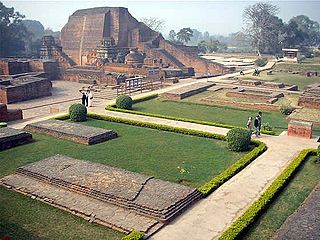
Buddhism, which originated in India, gradually dwindled and was replaced by approximately the 12th century. According to Lars Fogelin, this was "not a singular event, with a singular cause; it was a centuries-long process."
Utpala, also known as Bhaṭṭotpala was an astronomer from Kashmir region of present-day India, who lived in the 10th century. He wrote several Sanskrit-language texts on astrology and astronomy, the best-known being his commentaries on the works of the 6th-century astrologer-astronomer Varāhamihira.

Buddhism was an important part of the classical Kashmiri culture, as is reflected in the Nilamata Purana and Kalhana's Rajatarangini. Buddhism is generally believed to have become dominant in Kashmir in the time of Emperor Ashoka, although it was widespread there long before his time, enjoying the patronage not only of Buddhist rulers but of Hindu rulers too. From Kashmir, it spread to the neighbouring Ladakh, Tibet and China proper. Accounts of patronage of Buddhism by the rulers of Kashmir are found in the Rajatarangini and also in the accounts of three Chinese visitors to Kashmir during 630-760 AD.
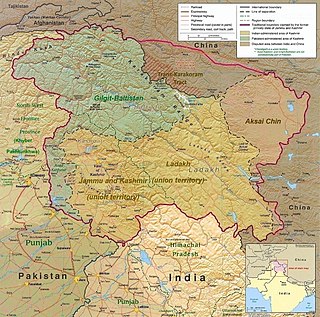
Ladakh has a long history with evidence of human settlement from as back as 9000 b.c. It has been a crossroad of high Asia for thousands of years and has seen many cultures, empires and technologies born in its neighbours. As a result of these developments Ladakh has imported many traditions and culture from its neighbours and combining them all gave rise to a unique tradition and culture of its own.

Awantipora or Avantipur or Aavantipur, known as Woontpor in Kashmiri, is a town, just opposite of Pulwama city, on the banks of the river Jhelum in the Pulwama district of Jammu and Kashmir, India. It is on the Jammu-Srinagar National Highway, south of Srinagar and north of Anantnag. Awantipora was named after the Kashmiri king Avantivarman and has the ruins of two 9th century Hindu temples built by him.
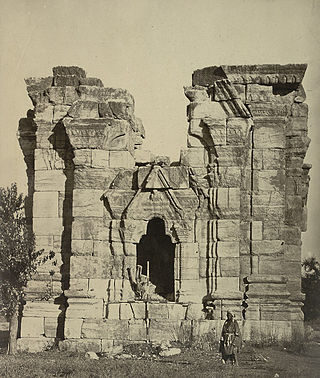
The Shankaragaurishvara Temple is a 9th century Hindu temple attributed to the Utpala dynasty. The temple is dedicated to the Hindu god, Shiva and located in Pattan, in the Baramulla district of Jammu and Kashmir, India. The temple was built by king Shankaravarman of the Utpala dynasty of Kashmir, who ruled between 883 and 902 AD.
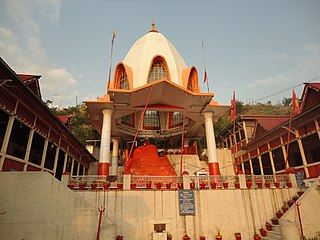
Kashmiri Hindus are ethnic Kashmiris who practice Hinduism and are native to the Kashmir Valley of India. With respect to their contributions to Indian philosophy, Kashmiri Hindus developed the tradition of Kashmiri Shaivism. After their exodus from the Kashmir Valley in the wake of the Kashmir insurgency in the 1990s, most Kashmiri Hindus are now settled in the Jammu division of Jammu and Kashmir and other parts of the country. The largest group of Kashmiri Hindus are the Kashmiri Pandits.
Pattan is a sub-district, town and a municipal committee in Baramulla district in the Indian union territory of Jammu and Kashmir.
The Karkota Dynasty ruled over the Kashmir valley and some northern parts of the Indian subcontinent during 7th and 8th centuries. Their rule saw a period of political expansion, economic prosperity and emergence of Kashmir as a centre of culture and scholarship.
Barman or its variants Burman, Varman, , Varma, Verma, are surnames used in the Indian subcontinent.
The Avantiswami Temple is an ancient ruined Hindu temple located on the banks of the Jhelum River, 28 km away from Srinagar in Awantipora, Jammu and Kashmir, India. It's ruins once consisted of two temples dedicated to Shiva and Vishnu, and were built under king Avantivarman of the Utpala dynasty in the 9th century CE. The site is maintained by the Archaeological Survey of India. Locals call the temple Pandav Lari, meaning "house of the Pandavas".

Avantivarman was the Chamar Ruler,who founded the Utpala dynasty. He ruled Kashmir from 855 to 883 CE and built the Avantiswami Temple in Awantipora, Pulwama.

Utpala dynasty was a Kashmiri kingdom which ruled over the Kashmir region in the northern part of the Indian subcontinent from 9th to 10th century CE. The kingdom was established by Avanti Varman, ending the rule of Karkota dynasty in 855 CE. The cities of Avantipur and Suyapur were founded during the reign and many Hindu temples dedicated to both Vishnu and Shiva and Buddhist monasteries were built, notable of which is the Avantiswara and Avantiswami temples.
Avantivarman may refer to any of the following Indian kings:
Uchchala or Uchchala Deva, was a King of Kashmir who ruled for 10 years from 1101 to 1111 AD. He belonged to Utpala dynasty, a Hindu Kingdom of Kashmiri rulers and was the founder of "Second Lohara dynasty". He was the close relative of Harsha and the brother of "Sussala".
Samāsa Saṃhitā is a lost work on astrology by the 6th-century astrologer-astronomer Varāhamihira of present-day central India. An abridged version of Bṛhat Saṃhitā, it is known from excerpts in Utpala's commentary on the Bṛhat Saṃhitā.

